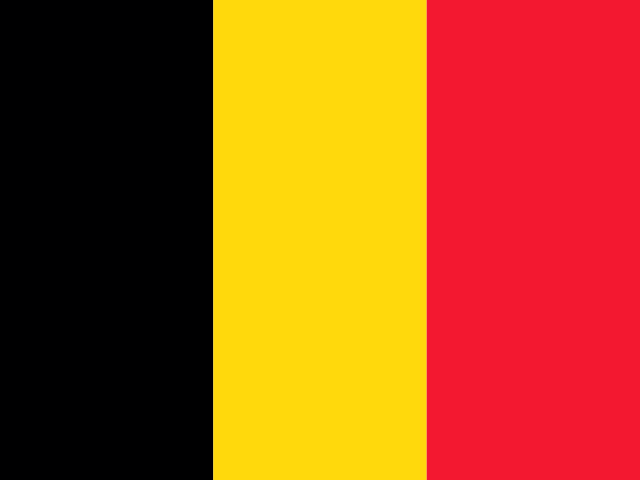
Flags in mourning and national mourning in Belgium
Published Written by Flagpole Guides
This page is an English translation of the Dutch original. Where the two versions differ, the Dutch text is the original.
In Belgium the flag plays a part in mourning at several levels: national mourning, a death in the Royal Family, the annual commemoration on 17 February and a death in an association or a family. For public buildings, the authorities issue instructions. For everyone else, these are customs, not rules.
National mourning
The federal government decides whether an event is marked by a day of national mourning. According to the public broadcaster VRT, little is set down in law, but there are established customs: the flags on official buildings fly at half-mast, a minute's silence is observed, and sometimes bells or sirens sound first. Days of national mourning have followed, among others, the Marcinelle mining disaster (1956), the fire at the Innovation department store in Brussels (1967), the death of King Baudouin (1993), the murder of ten Belgian peacekeepers in Rwanda (1994), the attacks in Brussels and Zaventem (2016) and the floods of July 2021.
Not every disaster leads to a day of national mourning. VRT gives the Buizingen train crash of 2010 as an example. Municipalities, provinces, communities and regions can also decide on their own to fly the flags on their buildings at half-mast.
Mourning in the Royal Family
The Belgian flag flies above the Royal Palace and Laeken Castle when the King is in Belgium. According to the Belgian Monarchy, the flag flies at half-mast on the death of the King, the Queen or a former monarch. After the death of Queen Fabiola in December 2014, the royal decree on flag flying was amended: her birthday on 11 June is no longer a flag day, and all deceased members of the Royal Family are remembered together on 17 February, with the flag at half-mast.
Half-mast or a black ribbon
According to the protocol service of the FPS Home Affairs, a flag at half-mast is lowered so that a space the height of the flag remains free above its upper edge. If the pole is too short, its top is wrapped with a black ribbon that flies with the flag. The method is described in the guide on half-mast.
Mourning in an association or a family
When a member of an association, a veteran or a relative dies, it is customary in Belgium for associations to carry their banner or flag with a black ribbon or crêpe at the funeral. Those with a flagpole at home can fly the flag at half-mast on the day of the death or the funeral. No rules require this. The method used on public buildings can serve as a guide.
Mourning and a flag day on the same day
If a day of national mourning falls on a flag day, the government indicates how flags are flown that day. On Flemish public buildings the Belgian, the Flemish and the European flag fly together under circular VR 2015/37, and in mourning it is customary for them to be lowered together. More on the order of flags is in the guide on flag protocol.
Frequently asked questions
Who decides on national mourning in Belgium?
The federal government decides whether there is a day of national mourning. According to the public broadcaster VRT, little is set down in law, but there are established customs: the flags on official buildings fly at half-mast and a minute's silence is observed.
Do private individuals fly their flag at half-mast during national mourning?
They are not required to. The government's instructions apply to public buildings. Private individuals, associations and businesses can take part voluntarily, for example by flying their flag at half-mast or tying a black ribbon to the pole.
What does a black ribbon on a flagpole mean?
According to the protocol service of the FPS Home Affairs, the top of the pole is wrapped with a black ribbon as a sign of mourning when the pole is too short to fly the flag at half-mast. The ribbon is clearly visible, flies with the flag and does not constrict it.
Which day does Belgium mark each year with the flag at half-mast?
17 February. On that day the Belgian and the European flag fly at half-mast on public buildings, in memory of the deceased members of the Royal Family. This is set out in the royal decree of 5 July 1974.
Sources
This guide is based on the following sources, most of them in Dutch:
- Wat is de zin van een dag van nationale rouw? – VRT NWS
- Comment mettre un drapeau en berne ? – FPS Home Affairs, Protocol Service
- Koninklijk besluit van 29 mei 2015 tot wijziging van het koninklijk besluit van 5 juli 1974 – Belgian Official Gazette
- Symbols – The Belgian Monarchy
- Omzendbrief VR 2015/37 over de bevlagging van de openbare gebouwen – Flemish Government
Related guides
- Half-mastHow a flag is flown at half-mast in Belgium according to the FPS Home Affairs, when this happens and the custom for a pole that is too short.
- Flag daysAll flag days in Belgium for 2026 and 2027: the days of the royal decree of 1974 and the feast days of the communities and regions, with the weekday.
- Flag rulesThe rules for flying flags in Belgium: the royal decree of 1974, the decrees of the communities and regions, and flag flying by private individuals.
- Flag protocolThe order of precedence of flags in Belgium: Belgian, Flemish, European, provincial and municipal flags, the position of the poles and the order of anthems.