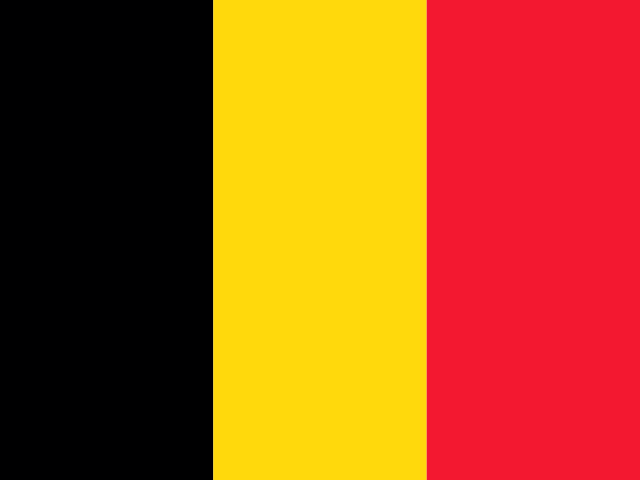
Flag protocol in Belgium: order and position
Published Written by Flagpole Guides
This page is an English translation of the Dutch original. Where the two versions differ, the Dutch text is the original.
When several flags fly side by side, an order of precedence decides which flag takes the place of honour. The most detailed rules in Belgium are in circular VR 2015/37 of the Flemish Government, for the public buildings of the Flemish Government, the provinces, the municipalities and the districts. Businesses, associations and private individuals often use the same rules as a guide.
The order of precedence
According to the circular, the order of the official flags is:
- the Belgian flag
- the Flemish flag
- the European flag
- the provincial flag
- the municipal flag
A flag's rank is also the number of the pole it flies on. Whether the poles are on the façade, on the roof or in front of the building makes no difference, according to the circular.
The position of the poles
To number the poles, the observer stands, according to the circular, with their back to the building. The arrangement depends on the number of flags.
With an odd number of flags (1, 3, 5 …), pole 1 is in the middle:
| 5 | 3 | 1 | 2 | 4 |
|---|
With an even number of flags (2, 4, 6 …), poles 1 and 2 are in the middle:
| 6 | 4 | 2 | 1 | 3 | 5 |
|---|
In both tables the building is behind the observer, and left and right are as seen from that position.
When a flag is missing or added
If a flag is not flown, the following flags move up one or more places, according to the circular. If the Belgian flag is not flown, for example, the Flemish flag takes pole 1. Conversely, a flag placed among the others moves the following flags back one place. The flag of a foreign state thus goes on pole 2, after the Belgian flag, and the other flags move back one place. More on this is in the guide on foreign flags in Belgium.
Theme flags
The circular also mentions theme flags: flags that are not official flags and were made for a special occasion, such as a festival flag. Their position depends on the other flags:
- if only the theme flag and the Flemish flag are flown, the Flemish flag goes on the right pole and the theme flag on the left pole
- if the theme flag, the Flemish flag and the Belgian flag are flown, the Belgian flag is in the middle, the Flemish flag on the right and the theme flag on the left
Here too, the observer stands with their back to the building.
Size and care
According to the circular, all flags have the same size when more than one is flown. It also recommends checking the heraldic colours and figures of the flags, keeping flags clean and replacing them in good time, and shaking them loose when they wrap around the pole.
The order of anthems
The circular also sets an order for the anthems at official ceremonies. At the start of a ceremony: first the Belgian anthem, then any foreign anthems and finally the Flemish anthem. At the end the reverse: first the Flemish anthem, then any foreign anthems and finally the Belgian anthem. The Flemish anthem consists of the first two verses of De Vlaamse Leeuw.
In Wallonia, Brussels and the German-speaking Community
The decrees of the French Community, the Walloon Region and the German-speaking Community set out where and when their flag is flown, but do not give their own order of precedence like the Flemish circular. For a specific case, the protocol service of the authority concerned can give an answer.
Frequently asked questions
In what order are flags flown on a Flemish public building?
According to circular VR 2015/37, the order of precedence is: 1 the Belgian flag, 2 the Flemish flag, 3 the European flag, 4 the provincial flag and 5 the municipal flag. The flag's rank is also the number of its pole.
How are the poles numbered?
According to the circular, the observer stands with their back to the building. With an odd number of flags, flag 1 is in the middle, flag 2 to its right and flag 3 to its left, and so on. With an even number, flags 1 and 2 are in the middle, with flag 1 to the right of flag 2 as seen from that position.
What happens if a flag is not flown?
Circular VR 2015/37 provides that the following flags then move up one or more places. If the Belgian flag is not flown, the Flemish, the European and the other flags each move up one place.
Are all flags the same size?
On Flemish public buildings, yes. According to circular VR 2015/37, all flags have the same size when more than one is flown.
Sources
This guide is based on the following sources, most of them in Dutch:
- Omzendbrief VR 2015/37 over de bevlagging van de openbare gebouwen – Flemish Government
- Koninklijk besluit van 5 juli 1974 betreffende de bevlagging van de openbare gebouwen – Justel (FPS Justice)
- Decreet houdende vaststelling van het wapen, de vlag, het volkslied en de feestdag van de Vlaamse Gemeenschap – Codex Vlaanderen
Related guides
- Foreign flagsForeign flags and the European flag in Belgium: their place next to the Belgian flag, state visits and flags of individuals and businesses.
- Flag rulesThe rules for flying flags in Belgium: the royal decree of 1974, the decrees of the communities and regions, and flag flying by private individuals.
- Flag daysAll flag days in Belgium for 2026 and 2027: the days of the royal decree of 1974 and the feast days of the communities and regions, with the weekday.
- Flagpoles for businessesFlagpoles at businesses in Belgium: logo flags and the Advertising Regulation, permits by region, flag protocol, flag days and well-being at work.