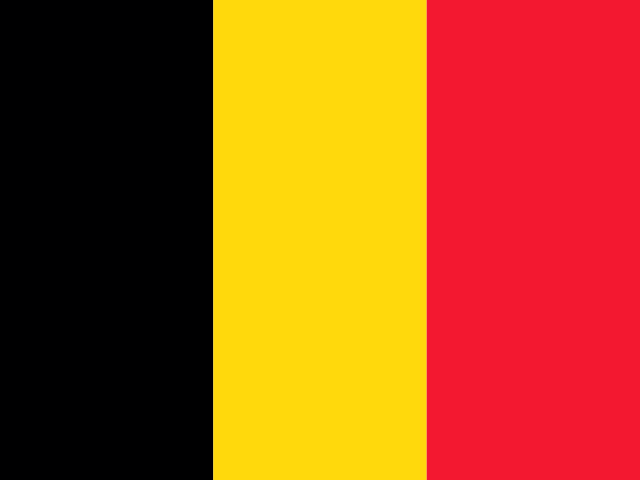
Flag rules in Belgium
Published Written by Flagpole Guides
This page is an English translation of the Dutch original. Where the two versions differ, the Dutch text is the original.
Flags in Belgium involve several authorities. The federal government regulates the national and the European flag on public buildings, and the communities and regions regulate their own flags. For private individuals, little is set down in law. This guide sets out the rules, from public buildings to a flag in one's own garden.
The federal rules
The royal decree of 5 July 1974 on flag flying on public buildings is the basis. Article 1 lists the days on which the national flag and the European flag are flown on public buildings. The decree was amended in 1989, 1993, 1998, 2013 and 2015. The full list of dates is in the guide on flag days.
The decree says nothing about times, the size of the flag or private homes. The colours themselves are in article 193 of the Constitution: red, yellow and black.
The rules of the communities and regions
| Authority | Flag | Feast day | Legal basis |
|---|---|---|---|
| Flemish Community | Yellow with a black lion, clawed and tongued red | 11 July | Decree of 7 November 1990 |
| French Community | Yellow with a red cockerel (coq hardi), proportions 2:3 | 27 September | Decree of 3 July 1991 |
| Walloon Region | Yellow with a red cockerel (coq hardi), proportions 2:3 | Third Sunday of September | Decree of 23 July 1998 |
| German-speaking Community | White with a red lion and nine blue cinquefoils | 15 November | Decree of 1 October 1990 |
| Brussels-Capital Region | Blue with an iris with yellow petals and a grey heart, edged in white | 8 May | Ordinances of 16 May 1991 and 13 March 2003 |
Each decree sets out where its flag is flown. The Flemish flag is flown on 11 July on public buildings in the Dutch-language area and on the buildings of Flemish institutions in Brussels, and also whenever the Belgian or the European flag is flown. The flag of the French Community is flown on 27 September on public buildings in the French-language area, and there on official buildings on the same days as the national flag. The Walloon Region and the German-speaking Community have similar provisions for their areas. The Flemish and Walloon decrees and the decree of the French Community also allow the government to order flags to be flown on other dates.
The Flemish circular
The Flemish Government set out the rules in more detail in circular VR 2015/37. It is addressed to the services of the Flemish Government, the provinces, the municipalities and the districts, and applies in the Dutch-language area and to Flemish institutions in Brussels. Among other things, it contains:
- an overview of the dates on which the Belgian, Flemish and European flags are flown, and the dates on which the provincial and municipal flags may be flown
- the order of precedence of the official flags, explained in the guide on flag protocol
- the rule that the Flemish flag flies permanently on the large administrative buildings of the Flemish Government, while municipalities and provinces are free to fly flags permanently
- practical recommendations: all flags of the same size, clean flags replaced in good time, and flags on isolated poles taken in in the evening
Under the decree of 7 November 1990, the provincial governors supervise compliance by the provinces and municipalities of the Dutch-language area.
Flying a flag as a private individual
For private individuals there is no obligation to fly a flag in Belgium and no list of set times. Anyone flying the tricolour or another flag can follow the rules for public buildings, but is not bound by them. It is customary to keep the flag clean and whole and not to let it touch the ground. The protocol service of the FPS Home Affairs mentions the latter explicitly for a flag at half-mast.
Other rules can still apply. A free-standing flagpole falls under the planning rules of the region, as described in the guide on flagpole installation. A flag or pole on or above the public highway, such as a pavement, can fall under the municipal police regulations. And flags with advertising fall under the Advertising Regulation in Flanders, covered in the guide on flagpoles for businesses.
Special events
For a death in the Royal Family, a national disaster, a state visit or a commemoration, the authorities issue separate instructions. These apply to public buildings. More on this is in the guides on half-mast, flags in mourning and foreign flags in Belgium.
Frequently asked questions
May anyone fly the Belgian flag in Belgium?
Yes. The rules on flag days and the order of flags apply to public buildings. Private individuals, associations and businesses can fly the tricolour voluntarily. Planning rules and municipal regulations can, however, apply to the flagpole and to advertising flags.
At what times is the flag flown?
The royal decree of 1974 does not set times. Circular VR 2015/37 of the Flemish Government recommends taking in flags on isolated poles in the evening, because such poles are more exposed to vandalism and theft.
Which authority is responsible for the flags of the communities and regions?
Each community and region regulates its own flag: the Flemish Community by the decree of 7 November 1990, the French Community by the decree of 3 July 1991, the Walloon Region by the decree of 23 July 1998, the German-speaking Community by the decree of 1 October 1990 and the Brussels-Capital Region by the ordinance of 16 May 1991.
Who supervises flag flying by Flemish municipalities?
Under the decree of 7 November 1990, the provincial governors supervise compliance with the flag rules by the provinces and municipalities of the Dutch-language area. The protocol service of the Flemish Government can advise on questions of interpretation.
Sources
This guide is based on the following sources, most of them in Dutch:
- Koninklijk besluit van 5 juli 1974 betreffende de bevlagging van de openbare gebouwen – Justel (FPS Justice)
- Omzendbrief VR 2015/37 over de bevlagging van de openbare gebouwen – Flemish Government
- Decreet houdende vaststelling van het wapen, de vlag, het volkslied en de feestdag van de Vlaamse Gemeenschap – Codex Vlaanderen
- Décret du 3 juillet 1991 déterminant le jour de fête et les emblèmes propres à la Communauté française de Belgique – Parliament of the Wallonia-Brussels Federation
- Décret du 23 juillet 1998 déterminant le jour de fête et les emblèmes propres à la Région wallonne – Wallex (Public Service of Wallonia)
- Dekret vom 1. Oktober 1990 betreffend die Einführung des Festtages, des Wappens und der Fahne der Deutschsprachigen Gemeinschaft – Ministry of the German-speaking Community
- Ordonnantie van 16 mei 1991 houdende vaststelling van het embleem en de vlag van het Brussels Hoofdstedelijk Gewest – Justel (FPS Justice)
Related guides
- Flag daysAll flag days in Belgium for 2026 and 2027: the days of the royal decree of 1974 and the feast days of the communities and regions, with the weekday.
- Flag protocolThe order of precedence of flags in Belgium: Belgian, Flemish, European, provincial and municipal flags, the position of the poles and the order of anthems.
- Half-mastHow a flag is flown at half-mast in Belgium according to the FPS Home Affairs, when this happens and the custom for a pole that is too short.
- Flag typesThe flags flown in Belgium: the tricolour, the flags of the communities, regions, provinces and municipalities, the European flag, theme flags and banners.