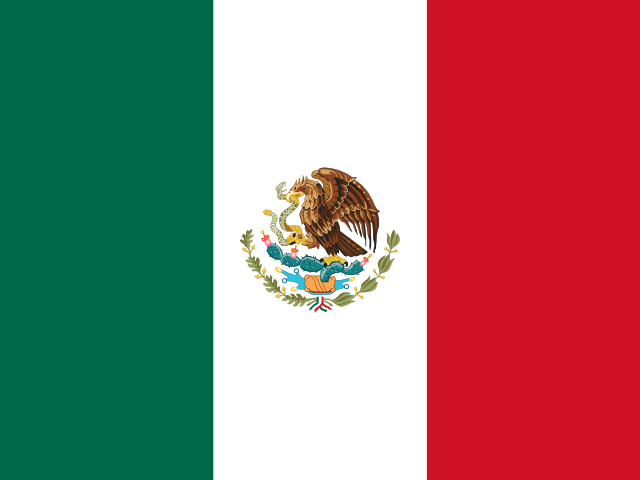
Flagpoles and flags in Mexico
Published Written by Flagpole Guides
This page is an English translation of the Spanish original. Where the two versions differ, the Spanish text is the original.
In Mexico, the national flag flies every day over town halls, schools, hospitals, customs posts, airports and public squares, and every Monday schools render honours to it at the start of the school day. Monumental flags on poles of at least 50 metres can be seen from far away in cities such as Monterrey, Tijuana, Ciudad Juárez and Mexico City. In September, the month of the national holidays, the flag appears on balconies, cars and shops. Unlike many countries, Mexico has a statutory list of days on which the flag flies at full mast or at half-mast, and a law of its own that regulates its use, the honours it receives and its sale. This page brings together the rules and customs for flags and flagpoles in Mexico, based on the legislation and the responsible authorities.
Key points
- Full and half-mast days: article 18 of the law sets 51 days at full mast, plus the closing days of Congress’s sessions, and 32 at half-mast. The guide to flag days lists them with the day of the week.
- Private use: under article 32, anyone may display the flag at home, at work or on a vehicle, with due respect and in any size, but not use it to promote their image, goods or services. The guide to flag rules covers these points.
- Half-mast and mourning: besides the days in the law, the President may declare national mourning by decree. More in the guides to half-mast and national mourning.
- Honours: on 24 February, 15 and 16 September and 20 November, honours to the flag are compulsory at the authorities’ buildings. The guide to flag protocol describes the civil salute and the presentation of the flag.
- Sizes: the law sets the 4 to 7 proportion and the size of the coat of arms, but no size per pole height. The flag size calculator shows a Mexican maker’s standard sizes.
- Price: what determines the price of a flagpole and of a flag is covered in the guides to the price of a flagpole and the price of a flag.
- Installation: a fixed flagpole is building work regulated by each municipality. More in the guide to flagpole installation.
Laws and authorities
The Law on the National Arms, Flag and Anthem (Ley sobre el Escudo, la Bandera y el Himno Nacionales), published in the Official Journal of the Federation on 8 February 1984 and in force since 24 February that year, regulates the features of the national symbols, the use of the coat of arms and the flag, the honours and the performance of the anthem. Its latest amendment, of July 2025, extended the days in article 18 with commemorations of women in Mexican history. The Ministry of the Interior (Secretaría de Gobernación) monitors compliance and sanctions infringements, and the education authorities do so in schools.
The Federal Criminal Code punishes outrage against and misuse of the national symbols in articles 191 and 192. The Armed Forces follow their own regulations, and the Ministry of National Defence has made, raised and guarded the monumental flags since the 1999 decree.
The flagpole is another matter: under article 115 of the Constitution, municipalities grant licences and permits for construction, so installing one depends on each municipality’s building regulations or, in Mexico City, on the borough (alcaldía).
The flagpole in Mexico
At public buildings, the flag usually flies on a free-standing pole in front of the façade or on the roof. Schools and offices also have a colour-guard flag, which makers offer in the regulation size of 0.90 × 1.58 metres, with its staff and display case. Mexican makers offer aluminium flagpoles of about 4.5 to 24 metres and steel flagpoles of more than 100 metres. The guides to types of flagpoles and flagpole heights cover these forms, and the guide to flagpole materials compares them.
About the guides
The guides are grouped by topic. Each one deals with a specific subject, ends with frequently asked questions, cites its sources and shows the date of its latest update. The federal law applies to the whole country; some federal states, such as Jalisco, also have a flag and a symbols law of their own, and each municipality has its own building regulations. The guides point out these differences where they matter.
All guides
Flag flying and rules
When and how the national flag flies in Mexico: the days in article 18, the rules of the 1984 law, half-mast, national mourning, holidays, honours and foreign flags.
- Flag daysThe days on which Mexico’s national flag is raised in 2026 and 2027, at full mast and at half-mast, under article 18 of the flag law, with the weekday.
- Flag rulesThe rules for the national flag of Mexico: where it flies, private use, inscriptions, the sale of flags, infringements and fines under the 1984 flag law.
- Half-mastWhen the national flag of Mexico flies at half-mast: the 32 days in the law, the mourning of 19 to 21 September, national mourning decrees and the states.
- National mourningHow national mourning is declared in Mexico: presidential decrees, the flag at half-mast, the yearly mourning for the earthquakes and examples from 2020–2021.
- Flags on holidaysThe flag on Mexico’s holidays: the September national celebrations, the statutory rest days of the Federal Labour Law and the Mondays they move to.
- Flag protocolThe protocol of Mexico’s national flag: honours, the civil salute, the anthem, the presentation of the flag, colour guards and the place of honour.
- Foreign flagsFlags of other countries in Mexico: official events and diplomatic relations, sporting events, embassies, the place of honour and private use.
The flag
The national flag and the other flags seen in the country: types, sizes, symbolism, history, what determines the price of a flag and a size calculator.
- Flag typesThe types of flags in Mexico: the national flag, the colour-guard flag, monumental flags, state flags such as Jalisco’s and Colima’s, and other insignia.
- Flag sizesThe sizes of Mexico’s national flag: the 4 to 7 proportion, stripes and arms under the law, the colour-guard flag, outdoor and monumental sizes.
- Flag size calculatorFlag size calculator for Mexico: the standard size for the height of the flagpole, the width of the stripes and the diameter of the coat of arms under the law.
- Flag symbolismWhat the flag of Mexico symbolises: the eagle on the cactus, the serpent, the oak and laurel, the colours of the Trigarante army and what the law says.
- Price of a flagWhat determines the price of a Mexican flag: size, fabric, printed, embroidered or painted arms, finishing, the rules on sale and consumer rights.
- History of the flagThe history of the flag of Mexico: insurgent banners, the Trigarante flag of 1821, the 1823 coat of arms, Carranza’s decree and the laws of 1968 and 1984.
The flagpole
Types of flagpoles, materials, height, accessories, hoisting mechanisms, lighting and what determines the price of a flagpole.
- Types of flagpolesThe types of flagpoles in Mexico: outdoor aluminium and steel poles, monumental poles, colour-guard, desk and vehicle staffs, and their hoisting systems.
- Flagpole materialsAluminium, steel, stainless steel, iron, brass and wood for a flagpole in Mexico: heights, corrosion, finishes, maintenance and lightning protection.
- Flagpole heightsThe height of a flagpole in Mexico: usual sizes, monumental poles of 50 to 125 metres, the relationship with the flag, foundations and wind by region.
- Flagpole accessoriesThe accessories of a flagpole in Mexico: revolving pulley, rope, cleat, ball, base plate, snap hooks, finial, tie, flag sling and display case.
- Flagpole mechanicsHow a flag is raised in Mexico: external rope with a revolving pulley, internal hoisting with a door and crank, telescopic poles and monumental flags.
- Flag lightingThe flag at night in Mexico: what the law says, lighting a flagpole, the electrical installation and the light pollution rules of Ensenada.
- Price of a flagpoleWhat determines the price of a flagpole in Mexico: height, aluminium or steel, hoisting system, accessories, foundation, installation and consumer rights.
Installation, safety and maintenance
Municipal permits, foundations, wind and hurricanes, maintenance, repair, lifespan and transport, for households, condominiums, schools, businesses and municipalities.
- Flagpole installationThe rules for installing a flagpole in Mexico: municipal permits, the Mexico City Building Regulations, monuments, condominiums and foundations.
- Flagpole safetyThe safety of a flagpole in Mexico: wind and structural design, SIAT-CT hurricane alerts, lightning, work at height and civil liability.
- Flagpole maintenanceMaintaining a flagpole and its flag in Mexico: aluminium and steel, rope and pulley, inspection after storms, care of the flag and incineration.
- Flagpole repairRepairing a flagpole in Mexico: broken rope, stuck pulley, corrosion, torn flags, work at height and the guarantee on repairs.
- Flagpole lifespanHow long an aluminium or steel flagpole lasts in Mexico, how long an outdoor or monumental flag lasts and what the law says about worn-out flags.
- Flagpole transportHow a flagpole is transported in Mexico: overhanging loads, red flags and lights under the federal traffic regulation, poles in sections and delivery.
- Flagpoles for businessesFlagpoles for businesses in Mexico: the national flag and advertising, private schools and hospitals, logo flags as signs and sets of flagpoles.
Frequently asked questions
Can a private person fly the national flag at home in Mexico?
Yes. Under article 32 of the Law on the National Arms, Flag and Anthem, individuals may display the national flag at their homes or workplaces and use it on their vehicles, provided they show the respect due to the national symbol, and the flag may be of any size.
Where is the national flag compulsory?
Under articles 15 and 16 of the law, at the seats of the authorities, at diplomatic and consular missions, at buildings providing education and medical services, at immigration offices, customs, harbour masters’ offices, airports and in the public squares the authorities designate. There the flag stays raised every day of the year.
What does the flag of Mexico look like?
Article 3 of the law describes it as a rectangle divided into three vertical stripes of identical size, green, white and red from the pole, with the national coat of arms in the centre of the white stripe. The arms have a diameter of three quarters of the width of that stripe, and the proportion of width to length is four to seven.
When does the flag fly at half-mast in Mexico?
On the 32 days in fraction II of article 18 of the law, such as 13 September for the Boy Heroes or 2 October for Tlatelolco, and when the President of the Republic declares national mourning by decree. Since 2017, a decree also sets national mourning on 19, 20 and 21 September every year.
Is a permit needed to install a flagpole?
Under article 115 of the Constitution, municipalities grant licences and permits for construction, so the answer depends on each municipality’s building regulations. In Mexico City, the Building Regulations do not list flagpoles among the works exempted by article 62, and the borough (alcaldía) can answer in each individual case.
What is the penalty for desecrating the flag?
Article 191 of the Federal Criminal Code punishes outrage against the coat of arms or the national flag, by word or deed, with six months to four years in prison, a fine or both. The Law on the National Arms, Flag and Anthem also provides fines of up to ten thousand times the Unit of Measurement and Update for its infringements.
Sources
This guide is based on the following sources, most of them in Spanish:
- Ley sobre el Escudo, la Bandera y el Himno Nacionales (última reforma DOF 21-07-2025) – Cámara de Diputados del H. Congreso de la Unión
- Constitución Política de los Estados Unidos Mexicanos (artículo 115) – Cámara de Diputados del H. Congreso de la Unión
- Código Penal Federal (artículos 191 y 192) – Cámara de Diputados del H. Congreso de la Unión
- Decreto por el que se modifica el diverso por el que se declaran tres días de duelo nacional publicado el 20 de septiembre de 1985 – Diario Oficial de la Federación
- Decreto por el que se establece que la Secretaría de la Defensa Nacional será responsable del programa de astas banderas y banderas monumentales – Diario Oficial de la Federación
- Reglamento de Construcciones para el Distrito Federal (texto vigente) – Procuraduría Ambiental y del Ordenamiento Territorial de la Ciudad de México
- Astas de aluminio – Grupo Symac
- Banderas, bases, astas y nichos – Banderas México