History of the Mexican flag: from the Trigarante to today
Published Written by Flagpole Guides
This page is an English translation of the Spanish original. Where the two versions differ, the Spanish text is the original.
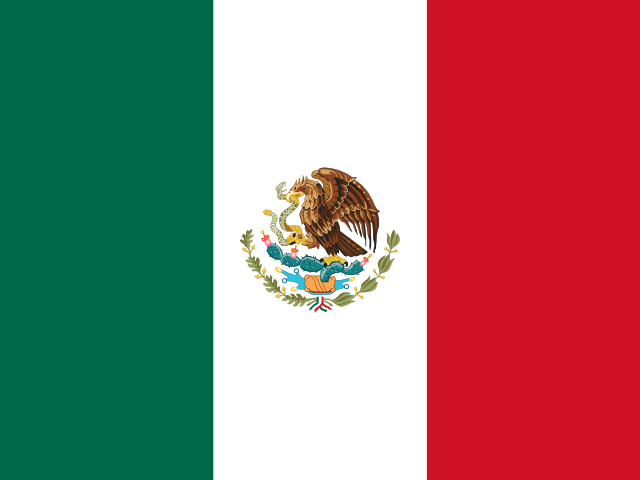
The green, white and red flag with the eagle on the cactus seems unchanging, but its current design dates from 1968. Before it came religious banners, insurgent flags, the diagonal flag of the Trigarante army, the crowned eagle of Iturbide’s Empire and numerous versions of the coat of arms in the 19th century. This guide summarises that history based on the publication La bandera nacional (2017) of the National Institute for Historical Studies of the Revolutions of Mexico (INEHRM), whose pieces are mostly kept at the National Museum of History in Chapultepec Castle.
Before Independence
The Mexica, Tlaxcalan and Tepanec armies used pennants, banners and coloured cloths to distinguish their military leaders and their political identity; in the time of Moctezuma Ilhuicamina, each Mexica district carried its own banner. The Conquest brought Spanish insignia: Hernán Cortés’s banner, with the image of the Virgin, paraded every 13 August in the Paseo del Pendón, and from 1529 a flag with the Cross of Burgundy was used.
The insurgent flags
On 16 September 1810, at the parish of Atotonilco, Miguel Hidalgo took as his flag an oil painting of the Virgin of Guadalupe painted by Andrés López in 1805. That same night, Captain Ignacio Allende raised two flags of the Queen’s Dragoons regiment in San Miguel el Grande, in sky blue and white. One of them is one of the so-called «twins», captured at the battle of Puente de Calderón on 17 January 1811 and sent to Spain; in 2010 Spain returned them, one for five years and the other permanently. The INEHRM considers them the first truly Mexican military flags.
On 19 August 1812, José María Morelos created a white and blue flag on which the eagle on a cactus appears for the first time as a coat of arms, above a three-arched bridge representing the aqueduct of Valladolid, today Morelia, with the Latin word UNUM, the union of the Americans.
The Trigarante and the Empire (1821–1823)
After the proclamation of the Plan of Iguala in February 1821, the tailor José Magdaleno Ocampo made the flag of the Trigarante Army, the first with the colours green, white and red. Its stripes ran diagonally, with a gold star on each and a crown in the centre. According to the INEHRM, white stood for religion, green for independence and red for union. With it, Agustín de Iturbide entered Mexico City at the head of the army, ending the War of Independence.
On 2 November 1821, Iturbide decreed that the flag should have vertical stripes in the order green, white and red, with a crowned eagle, without a serpent, perched on a cactus on an island in a lake. The INEHRM considers it the first national flag with the order of the colours and the eagle on the cactus in its centre.
The Republic and the 19th century
On 14 April 1823, after the fall of the Empire, the Constituent Congress set the coat of arms according to the indigenous tradition: the eagle in profile, perched on a cactus, devouring a serpent, without a crown and with branches of oak and laurel. The engraver José Mariano Torreblanca made the first official design. The colours did not change again, but the coat of arms did: in a century of civil wars and invasions, each faction created its own version.
During the Second Empire (1864–1867), Maximilian of Habsburg used his own imperial arms. During the Porfiriato, the flag showed an eagle facing forward, devouring the serpent, surrounded by a classical laurel wreath.
From Carranza to 1968
On 20 September 1916, Venustiano Carranza decreed that the coat of arms should appear on flags again in a new design by the Michoacán artist Antonio Gómez: the eagle in profile, its wings in an attacking stance, devouring the serpent, with the words «Estados Unidos Mexicanos».
The first Law on the Features and Use of the National Arms, Flag and Anthem was published in the Official Journal of the Federation on 17 August 1968 and brought together the scattered provisions on the national symbols in a single text. It set the design the flag has kept since September 1968.
The 1984 law
The current law, submitted by President Miguel de la Madrid, was published on 8 February 1984, repealed the 1968 law and entered into force on 24 February 1984, Flag Day. In 1995 the rule on the eagle on the reverse was added; in 2018, the rules on the presentation of the flag, private use and sanctions; and numerous amendments, from 1991 to 2025, have changed the flag days in article 18. In 1999, a decree entrusted the Ministry of National Defence with the monumental flags, which have since shaped the skyline of many cities.
Famous flags
The National Museum of History keeps flags with a history of their own. That of the San Blas Active Battalion, with its colours reversed and traces of the blood of its commander, Lieutenant Colonel Felipe Santiago Xicoténcatl, killed in the defence of Chapultepec in 1847, has been the museum’s official emblem since 1947. That of Squadron 201 of the Mexican Expeditionary Air Force, which fought in the Philippines in 1945, is according to the INEHRM the most decorated Mexican flag. The guide to flag symbolism explains its elements, and the guide to flag days lists the anniversaries of this history.
Frequently asked questions
What was the first flag of Mexico?
According to the National Institute for Historical Studies of the Revolutions of Mexico, the first with today’s colours was that of the Trigarante Army, made by José Magdaleno Ocampo after the proclamation of the Plan of Iguala in 1821, with diagonal stripes and a star on each. The first with vertical stripes in today’s order and the eagle on the cactus is the one decreed by Iturbide on 2 November 1821.
Since when has the flag had its current design?
Since 1968. The first Law on the Features and Use of the National Arms, Flag and Anthem was published in the Official Journal of the Federation on 17 August 1968, and the design was kept by the current law of 1984, which entered into force on 24 February of that year.
Who first used the eagle on the cactus on a flag?
José María Morelos. According to the National Institute for Historical Studies of the Revolutions of Mexico, the flag he created on 19 August 1812 shows for the first time the eagle on a cactus as a coat of arms, above a three-arched bridge and with the Latin word UNUM.
Which flag did Miguel Hidalgo carry?
An oil painting of the Virgin of Guadalupe, painted by Andrés López in 1805, which Hidalgo took as his troops’ banner at the parish of Atotonilco on 16 September 1810, according to the National Institute for Historical Studies of the Revolutions of Mexico. It was abandoned after a defeat in November that year.
Sources
This guide is based on the following sources, most of them in Spanish:
- La bandera nacional. Testimonio de la construcción de la identidad mexicana – Instituto Nacional de Estudios Históricos de las Revoluciones de México
- Ley sobre el Escudo, la Bandera y el Himno Nacionales (transitorios) – Cámara de Diputados del H. Congreso de la Unión
- Decreto por el que se establece que la Secretaría de la Defensa Nacional será responsable del programa de astas banderas y banderas monumentales – Diario Oficial de la Federación
Related guides
- Flag symbolismWhat the flag of Mexico symbolises: the eagle on the cactus, the serpent, the oak and laurel, the colours of the Trigarante army and what the law says.
- Flag typesThe types of flags in Mexico: the national flag, the colour-guard flag, monumental flags, state flags such as Jalisco’s and Colima’s, and other insignia.
- Flag rulesThe rules for the national flag of Mexico: where it flies, private use, inscriptions, the sale of flags, infringements and fines under the 1984 flag law.
- Flag daysThe days on which Mexico’s national flag is raised in 2026 and 2027, at full mast and at half-mast, under article 18 of the flag law, with the weekday.