Flag rules in Mexico: what the 1984 flag law says
Published Written by Flagpole Guides
This page is an English translation of the Spanish original. Where the two versions differ, the Spanish text is the original.
In Mexico, the use of the flag is regulated by a law of its own, the Law on the National Arms, Flag and Anthem (Ley sobre el Escudo, la Bandera y el Himno Nacionales), published in the Official Journal of the Federation on 8 February 1984. It replaced the first law on the national symbols, of 1968, and has been amended many times, most recently in July 2025. Unlike other flag laws, it is not limited to public buildings: it also regulates private use, inscriptions, the sale of flags and sanctions. This guide summarises what it says.
The national symbols
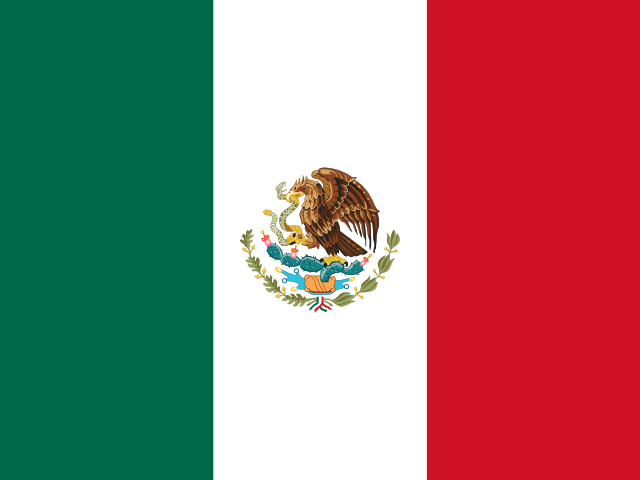
Under article 1, the national arms, flag and anthem are the national symbols of the United Mexican States, and the law is a matter of public order. Article 3 describes the flag: a rectangle divided into three vertical stripes of identical size, green, white and red from the pole, with the national coat of arms in the centre of the white stripe and a diameter of three quarters of the width of that stripe. The proportion of width to length is four to seven, and the flag may carry a bow or tie in the same colours at the foot of the finial. A model authenticated by the three branches of government is kept at the General Archive of the Nation and another at the National Museum of History.
The law distinguishes between authorities, the public bodies of the three levels of government, and institutions, legal persons that are not authorities (article 1 Bis). Many rules depend on that distinction.
Where the national flag flies
Under article 15, the flag is raised at the seats of the authorities and of Mexico’s diplomatic and consular missions, at the buildings of authorities and institutions providing education and medical services, at immigration offices, customs, harbour masters’ offices, airports and in the public squares the authorities designate. All Mexican aircraft and ships carry the flag.
At these places, the flag stays raised every day of the year, except in unforeseeable cases or force majeure (article 16), and on the days in article 18 it flies at full mast or at half-mast. The guide to flag days lists them. Article 17 provides that these flags have the size and upkeep appropriate to their use and dignity.
Article 21 requires every school in the country, public or private, to have a national flag for civic ceremonies.
Private use
Article 32 allows individuals to use the flag on their vehicles or display it at their homes or workplaces, provided they show the respect due to the national symbol, and in these cases the flag may be of any size. Article 32 Bis adds a limit: neither individuals nor institutions may use the flag to promote their image, goods or services.
Inscriptions and the coat of arms
Under article 7, authorities may inscribe their name on the flag provided this contributes to the respect for the symbol, does not cover the coat of arms and the copy follows article 3. Institutions may do so with the authorisation of the Ministry of the Interior. The coat of arms itself may only be reproduced by institutions and individuals with that Ministry’s authorisation and where it contributes to its respect or to spreading knowledge of its origin, history and meaning (article 6).
The sale of flags
Article 33 provides that flags intended for sale follow article 3, and prohibits selling copies with the inscriptions of article 7. Accessories that reproduce the flag for commercial purposes also meet the requirements of the law’s regulation (article 33 Bis). The guide to the price of a flag covers buying one.
Infringements and sanctions
The Ministry of the Interior monitors compliance with the law, with all the country’s authorities as auxiliaries, and the education authorities do so in schools (article 55). Article 56 lists the infringements, among them altering the features of the flag, inscribing the corporate name of an institution on it without authorisation, selling flags with inscriptions, omitting the compulsory honours of article 11, or inscribing on it the names of persons or institutions to promote their image, goods or services. Under article 56 Ter, the serious ones include altering the flag, using the coat of arms without authorisation, selling flags with inscriptions and such promotional inscriptions.
The sanctions in article 56 Quintus range from a warning to a fine of up to ten thousand times the Unit of Measurement and Update, with an additional fine of the same amount for each day the infringement continues, and detention of up to thirty-six hours. They apply without prejudice to civil or criminal liability.
Outrage and misuse
Article 191 of the Federal Criminal Code punishes anyone who commits outrage against the coat of arms of the Republic or the national flag, by word or deed, with six months to four years in prison, a fine of fifty to three thousand pesos or both, at the judge’s discretion. Article 192 punishes misuse of the national arms, insignia or anthem with three days to one year in prison and a fine of twenty-five to one thousand pesos.
Old flags
Under article 54 Bis, when a copy of the national flag is to be destroyed, it is incinerated in a respectful and solemn ceremony, in accordance with the specifications of the regulation. The guide to flagpole lifespan covers the wear of flags.
Armed Forces and federal states
The use of the arms and flag by the Armed Forces follows their own laws and regulations (article 50). The executives of the Federation, the federal states, the municipalities and the boroughs of Mexico City promote respect for the national symbols within their powers (article 51). Some states have a flag of their own; the guide to flag types presents them.
Frequently asked questions
Can I put the Mexican flag on my car?
Yes. Article 32 of the Law on the National Arms, Flag and Anthem allows individuals to use the national flag on their vehicles or display it at their homes or workplaces, provided they show the respect due to the national symbol. The flag may be of any size.
Can a business put its logo on the national flag?
Not to promote itself. Article 32 Bis prohibits individuals and institutions from using the national flag to promote their image, goods or services. Under article 7, institutions may inscribe their name on the flag with the authorisation of the Ministry of the Interior, without covering the coat of arms, and article 33 prohibits selling flags with inscriptions.
Can a flag with a modified coat of arms be sold?
No. Under article 33, flags intended for sale follow the features in article 3. Altering or modifying those features is a serious infringement under articles 56 and 56 Ter, and the Ministry of the Interior can sanction it with a fine of up to ten thousand times the Unit of Measurement and Update.
What happens if someone desecrates the flag?
Article 191 of the Federal Criminal Code punishes outrage against the coat of arms of the Republic or the national flag, by word or deed, with six months to four years in prison, a fine of fifty to three thousand pesos or both, at the judge’s discretion. Article 192 punishes misuse with three days to one year in prison and a fine.
How is an old flag destroyed?
Under article 54 Bis of the law, when a copy of the national flag is to be destroyed, it is incinerated in a respectful and solemn ceremony, in accordance with the specifications of the corresponding regulation.
Sources
This guide is based on the following sources, most of them in Spanish:
- Ley sobre el Escudo, la Bandera y el Himno Nacionales – Cámara de Diputados del H. Congreso de la Unión
- Código Penal Federal (artículos 191 y 192) – Cámara de Diputados del H. Congreso de la Unión
Related guides
- Flag daysThe days on which Mexico’s national flag is raised in 2026 and 2027, at full mast and at half-mast, under article 18 of the flag law, with the weekday.
- Flag protocolThe protocol of Mexico’s national flag: honours, the civil salute, the anthem, the presentation of the flag, colour guards and the place of honour.
- Half-mastWhen the national flag of Mexico flies at half-mast: the 32 days in the law, the mourning of 19 to 21 September, national mourning decrees and the states.
- Foreign flagsFlags of other countries in Mexico: official events and diplomatic relations, sporting events, embassies, the place of honour and private use.