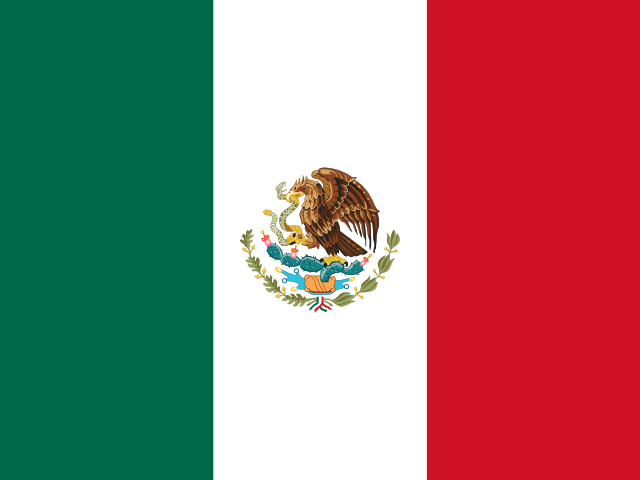
Flags on holidays in Mexico: national days and rest days
Published Written by Flagpole Guides
This page is an English translation of the Spanish original. Where the two versions differ, the Spanish text is the original.
In Mexico, public holidays and flag days do not fully coincide. The Federal Labour Law sets the statutory rest days, and since 2006 it has moved three of them to the Monday nearest the historical date. The Law on the National Arms, Flag and Anthem, on the other hand, sets the raising of the flag on the historical date itself. This guide relates the two calendars and describes the flag during the national celebrations.
The statutory rest days
Article 74 of the Federal Labour Law establishes as statutory rest days:
| Rest day | 2026 | 2027 | Flag day (art. 18 of the flag law) |
|---|---|---|---|
| 1 January | Thursday 1 | Friday 1 | Not listed |
| First Monday of February, for 5 February | Monday 2 | Monday 1 | 5 February, full mast |
| Third Monday of March, for 21 March | Monday 16 | Monday 15 | 21 March, full mast |
| 1 May | Friday 1 | Saturday 1 | 1 May, full mast |
| 16 September | Wednesday 16 | Thursday 16 | 16 September, full mast and compulsory honours |
| Third Monday of November, for 20 November | Monday 16 | Monday 15 | 20 November, full mast and compulsory honours |
| 25 December | Friday 25 | Saturday 25 | Not listed |
To these come 1 October every six years, when it coincides with the transfer of the federal executive power (under article 83 of the Constitution, the President takes office that day; the next time will be in 2030), and the day the federal and local electoral laws set for election day in ordinary elections.
The historical date and the Monday off
5 February recalls the promulgation of the Constitutions of 1857 and 1917, 21 March the birth of Benito Juárez and 20 November the start of the Mexican Revolution. The Federal Labour Law moves the rest day for these three dates to the Monday, but article 18 of the Law on the National Arms, Flag and Anthem sets full mast on the historical date. So in 2026 the rest day for 20 November is Monday 16, and the flag flies at full mast with compulsory honours on Friday 20. The guide to flag days shows all the days with their day of the week.
The national celebrations
September is the month of the nation. On the night of 15 September, the Cry of Independence is commemorated: under article 35 of the law, the President of the Republic is required to wear the presidential sash at the commemoration of the Cry of Dolores. 16 September recalls the start of Independence in 1810 and is a statutory rest day. Under article 11, honours to the flag are compulsory at the authorities’ buildings on both days, and 27 September, the anniversary of the completion of Independence in 1821, is also a full-mast day.
In those weeks, the flag appears on balconies, windows, cars and shops. Article 32 allows anyone to display it at home, at work or on a vehicle, in any size, with due respect; article 32 Bis prevents its use to promote anyone’s image, goods or services. The guide to flag rules covers these limits.
Other civic days
Many flag days are not rest days: 24 February, Flag Day, 18 March, the anniversary of the Oil Expropriation, 5 May, the victory at Puebla in 1862, and 12 October, Día de la Raza. On these days the flag flies at full mast at the buildings in article 15 even though they are working days.
Christmas and New Year
1 January and 25 December are statutory rest days, but they are not in article 18. At the buildings and places in article 15, the flag stays raised every day of the year under article 16, including on these days.
State days
The federal states also celebrate their own days, such as the anniversary of their founding or of their joining the Federation; 14 September, when Chiapas joined the federal pact in 1824, is even in the federal law. In states with a flag of their own, such as Jalisco, the symbols law provides that the state flag is raised on the state’s solemn days, after the honours to the national flag. The guide to flag types presents them, and the guide to flag protocol explains the order of honours.
Frequently asked questions
What are the statutory rest days in Mexico?
Under article 74 of the Federal Labour Law: 1 January, the first Monday of February for 5 February, the third Monday of March for 21 March, 1 May, 16 September, the third Monday of November for 20 November, 1 October every six years with the transfer of executive power, 25 December and election day as set by the electoral laws.
Is the flag raised on the Monday off or on the historical date?
On the historical date. Article 18 of the Law on the National Arms, Flag and Anthem sets full mast on 5 February, 21 March and 20 November, while the Federal Labour Law moves the rest day to the corresponding Monday. In 2026, the rest day for 20 November is Monday 16.
When are the national celebrations in September?
On the night of 15 September the Cry of Independence is commemorated, and on 16 September the start of Independence in 1810. Both days are at full mast in article 18 of the law, and on both, honours to the flag are compulsory at the authorities’ buildings under article 11.
Is the flag raised at Christmas or on New Year’s Day?
1 January and 25 December are statutory rest days under the Federal Labour Law, but they are not among the days in article 18. At the buildings in article 15, the flag stays raised every day of the year under article 16.
Sources
This guide is based on the following sources, most of them in Spanish:
- Ley Federal del Trabajo (artículo 74) – Cámara de Diputados del H. Congreso de la Unión
- Ley sobre el Escudo, la Bandera y el Himno Nacionales (artículos 11, 16, 18 y 35) – Cámara de Diputados del H. Congreso de la Unión
- Constitución Política de los Estados Unidos Mexicanos (artículo 83) – Cámara de Diputados del H. Congreso de la Unión
- Ley de los Símbolos Oficiales del Estado de Jalisco – Gobierno del Estado de Jalisco
Related guides
- Flag daysThe days on which Mexico’s national flag is raised in 2026 and 2027, at full mast and at half-mast, under article 18 of the flag law, with the weekday.
- Flag protocolThe protocol of Mexico’s national flag: honours, the civil salute, the anthem, the presentation of the flag, colour guards and the place of honour.
- Flag typesThe types of flags in Mexico: the national flag, the colour-guard flag, monumental flags, state flags such as Jalisco’s and Colima’s, and other insignia.
- Flag rulesThe rules for the national flag of Mexico: where it flies, private use, inscriptions, the sale of flags, infringements and fines under the 1984 flag law.