Flag types in Mexico: national, state and monumental flags
Published Written by Flagpole Guides
This page is an English translation of the Spanish original. Where the two versions differ, the Spanish text is the original.
In Mexico, the word «bandera» almost always means the national flag, the lábaro patrio. But around it there are several forms: the colour-guard flag of schools, the monumental flags of the Ministry of National Defence, the flags of some states, military insignia and corporate flags. This guide presents the most common types and what the rules say about each.
The national flag
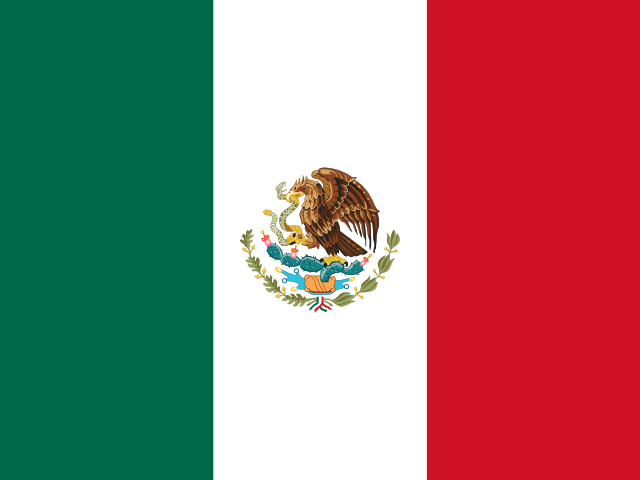
Under article 3 of the Law on the National Arms, Flag and Anthem, the national flag is a rectangle with three vertical stripes of identical size, green, white and red from the pole, with the national coat of arms in the centre of the white stripe and a proportion of 4 to 7. It may carry a bow or tie in the same colours at the foot of the finial, the tip of the staff; when a flag is decorated, the decoration is pinned to the tie (article 22). On the reverse, the eagle of the coat of arms faces the other way, standing on its right talon (article 2).
Unlike other countries, Mexico does not distinguish between a civil flag without arms and an official one with arms: the flag always carries the coat of arms. The guides to flag symbolism and the history of the Mexican flag explain its elements.
The colour-guard flag
Every school in the country has a national flag for civic ceremonies (article 21), and many institutions have their own. This is the colour-guard flag (bandera de escolta), carried by the flag bearer and their guard at the Monday honours and in parades. Mexican makers offer it in the regulation size of 0.90 × 1.58 metres, with a regulation staff of about 2.20 to 2.30 metres, a finial, a tie and a display case to keep it in. Articles 27 to 30 of the law describe how it is carried on the march; the guide to flag protocol summarises them.
Under article 7, authorities may inscribe their name on the flag without covering the coat of arms, and institutions may do so with the authorisation of the Ministry of the Interior. Article 33 prohibits selling flags with such inscriptions.
Monumental flags
Since the late 1990s, the federal government has installed monumental flagpoles and flags in squares, military camps and border cities. The decree published on 1 July 1999 made the Ministry of National Defence responsible for building, operating, maintaining and guarding them, and the only body authorised to raise and lower them. According to its recitals, monumental flagpoles are at least 50 metres high and their flags at least 25 by 14.3 metres. Among the best known, the decree cites those at Campo Marte, the Plaza de la Constitución and the San Jerónimo roundabout in Mexico City, and those in Tijuana, Ciudad Juárez, Veracruz and Iguala. The guide to flagpole heights covers their dimensions.
State flags
The federal law does not provide for flags for the federal states, but several have regulated theirs:
- Jalisco: the Law on the Official Symbols of the State of Jalisco of 2010 describes a flag of two vertical stripes of identical size, blue and gold from the pole, with the state coat of arms in the centre and a proportion of 4 to 7. Public buildings and schools have it, and its honours are rendered after those of the national flag.
- Colima: Decree 459 of 2018 allows the state’s official coat of arms to be used as a flag: a white rectangle in the proportion 4 to 7 with the coat of arms in the centre, up to three quarters of the width.
In its statement of reasons, Colima’s decree cites the laws of Jalisco and Querétaro as examples of state legislation regulating the use of a state flag.
Standards, guidons and insignia
The National Institute for Historical Studies of the Revolutions of Mexico distinguishes between the flag, a cloth fastened along one side to a staff, the standard (estandarte), a square insignia of mounted units with the national colours and the coat of arms, the corneta, a small two-pointed flag used in the Navy, and the pennant (gallardete), a strip ending in a point at the top of a mast. The Armed Forces follow their own regulations (article 50 of the law).
Corporate and foreign flags
Businesses fly flags with their logo next to the national flag, and hotels and consulates fly foreign flags. The law does not regulate these flags, but it does prevent the national flag from being used to promote anyone’s image, goods or services (article 32 Bis). The guides to flagpoles for businesses and foreign flags cover these cases, and the guide to flag sizes compares the sizes.
Frequently asked questions
Do Mexico’s states have flags?
Some do. The federal law does not provide for state flags, but several states have regulated theirs. Jalisco has a Law on the Official Symbols with a flag of two vertical stripes, blue and gold, and the state coat of arms in the centre, and Colima allows its official coat of arms to be used on a white flag in the proportion 4 to 7.
What is a monumental flag?
Under the decree published in the Official Journal of the Federation on 1 July 1999, monumental flagpoles are at least 50 metres high and their flags at least 25 by 14.3 metres. The Ministry of National Defence is responsible for making, guarding and replacing them, and is the only body authorised to raise and lower them.
What is the colour-guard flag?
The flag with which a school or an institution renders honours and parades, carried by a flag bearer and their guard. Makers offer it in the regulation size of 0.90 × 1.58 metres, with a staff of about 2.20 to 2.30 metres, and articles 27 to 30 of the law describe how the guard marches.
Can a national flag carry the name of a school?
Yes, under conditions. Under article 7 of the Law on the National Arms, Flag and Anthem, authorities may inscribe their name on the flag without covering the coat of arms, and institutions may do so with the authorisation of the Ministry of the Interior. Such copies cannot be sold.
Sources
This guide is based on the following sources, most of them in Spanish:
- Ley sobre el Escudo, la Bandera y el Himno Nacionales (artículos 3, 7, 22, 27 a 34) – Cámara de Diputados del H. Congreso de la Unión
- Decreto por el que se establece que la Secretaría de la Defensa Nacional será responsable del programa de astas banderas y banderas monumentales – Diario Oficial de la Federación
- Ley de los Símbolos Oficiales del Estado de Jalisco – Gobierno del Estado de Jalisco
- Decreto 459, por el que se reforma el Decreto 122 por el que se adopta el Escudo Oficial del Estado de Colima – H. Congreso del Estado de Colima
- La bandera nacional. Testimonio de la construcción de la identidad mexicana – Instituto Nacional de Estudios Históricos de las Revoluciones de México
- Banderas, bases, astas y nichos – Banderas México
- Astas y portaestandartes – BHC México
Related guides
- Flag sizesThe sizes of Mexico’s national flag: the 4 to 7 proportion, stripes and arms under the law, the colour-guard flag, outdoor and monumental sizes.
- Flag symbolismWhat the flag of Mexico symbolises: the eagle on the cactus, the serpent, the oak and laurel, the colours of the Trigarante army and what the law says.
- History of the flagThe history of the flag of Mexico: insurgent banners, the Trigarante flag of 1821, the 1823 coat of arms, Carranza’s decree and the laws of 1968 and 1984.
- Price of a flagWhat determines the price of a Mexican flag: size, fabric, printed, embroidered or painted arms, finishing, the rules on sale and consumer rights.