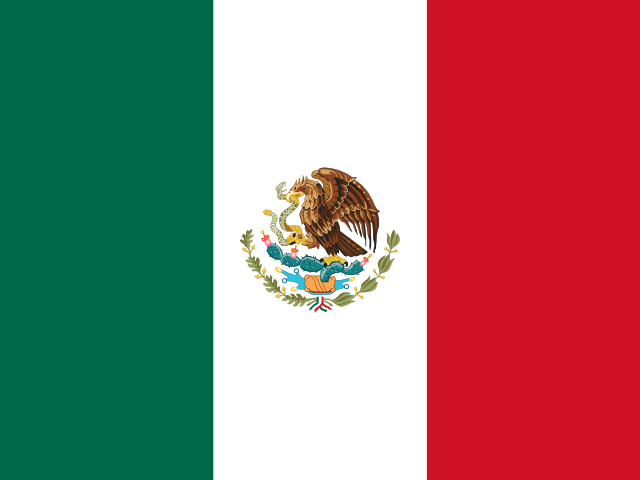
National mourning in Mexico: the flag on days of grief
Published Written by Flagpole Guides
This page is an English translation of the Spanish original. Where the two versions differ, the Spanish text is the original.
When a tragedy or the death of a national figure moves the country, the President of the Republic may declare national mourning. Mexico has no specific law on official mourning: mourning is declared by decree published in the Official Journal of the Federation, on the basis of the Law on the National Arms, Flag and Anthem, and its visible effect is the national flag at half-mast. This guide explains how it works and gives examples.
The legal basis
National mourning decrees always cite the same rules: the President’s regulatory power in article 89, fraction I, of the Constitution, articles 15 and 19 of the Law on the National Arms, Flag and Anthem and article 27 of the Organic Law of the Federal Public Administration, which sets out the powers of the Ministry of the Interior. Article 19 allows the President to order the flag raised on days other than those in article 18 for events of exceptional importance; article 15 lists the buildings and places where it flies.
The decree is signed by the President and the head of the Ministry of the Interior, and usually enters into force on the day of its publication.
What a decree provides
A national mourning decree has a short structure. The first article declares the mourning and its length; the second orders the national flag raised at half-mast on the days it sets. Some add other measures or rules for the days on which the law provides for the flag at full mast.
Examples
The earthquakes of 1985 and 2017. On 20 September 1985, a decree of three days of national mourning was published for the earthquake of the day before. On 19 September 2017, the day of the second major earthquake, a new decree amended it to declare national mourning on 19, 20 and 21 September every year, with the flag at half-mast and any official festive event suspended. It is therefore a national mourning that recurs every year; 19 September is also in fraction II of article 18 of the law.
The COVID-19 pandemic (2020). The decree published on 14 August 2020 declared 30 days of national mourning for the deaths and infections caused by the pandemic. The flag flew at half-mast from 13 August to 11 September 2020, except on the days in fraction I of article 18, when it flew as the law provides. Public servants of the Federal Public Administration kept a minute of silence every day at 12:00.
Line 12 of the Metro (2021). The decree published on 4 May 2021 declared three days of national mourning for the tragedy on Line 12 of the Mexico City Metro the day before, and ordered the flag at half-mast on 4 and 6 May. 5 May, the anniversary of the victory over the French Army at Puebla, is one of the full-mast days in the law.
Mourning in the states and municipalities
Under article 19, governors have the same power as the President in similar cases within their state, so a state can order the flag to half-mast in its territory. States with a flag of their own also regulate its use: Jalisco’s symbols law, for example, provides for the state flag at half-mast on the state’s solemn days of mourning.
The flag during mourning
During mourning, the flag flies at half-mast at the buildings and places in article 15: seats of the authorities, embassies and consulates, schools, hospitals, immigration offices, customs, harbour masters’ offices, airports and public squares. The guide to half-mast covers the procedure and the fixed days, and the guide to flag days shows which days of 2026 and 2027 are full or half-mast.
Frequently asked questions
Who declares national mourning in Mexico?
The President of the Republic, by a decree published in the Official Journal of the Federation. The decrees are based on article 89, fraction I, of the Constitution, articles 15 and 19 of the Law on the National Arms, Flag and Anthem and article 27 of the Organic Law of the Federal Public Administration.
How long does national mourning last?
Each decree sets it. The one for the Line 12 Metro tragedy, in May 2021, lasted three days; the one for the victims of the COVID-19 pandemic, in August 2020, 30 days. The yearly mourning for the earthquakes of 1985 and 2017 runs from 19 to 21 September.
What changes during national mourning?
The national flag flies at half-mast on the days the decree sets, at the buildings and places in article 15 of the law. Some decrees add other measures: the 2020 decree provided for a daily minute of silence at 12:00 in the offices of the Federal Public Administration, and the earthquake decree suspends official festive events.
Can a state declare its own mourning?
Article 19 of the law gives governors the power to order the national flag raised on days other than those in article 18, for events of exceptional importance within their state. State governments declare mourning in their territory this way.
Sources
This guide is based on the following sources, most of them in Spanish:
- Ley sobre el Escudo, la Bandera y el Himno Nacionales (artículos 15, 18 y 19) – Cámara de Diputados del H. Congreso de la Unión
- Decreto por el que se modifica el diverso por el que se declaran tres días de duelo nacional publicado el 20 de septiembre de 1985 – Diario Oficial de la Federación
- Decreto por el que se declara duelo nacional de 30 días por los decesos causados por la pandemia de COVID-19 – Diario Oficial de la Federación
- Decreto por el que se declara duelo nacional de tres días, por la tragedia ocurrida en la Línea 12 del Sistema de Transporte Colectivo Metro – Diario Oficial de la Federación
Related guides
- Half-mastWhen the national flag of Mexico flies at half-mast: the 32 days in the law, the mourning of 19 to 21 September, national mourning decrees and the states.
- Flag daysThe days on which Mexico’s national flag is raised in 2026 and 2027, at full mast and at half-mast, under article 18 of the flag law, with the weekday.
- Flag rulesThe rules for the national flag of Mexico: where it flies, private use, inscriptions, the sale of flags, infringements and fines under the 1984 flag law.
- Flag protocolThe protocol of Mexico’s national flag: honours, the civil salute, the anthem, the presentation of the flag, colour guards and the place of honour.