Symbolism of the Mexican flag: colours, eagle and coat of arms
Published Written by Flagpole Guides
This page is an English translation of the Spanish original. Where the two versions differ, the Spanish text is the original.
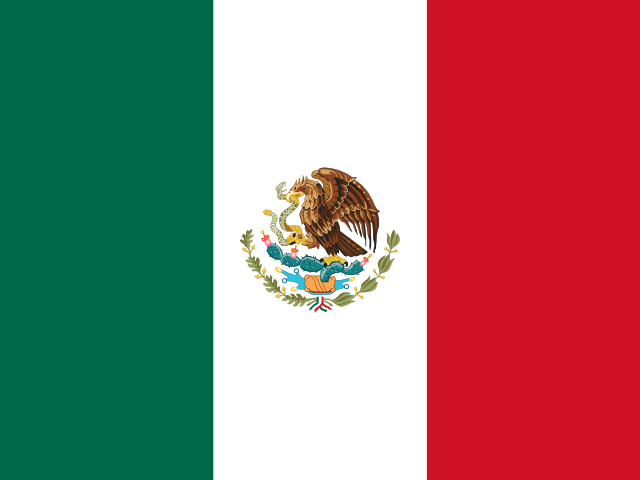
The flag of Mexico brings together symbols from very different eras on a single cloth. According to the National Institute for Historical Studies of the Revolutions of Mexico (INEHRM), it mixes allegories from three civilisations: the pre-Hispanic, with the eagle on the cactus; the Spanish, religious and colonial, with the oak and laurel branches; and that of Enlightenment liberalism, French and English, with its green, white and red colours. This guide explains each element and what the law says about it.
The eagle, the cactus and the serpent
Article 2 of the Law on the National Arms, Flag and Anthem describes the coat of arms precisely: a Mexican eagle with its left profile showing, its wings slightly spread in a fighting stance, perched with its left talon on a flowering nopal cactus growing from a rock that rises out of a lake, and holding with its right talon and its beak, as if to devour it, a curved serpent.
According to the INEHRM, the eagle standing on a cactus is the mythical founding symbol of Olmec, Maya and Mexica mythology, which became the emblem of the Mexica state and, in time, the national coat of arms. The rock in the lake recalls the island where, according to tradition, the Mexica founded México-Tenochtitlan. The insurgent leader José María Morelos was the first to use the eagle on the cactus as a coat of arms on a flag, in 1812, according to the same institute.
The oak and the laurel
Under article 2, two branches, one of oak in front of the eagle and one of laurel on the opposite side, form a lower semicircle and are joined by a ribbon of three stripes which, in natural colours, match those of the flag. The INEHRM attributes them to the Spanish tradition and describes them as symbols of strength and victory; they were introduced by the 1823 decree that set the coat of arms of the first Republic.
The colours
The law describes the colours, green, white and red from the pole, but gives them no meaning. They go back to the flag of the Trigarante Army, made after the proclamation of the Plan of Iguala in 1821: according to the INEHRM, on it white stood for religion, green for independence and red for union, the three guarantees of Agustín de Iturbide’s army. The current law does not adopt that or any other interpretation of the colours.
The coat of arms as a protected symbol
The coat of arms is protected by law. Under article 5, every reproduction corresponds faithfully to the official model, which cannot be varied or altered. Authorities use it without authorisation; institutions and individuals need the authorisation of the Ministry of the Interior (article 6). On the authorities’ coins, seals, stationery, buildings, vehicles and websites, only the words «Estados Unidos Mexicanos» may be inscribed alongside it, in an upper semicircle.
A model of the coat of arms authenticated by the three branches of government is kept at the General Archive of the Nation, another at the National Museum of History and another at the Mint (article 2).
The reverse of the flag
Since the 1995 amendment, article 2 provides that when the coat of arms is reproduced on the reverse of the flag, the eagle stands on its right talon, holding the serpent with its left talon and beak. Seen from either side, the eagle thus faces the pole.
The coat of arms and the stripes
The coat of arms sits in the centre of the white stripe, with a diameter of three quarters of its width (article 3). The guide to flag sizes shows how these proportions are calculated, and the guide to the history of the Mexican flag traces the earlier designs, from Hidalgo’s banner to the 1968 design.
Frequently asked questions
What do the colours of the Mexican flag mean?
The law gives them no meaning. According to the National Institute for Historical Studies of the Revolutions of Mexico, on the flag of the Trigarante Army of 1821, the first with green, white and red, white stood for religion, green for independence and red for union, the three guarantees of the Plan of Iguala.
What does the eagle on the cactus represent?
The founding myth of México-Tenochtitlan. According to the National Institute for Historical Studies of the Revolutions of Mexico, the eagle standing on a nopal cactus, drawn from Olmec, Maya and Mexica mythology, became the emblem of the Mexica state and, in time, the national coat of arms.
What do the branches on the coat of arms mean?
The coat of arms has an oak branch in front of the eagle and a laurel branch on the opposite side, joined by a ribbon in the national colours, under article 2 of the law. The National Institute for Historical Studies of the Revolutions of Mexico describes them as symbols of strength and victory, of Spanish tradition.
Why does the eagle face the other way on the reverse?
Because article 2 of the Law on the National Arms, Flag and Anthem has provided so since 1995: when the coat of arms is reproduced on the reverse of the flag, the eagle stands on its right talon and holds the serpent with its left talon and beak.
Sources
This guide is based on the following sources, most of them in Spanish:
- Ley sobre el Escudo, la Bandera y el Himno Nacionales (artículos 1 a 6) – Cámara de Diputados del H. Congreso de la Unión
- La bandera nacional. Testimonio de la construcción de la identidad mexicana – Instituto Nacional de Estudios Históricos de las Revoluciones de México
Related guides
- History of the flagThe history of the flag of Mexico: insurgent banners, the Trigarante flag of 1821, the 1823 coat of arms, Carranza’s decree and the laws of 1968 and 1984.
- Flag typesThe types of flags in Mexico: the national flag, the colour-guard flag, monumental flags, state flags such as Jalisco’s and Colima’s, and other insignia.
- Flag rulesThe rules for the national flag of Mexico: where it flies, private use, inscriptions, the sale of flags, infringements and fines under the 1984 flag law.
- Flag sizesThe sizes of Mexico’s national flag: the 4 to 7 proportion, stripes and arms under the law, the colour-guard flag, outdoor and monumental sizes.