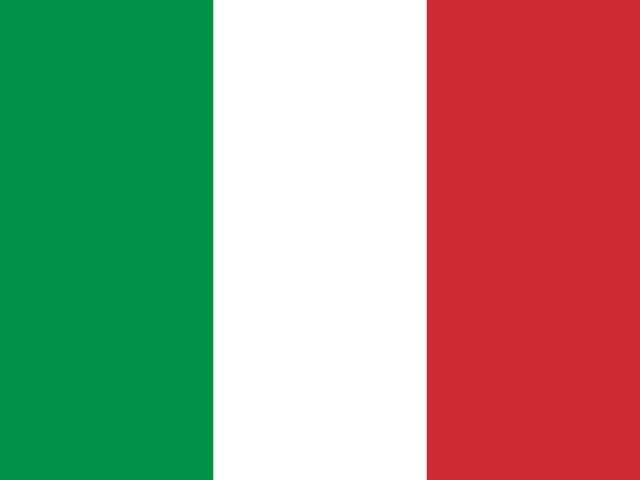
Flag days in Italy, 2026 and 2027
Published Written by Flagpole Guides
This page is an English translation of the Italian original. Where the two versions differ, the Italian text is the original.
Many public buildings fly the Tricolore and the European flag on every day their offices are open. On other buildings housing public offices and institutions, D.P.R. no. 121 of 7 April 2000 provides for flags on specific days. Added to these are the civil solemnities set by specific laws and the days set by the Government from time to time. Below are the flag days and public holidays of 2026 and 2027, with the weekday and the rule that applies.
Flag days and holidays each year
Sundays do not appear in the table, although they are public holidays. Easter and Easter Monday change date every year. On the days marked as a "public holiday", no national rule provides for flags on public buildings, but on many buildings the flag is flown every day anyway.
What D.P.R. no. 121/2000 provides
Article 1, paragraph 2, of the regulation distinguishes three cases:
| Case | Rule |
|---|---|
| 7 January, 11 February, 25 April, 1 May, 9 May, 2 June, 28 September, 4 October, 4 November | Flags are flown on buildings housing public offices and institutions |
| 24 October, United Nations Day | Flags are flown together with the United Nations flag |
| Other anniversaries and occasions | According to directives of the President of the Council of Ministers or, locally, of the prefect |
Paragraph 5 provides that, on the same occasions, further copies of the national and European flags may be flown on buildings that already fly them every day.
The civil solemnities
Law no. 260 of 27 May 1949 calls days on which public buildings fly flags without being public holidays "civil solemnities" (solennità civili). Besides 11 February and 28 September, two later laws added 10 February, the Day of Remembrance of the foibe and the Istrian-Dalmatian exodus (Law no. 92/2004), and 12 November, the Day of Remembrance of the military and civilians who fell in international peace missions (Law no. 162/2009).
7 January is the national flag day, established by Law no. 671 of 31 December 1996 on the anniversary of the birth of the first Tricolore in Reggio Emilia; the law provides that it is not a public holiday. 17 March marks the proclamation of the unification of Italy in Turin in 1861: Law no. 222/2012 recognises it as the Day of National Unity, the Constitution, the Anthem and the Flag, and the State Ceremonial Office lists flags on public buildings for that day.
The public holidays
The list of public holidays in Law no. 260/1949 has been amended several times. Today the public holidays are every Sunday, 1 and 6 January, Easter Monday, 25 April, 1 May, 2 June, 15 August, 1 November, 8, 25 and 26 December, and in each municipality the day of its patron saint. From 2026, 4 October, the national feast of Saint Francis of Assisi, is once again a public holiday under Law no. 151 of 8 October 2025.
The National Unity Day of 4 November is officially celebrated on the first Sunday of November, but 4 November remains a flag day under D.P.R. no. 121/2000. The meaning of the occasions is explained in the guide to flags on holidays.
The regional days
Regional laws set their own days for the regional flag, always together with the Tricolore and the European flag. According to the collection of regulations published by the State Ceremonial Office, for example:
- Sardinia: 26 February, the anniversary of the Special Statute, and 28 April, "Sa die de sa Sardigna" (regional law no. 10/1999).
- Sicily: 15 May, the Feast of Sicilian Autonomy, and 25 May, the anniversary of the first sitting of the Regional Assembly (regional law no. 1/2000).
- Aosta Valley: 26 February or the last Sunday of February, and 7 September, the Feast of the Aosta Valley (regional law no. 6/2006).
The regional flags are described in the guide to flag types.
Hours on flag days
Under article 4 of D.P.R. no. 121/2000, flags are as a rule not raised before sunrise and are lowered at sunset. Flying them at night is permitted only if the place is adequately lit. More information is in the guide to the flag rules.
When a flag day coincides with mourning
When the Government orders half-mast for national mourning, the flags on public buildings are flown at half-mast for the period stated, even on a feast day. In April 2025, for example, the national mourning for the death of Pope Francis included 25 April. The subject is covered in the guides to half-mast and national mourning.
Frequently asked questions
Is there an official list of flag days in Italy?
Yes. Article 1, paragraph 2, of D.P.R. no. 121 of 7 April 2000 lists the days on which flags are flown on buildings housing public offices and institutions: 7 January, 11 February, 25 April, 1 May, 9 May, 2 June, 28 September, 4 October and 4 November, and 24 October together with the United Nations flag.
Is the flag also flown on 17 March?
Law no. 222 of 23 November 2012 established 17 March as the Day of National Unity, the Constitution, the Anthem and the Flag. It is not a public holiday. According to the State Ceremonial Office, a wreath is laid at the Altare della Patria on this day and flags are flown on public buildings.
Who can set further flag days?
Under article 1 of D.P.R. no. 121/2000, flags are also flown on other anniversaries and occasions according to directives issued case by case by the President of the Council of Ministers or, locally, by the prefect. The regions also set days for flying the regional flag.
Are private individuals obliged to fly the flag on these days?
No. The days in D.P.R. no. 121/2000 concern public buildings. According to the State Ceremonial Office, private individuals are free to decide whether to fly the Tricolore, provided they respect the dignity of the flag.
Is 4 October a public holiday?
Yes, from 2026. Law no. 151 of 8 October 2025 established the national feast of Saint Francis of Assisi, patron saint of Italy, and added it to the public holidays of Law no. 260/1949. 4 October was already a flag day under D.P.R. no. 121/2000.
Sources
This guide is based on the following sources, most of them in Italian:
- D.P.R. 7 aprile 2000, n. 121 (articolo 1) – Normattiva
- Legge 27 maggio 1949, n. 260 (ricorrenze festive) – Normattiva
- Legge 8 ottobre 2025, n. 151 (festa nazionale di San Francesco d'Assisi) – Normattiva
- Legge 23 novembre 2012, n. 222 (Giornata dell'Unità nazionale, della Costituzione, dell'inno e della bandiera) – Normattiva
- Legge 31 dicembre 1996, n. 671 (giornata nazionale della bandiera) – Normattiva
- Legge 30 marzo 2004, n. 92 (Giorno del ricordo) – Normattiva
- Legge 12 novembre 2009, n. 162 (Giornata del ricordo dei Caduti nelle missioni internazionali per la pace) – Normattiva
- Festività e giornate nazionali – Presidenza del Consiglio dei Ministri, Ufficio del Cerimoniale di Stato
Related guides
- Flag rulesThe rules on using the Tricolore in Italy: who flies it, flying hours, dignity of the flag, one flag per staff, private use and protection under criminal law.
- Flags on holidaysThe Tricolore on Italy's national days: 25 April, 1 May, 2 June, 4 October and 4 November, the flag days and the holidays without a flag rule.
- Half-mastHalf-mast in Italy: what D.P.R. 121/2000 provides, the two strips of black crêpe, who orders half-mast and how flags are draped in mourning indoors.
- National mourningNational mourning in Italy: who declares it, State funerals, half-mast on public buildings and some recent examples from 2023 to 2025.