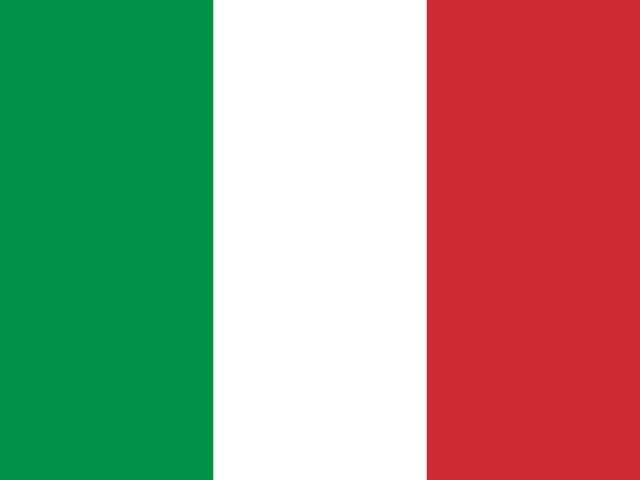
Rules for the Italian flag
Published Written by Flagpole Guides
This page is an English translation of the Italian original. Where the two versions differ, the Italian text is the original.
The rules on using the Italian flag are set out in Law no. 22 of 5 February 1998 and its implementing regulation, D.P.R. no. 121 of 7 April 2000. The regulation addresses State administrations and public bodies, but under the law its provisions are also the general rules governing the subject. This guide summarises what the rules say about who flies the flag, flying hours, the flag's dignity and its protection under criminal law. The rules on flying several flags together are in the guide to flag protocol.
Who flies the flag
Law no. 22/1998 provides that the Italian flag and the flag of the European Union are flown outside the headquarters of:
- constitutional bodies and bodies of constitutional importance, and the seat of the Government when the Council of Ministers is in session;
- ministries;
- regional, provincial and municipal councils, when they meet;
- judicial offices;
- State schools and universities.
Flags are also flown outside polling stations during elections and outside Italian diplomatic and consular missions abroad. D.P.R. no. 121/2000 extends the rule to prefectures, managerial-level local offices of the State, independent authorities and national public bodies.
Private individuals
According to the State Ceremonial Office, there is no authorisation scheme for private individuals, who are free to decide whether to fly the Tricolore. In its answers to frequently asked questions, the Office states that a private individual can fly the national flag from their balcony, and a hotel or a company can fly it on its own, provided they respect its dignity. The general rules on dignity in article 9 of the regulation still apply. The legislation sets no specific penalties for failing to observe these rules, but article 292 of the Penal Code remains in force.
Flying hours
| Situation | Rule of D.P.R. no. 121/2000 |
|---|---|
| Public offices | Flags flown during the offices' working hours (article 4, paragraph 2) |
| State schools and universities | On days of lessons and examinations (article 4, paragraph 3) |
| Polling stations | From the opening of the polling station to the end of the count (article 4, paragraph 4) |
| General rule | As a rule not before sunrise, lowered at sunset (article 4, paragraph 6) |
| At night | Permitted only if the place is adequately lit (article 4, paragraph 6) |
According to the State Ceremonial Office, it is nonetheless desirable, as happens on many public buildings, for flags to stay up at night where the places are lit. Several regional laws set hours from 8 a.m. to sunset for the regional flag. Lighting is covered in the guide to flag lighting.
Raising and lowering
Under article 2 of the regulation, when the national flag is flown with the European flag it is raised first and lowered last. The regulation does not describe how the flag is raised; it is common for flag raising and lowering to be carried out with the same dignity the rules require for the flag itself. Half-mast is covered in the guide to half-mast.
Dignity of the flag
Article 9 of D.P.R. no. 121/2000 provides that:
- flags are flown in good condition and properly unfurled;
- no written figures or letters of any kind are applied to the flags or to the staff;
- only one flag is flown on each staff.
Each body designates the people responsible for flying the flags correctly, the so-called flag men. In a circular of 26 January 2011, the Presidency of the Council of Ministers asked administrations to check that flags were not worn, faded, torn, dirty or badly wrapped around the staff, and to replace them immediately. Caring for the flag is covered in the guide to flagpole maintenance.
Colours and proportions
The flag's height is two thirds of its length, with the green at the hoist, the side next to the staff. The State Ceremonial Office gives the textile Pantone codes green 17-6153, white 11-0601 and red 18-1662 for the three colours. More information is in the guide to flag sizes.
What the criminal law says
Article 292 of the Penal Code, as amended by Law no. 85 of 24 February 2006, provides for two cases:
- Insult: anyone who insults the national flag or another emblem of the State with offensive expressions is punished with a fine of 1,000 to 5,000 euros, raised to 5,000 to 10,000 euros if the act is committed during a public anniversary or an official ceremony.
- Damage: anyone who publicly and intentionally destroys, disperses, damages, renders unusable or defaces the national flag or another emblem of the State is punished with imprisonment of up to two years.
For the purposes of the criminal law, the national flag means the official flag of the State and any other flag bearing the national colours. The flags of other States have their own protection in article 299, described in the guide to foreign flags in Italy.
Frequently asked questions
Can the Tricolore be flown from a private balcony?
Yes. In its answers to frequently asked questions, the State Ceremonial Office states that a private individual can fly the national flag from their own balcony, provided they respect its dignity.
Can anything be written on the Tricolore?
Under article 9 of D.P.R. no. 121/2000, no written figures or letters of any kind are applied to the flags or to the staff that carries them. According to the State Ceremonial Office, this rule on the flag's dignity applies to anyone who flies the national flag.
Can the flag stay up at night?
D.P.R. no. 121/2000 provides that flags are as a rule lowered at sunset and that flying them at night is permitted only if the place is adequately lit.
What does the Penal Code provide?
Article 292 punishes anyone who insults the national flag with offensive expressions with a fine of 1,000 to 5,000 euros, higher during a public anniversary or an official ceremony. Anyone who publicly and intentionally destroys, disperses, damages, renders unusable or defaces the flag is punished with imprisonment of up to two years.
Sources
This guide is based on the following sources, most of them in Italian:
- Legge 5 febbraio 1998, n. 22 – Normattiva
- D.P.R. 7 aprile 2000, n. 121 – Normattiva
- Risposte a domande frequenti: bandiere – Presidenza del Consiglio dei Ministri, Ufficio del Cerimoniale di Stato
- La Bandiera: cenni storici e norme per l'esposizione – Presidenza del Consiglio dei Ministri, Ufficio del Cerimoniale di Stato
- Codice penale (articolo 292) – Normattiva
Related guides
- Flag daysWhen the Tricolore is flown on public buildings in Italy: the days of D.P.R. 121/2000, the civil solemnities and the public holidays of 2026 and 2027.
- Half-mastHalf-mast in Italy: what D.P.R. 121/2000 provides, the two strips of black crêpe, who orders half-mast and how flags are draped in mourning indoors.
- Flag protocolThe order of flags in Italy: the Tricolore's place of honour, the European flag, regional and municipal banners, foreign guests and the order at ceremonies.
- Flag lightingFlying the flag at night in Italy: what D.P.R. 121/2000 provides, regional laws, floodlights and lights at the top of the pole, and light pollution.
- Flag typesThe flags used in Italy: the Tricolore, the European flag, regional flags, gonfalons, naval ensigns, the presidential standard and indoor flags.