History of the flagpole and the flag in Italy
Published Written by Flagpole Guides
This page is an English translation of the Italian original. Where the two versions differ, the Italian text is the original.
The history of the flagpole in Italy is bound up with that of the Tricolore: from the first green, white and red flag of 1797 to the flags of the ships, down to the staffs on the façades of today's town halls. This guide traces the main stages, based on the publications of the State Ceremonial Office and the Italian Navy.
From the sea to the land
For centuries the pennone was above all part of a ship: in Italian naval usage the word still means the yard of a mast, from which the sail is set. At sea the flag identified the nationality and allowed signals to be exchanged. On land, flags and standards were carried in battle, in processions and at civic ceremonies, like the gonfalons of the medieval communes, from which the gonfalons of today's local authorities descend.
1797: the birth of the Tricolore
According to the Italian Navy, between the end of 1796 and the beginning of 1797 the congress of the representatives of Bologna, Ferrara, Modena and Reggio met in Reggio Emilia. On 7 January 1797, in the room of the town hall that now bears the name Sala del Tricolore, the Parliament of the Cispadane Republic adopted the green, white and red flag, with horizontal bands. The Cisalpine Republic adopted the tricolour with vertical bands shortly afterwards.
In 1802 the flag of the Italian Republic was changed into a red cloth with a white lozenge and a green rectangle, and it kept this form under the Napoleonic Kingdom of Italy from 1805. After the Restoration the Tricolore became the symbol of a denied nationhood and reappeared in the uprisings of 1821, 1831 and the years that followed.
1848–1861: from the Kingdom of Sardinia to the Kingdom of Italy
On 23 March 1848 Charles Albert of Savoy, going to war against Austria, chose for his troops the Tricolore with the Savoy shield in the centre. On 11 April of the same year a decree extended the flag to warships and the merchant navy, with a crown above the shield for warships. In 1861 the Tricolore with the Savoy shield became the flag of the Kingdom of Italy.
1946–1948: the Republic
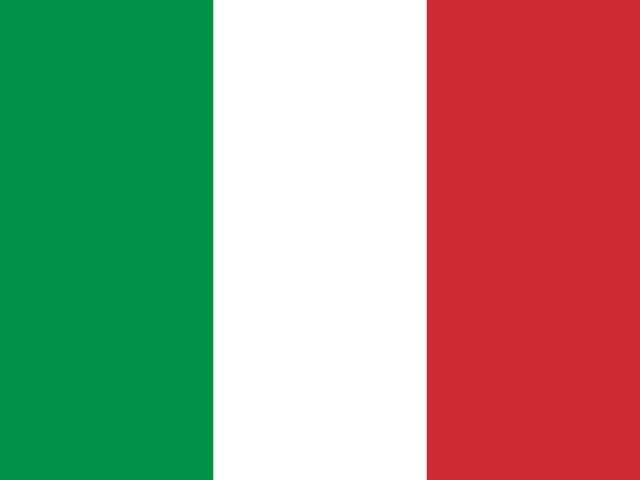
After the referendum of 2 June 1946, legislative decree no. 1 of 19 June 1946 provided that the national flag consisted of a rectangular cloth divided vertically into three equal sections, green, white and red, two thirds as high as it is long, without the shield. Article 12 of the Constitution, in force from 1948, confirmed the Tricolore as the flag of the Republic. On 9 November 1947 the new naval ensign was established, with the arms of the maritime republics.
From the laws of 1923 to the regulation of 2000
For much of the twentieth century the use of the flag was governed by royal decree-law no. 2072 of 24 September 1923, and the display of foreign flags by Law no. 1085 of 24 June 1929. Law no. 22/1998 and D.P.R. no. 121/2000 replaced them, introducing the joint display of the Tricolore and the European flag on public buildings. Since then the façades of town halls, prefectures and schools almost always show two or three staffs side by side.
The flagpole today
Today the flags on public buildings are flown mostly on balcony staffs and on ground-mounted poles of aluminium or steel. On the Quirinale, according to the State Ceremonial Office, the Tricolore and the European flag are flown from the central balcony and from the tower, alongside the standard of the President of the Republic. The types of flagpoles are described in the guide to types of flagpoles, and the meaning of the colours in the guide to flag symbolism.
Frequently asked questions
When was the Tricolore born?
The Tricolore was adopted on 7 January 1797 in Reggio Emilia by the Parliament of the Cispadane Republic, as the flag of a sovereign State. It had horizontal bands, with the republic's emblem in the centre. Shortly afterwards the Cisalpine Republic adopted the tricolour with vertical bands.
When was the Savoy shield removed from the flag?
After the institutional referendum of 2 June 1946. Legislative decree no. 1 of 19 June 1946 provided that the national flag consisted of a cloth divided vertically into three equal sections, green, white and red, and the 1948 Constitution confirmed it in article 12.
Where can the room in which the Tricolore was born be seen?
In Reggio Emilia, in the town hall. The room in which the Tricolore was born on 7 January 1797 is today the Sala del Tricolore, and next to it the Tricolore Museum was set up between 2004 and 2006.
Sources
This guide is based on the following sources, most of them in Italian:
- La Bandiera: cenni storici e norme per l'esposizione – Presidenza del Consiglio dei Ministri, Ufficio del Cerimoniale di Stato
- Bandiera Nazionale e Bandiere Navali – Marina Militare
- Museo del Tricolore – Musei Civici di Reggio Emilia
- Decreto legislativo presidenziale 19 giugno 1946, n. 1 (articolo 8) – Normattiva
- Legge 5 febbraio 1998, n. 22 (articolo 4) – Normattiva
Related guides
- Flag symbolismWhat the Tricolore stands for: its origin in the cockade, the meaning of the colours in the songs of the Risorgimento and its place in the Constitution.
- Flag typesThe flags used in Italy: the Tricolore, the European flag, regional flags, gonfalons, naval ensigns, the presidential standard and indoor flags.
- Types of flagpolesTypes of flagpoles and staffs in Italy: ground-mounted poles, balcony staffs, roof poles, poles with a yard, telescopic poles and indoor staffs.
- Flags on holidaysThe Tricolore on Italy's national days: 25 April, 1 May, 2 June, 4 October and 4 November, the flag days and the holidays without a flag rule.