Types of flags in Italy
Published Written by Flagpole Guides
This page is an English translation of the Italian original. Where the two versions differ, the Italian text is the original.
In Italy the Tricolore is the most common flag, but on public buildings it almost always appears next to the flag of the European Union and often next to the banner of the region or municipality. There are also flags for particular uses: naval ensigns, the standard of the President of the Republic, gonfalons and indoor flags. This guide describes the main types.
The Tricolore
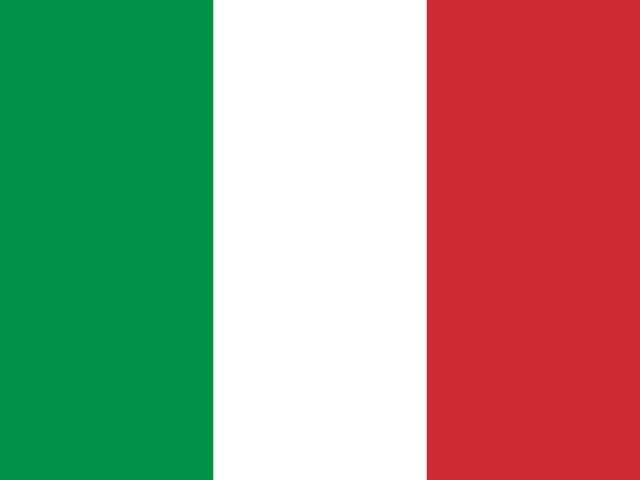
Under article 12 of the Constitution, the flag of the Republic is the Italian tricolour: green, white and red, in three vertical bands of equal size. The green is at the hoist, and the flag's height is two thirds of its length. The Tricolore carries no arms: the Savoy shield, present since 1848, disappeared with the Republic in 1946. The history and meaning of the colours are in the guide to flag symbolism.
The European flag
The flag of the European Union, blue with twelve gold stars in a circle, is flown together with the Tricolore on all the public buildings listed in Law no. 22/1998. Under D.P.R. no. 121/2000 the two flags are of equal size and material, and the European flag takes second position. The order is described in the guide to flag protocol.
Regional flags
Many regions have adopted their own flag by regional law. The collection of regulations published by the State Ceremonial Office includes, among others:
| Region | Flag under regional law |
|---|---|
| Sardinia | White field with a red cross and in each quarter a Moor's head with a band across the forehead (regional law no. 10/1999) |
| Sicily | Orange-red and yellow cloth with the triskelion, the gorgoneion and ears of wheat in the centre (regional law no. 1/2000) |
| Piedmont | White cross on a red field with a blue label, blue border and gold fringe, 150 × 100 cm (regional law no. 15/2004) |
| Friuli Venezia Giulia | Regional arms on a blue field, height two thirds of the length (regional law no. 27/2001) |
| Apulia, Basilicata, Abruzzo | Regional arms in the centre, height two thirds of the length, with a tricolour ribbon tied to the staff |
In several regions the law provides for a ribbon in the national colours tied below the finial of the staff. The regional flag is flown together with the Tricolore and the European flag, usually on the Tricolore's left. In Sicily the regional law provides that private individuals are free to fly the regional flag, provided they do so with dignity.
Gonfalons and local authority banners
Regions, provinces and municipalities have a gonfalone, a banner hung from a crossbar, carried at ceremonies and sometimes displayed in the authority's offices. Under article 12 of D.P.R. no. 121/2000, whenever the authority's banner or gonfalone is to be displayed, the national and European flags are displayed too. In the order at ceremonies, the gonfalons of regions, provinces and municipalities come after the national flags and the decorated gonfalons.
Naval ensigns
According to the Italian Navy, the naval ensign established on 9 November 1947 is the Tricolore with the arms of the maritime republics, Venice, Pisa, Genoa and Amalfi, in the centre of the white band. For the Navy the arms are topped by a turreted and rostrate crown and the lion of Saint Mark holds a sword; for the merchant navy there is no crown and the lion holds a book. Vessels in non-commercial government service use the Tricolore with the emblem of the Republic.
Standard and distinguishing flags
The standard of the President of the Republic is square, red with a blue border, with a white lozenge in the centre and, in a green square, the gold emblem of the Republic. According to the State Ceremonial Office, it is flown when the President is present, for example on public buildings and on the Quirinale Palace. Other office holders, such as the President of the Council of Ministers, have a distinguishing flag.
Indoor and parade flags
Inside public offices the Tricolore and the European flag are displayed on floor-standing staffs, often with a finial and fringes. According to an Italian flag maker, military flags come in eight standard sizes, from the first, 5.50 × 8.25 metres, to the eighth, 0.30 × 0.45 metres. Sizes are described in the guide to flag sizes, and the factors that affect the price in the guide to buying a flag.
Frequently asked questions
Do all Italian regions have a flag?
Many regions have adopted a flag by regional law, often with the regional coat of arms in the centre and a height of two thirds of the length. Sardinia uses the traditional flag of the four Moors, Sicily the triskelion on orange-red and yellow.
What is a gonfalon?
A gonfalon (gonfalone) is a banner hung from a horizontal crossbar carried upright, used by regions, provinces and municipalities at ceremonies. According to the State Ceremonial Office, the Tricolore and the European flag are flown together with the gonfalon whenever it is displayed, respecting the priority dignity of the national flag.
What is the difference between the national flag and the naval ensign?
According to the Italian Navy, the naval ensign established in 1947 is the Tricolore with the coat of arms of the maritime republics of Venice, Pisa, Genoa and Amalfi in the centre of the white band. For the Navy the arms are topped by a turreted and rostrate crown, for the merchant navy they are not.
Can the Tricolore be flown with a coat of arms?
The flag of the Republic under article 12 of the Constitution is the tricolour without arms. The Savoy shield was removed after the 1946 referendum. Flags with emblems exist for specific uses, such as ships, and D.P.R. no. 121/2000 rules out figures and writing on the flags flown by public bodies.
Sources
This guide is based on the following sources, most of them in Italian:
- Costituzione della Repubblica Italiana (articolo 12) – Normattiva
- La Bandiera: cenni storici e norme per l'esposizione (con la normativa regionale) – Presidenza del Consiglio dei Ministri, Ufficio del Cerimoniale di Stato
- Bandiera Nazionale e Bandiere Navali – Marina Militare
- D.P.R. 7 aprile 2000, n. 121 (articoli 9 e 12) – Normattiva
- Le dimensioni delle bandiere – Bandiere.it
Related guides
- Flag symbolismWhat the Tricolore stands for: its origin in the cockade, the meaning of the colours in the songs of the Risorgimento and its place in the Constitution.
- Flag sizesSizes of the Tricolore: 2:3 proportions, Pantone colours, the ordinary sizes of the State Ceremonial Office, standard sizes and the flag-to-pole ratio.
- Flag protocolThe order of flags in Italy: the Tricolore's place of honour, the European flag, regional and municipal banners, foreign guests and the order at ceremonies.
- Flag rulesThe rules on using the Tricolore in Italy: who flies it, flying hours, dignity of the flag, one flag per staff, private use and protection under criminal law.
- Buying a flagWhat affects the price of a flag in Italy: size, fabric, make-up, finishing, customisation, the official colours of the Tricolore and consumer rights.