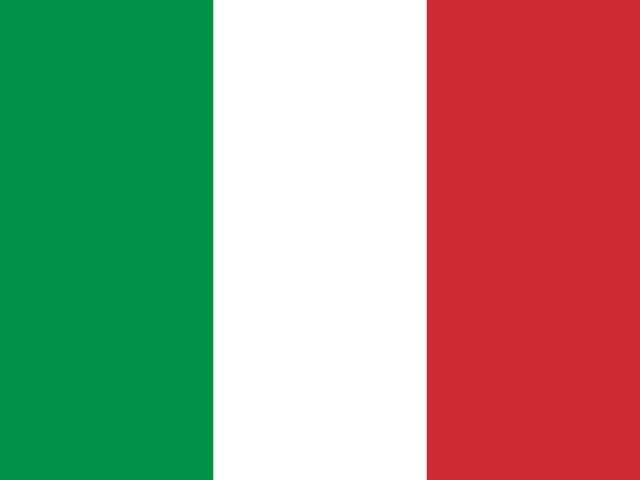
The Tricolore on national days and public holidays
Published Written by Flagpole Guides
This page is an English translation of the Italian original. Where the two versions differ, the Italian text is the original.
On national days the Tricolore appears on town halls, schools and public offices, but also on many private balconies. Not every public holiday is a flag day, however: D.P.R. no. 121/2000 lists the days on which the flag is flown on all public buildings, and some of them are holidays while others are working days. This guide explains the meaning of the main occasions. The full calendar for 2026 and 2027 is in the guide to flag days.
National holidays with flags
| Date | Occasion | Meaning |
|---|---|---|
| 25 April | Liberation Day | Anniversary of the liberation in 1945 |
| 1 May | Labour Day | International workers' day |
| 2 June | Republic Day | The institutional referendum of 2 June 1946, which chose the Republic |
| 4 October | Saint Francis of Assisi | Patron saint of Italy; a national holiday again from 2026 |
2 June is the national day par excellence. Law no. 260/1949 declares it the national holiday; moved to the first Sunday of June by Law no. 54/1977, it was restored to 2 June by Law no. 336/2000. In Rome the day includes the laying of a wreath at the Altare della Patria and the parade along the Via dei Fori Imperiali.
4 October was a civil solemnity dedicated to Italy's patron saints, Saint Francis of Assisi and Saint Catherine of Siena. Law no. 151 of 8 October 2025 made it a public holiday again as the national feast of Saint Francis of Assisi, from 2026, the year of the eighth centenary of his death.
Flag days that are not holidays
- 7 January, Tricolour Day: the anniversary of the birth of the first green, white and red flag in Reggio Emilia in 1797.
- 11 February: the anniversary of the Lateran Pacts of 1929 between the Italian State and the Holy See.
- 17 March: the proclamation of the unification of Italy in Turin in 1861, today the Day of National Unity, the Constitution, the Anthem and the Flag.
- 9 May, Europe Day: the anniversary of the Schuman Declaration of 1950.
- 28 September: the anniversary of the popular uprising in Naples in 1943, the "Four Days".
- 24 October, United Nations Day: the UN flag is flown together with the Tricolore and the European flag.
- 4 November: National Unity Day, the anniversary of the end of the First World War for Italy; the day is officially celebrated on the first Sunday of November.
Holidays without a flag rule
New Year's Day, Epiphany, Easter Monday, the Assumption (Ferragosto), All Saints' Day, the Immaculate Conception, Christmas Day and Saint Stephen's Day are public holidays under Law no. 260/1949 and D.P.R. no. 792/1985, but are not among the regulation's flag days. The same applies to the feast of the patron saint, which is a holiday in the individual municipality. On buildings that fly flags every day, such as prefectures and ministries, the Tricolore remains up anyway.
Flags on balconies
On national days and during major sporting events, many people hang the Tricolore from windows and balconies. According to a publication of the State Ceremonial Office, in the days around 17 March 2011, the 150th anniversary of unification, Italians hung about 13 million tricolours from their windows, according to a survey by the Istituto Piepoli. For private individuals, the rules on dignity described in the guide to the flag rules apply.
The flag at night on feast days
On feast days the flag sometimes stays up after sunset. D.P.R. no. 121/2000 permits flying at night only if the place is adequately lit. The subject is covered in the guide to flag lighting, and the meaning of the colours in the guide to flag symbolism.
Frequently asked questions
What is Italy's national day?
Under article 1 of Law no. 260 of 27 May 1949, 2 June, the date on which the Republic was founded, is declared the national holiday. Moved to the first Sunday of June in 1977, it was restored to 2 June by Law no. 336 of 20 November 2000.
Is the flag flown at Christmas?
25 December is a public holiday but is not one of the flag days in D.P.R. no. 121/2000. On public buildings that fly the flag every day, the Tricolore is visible on public holidays too.
Why is 7 January Tricolour Day?
On 7 January 1797 the Parliament of the Cispadane Republic, meeting in Reggio Emilia, adopted the green, white and red flag. Law no. 671 of 31 December 1996 declared 7 January the national flag day, which is not a public holiday.
What is celebrated on 4 November?
Law no. 260/1949 names 4 November as the day of national unity, the anniversary of the end of the First World War for Italy in 1918. According to the State Ceremonial Office, National Unity Day is celebrated on the first Sunday of November, while D.P.R. no. 121/2000 provides for flags on public buildings on 4 November.
Sources
This guide is based on the following sources, most of them in Italian:
- Legge 27 maggio 1949, n. 260 (ricorrenze festive) – Normattiva
- Legge 20 novembre 2000, n. 336 (ripristino della festività del 2 giugno) – Normattiva
- Legge 5 marzo 1977, n. 54 (giorni festivi) – Normattiva
- D.P.R. 28 dicembre 1985, n. 792 (festività religiose) – Normattiva
- Legge 8 ottobre 2025, n. 151 (festa nazionale di San Francesco d'Assisi) – Normattiva
- Legge 31 dicembre 1996, n. 671 – Normattiva
- D.P.R. 7 aprile 2000, n. 121 (articolo 1) – Normattiva
- Festività e giornate nazionali – Presidenza del Consiglio dei Ministri, Ufficio del Cerimoniale di Stato
Related guides
- Flag daysWhen the Tricolore is flown on public buildings in Italy: the days of D.P.R. 121/2000, the civil solemnities and the public holidays of 2026 and 2027.
- Flag rulesThe rules on using the Tricolore in Italy: who flies it, flying hours, dignity of the flag, one flag per staff, private use and protection under criminal law.
- Flag symbolismWhat the Tricolore stands for: its origin in the cockade, the meaning of the colours in the songs of the Risorgimento and its place in the Constitution.
- Flag lightingFlying the flag at night in Italy: what D.P.R. 121/2000 provides, regional laws, floodlights and lights at the top of the pole, and light pollution.