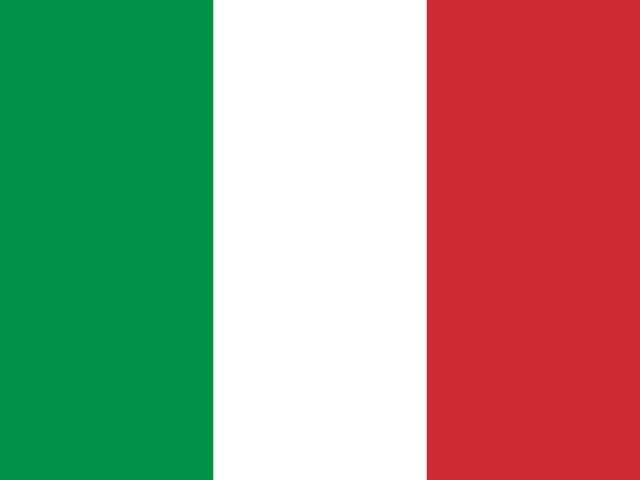
Flying the flag at half-mast in Italy
Published Written by Flagpole Guides
This page is an English translation of the Italian original. Where the two versions differ, the Italian text is the original.
A flag at half-mast is the most visible sign of mourning on Italian public buildings. D.P.R. no. 121 of 7 April 2000 devotes only a few lines to mourning, supplemented by the guidance of the State Ceremonial Office. This guide summarises what they provide, who decides on half-mast and what differs between the outside and the inside of buildings. Decisions on national mourning are described in the guide to national mourning.
What the regulation provides
| Situation | Rule of D.P.R. no. 121/2000 |
|---|---|
| Flags flown outdoors, as a sign of mourning | Kept at half-mast; two strips of black crêpe may be attached to the top of the hoist (article 3) |
| Public funeral ceremonies | Two strips of black crêpe are attached to the flags (article 5) |
| Flags inside offices | Two strips of black crêpe may be attached (article 7) |
The hoist is the side of the flag fixed to the staff. In its answers to frequently asked questions, the State Ceremonial Office describes the strips as two strips of black velvet or silk tied "like a necktie".
Who orders half-mast
According to the State Ceremonial Office, public mourning is declared by bodies or institutions according to its importance:
- National mourning: decided by the Government, with the instructions on half-mast issued by the State Ceremonial Office to all central administrations and to the prefectures for their local offices.
- Local mourning: decided by the local authorities, and the instructions concern only the authorities' own banners. To drape the other flags as well, the authority asks the other institutions whether they wish to join the mourning.
For State funerals, the flags on public buildings are lowered to half-mast according to the instructions of the Presidency of the Council of Ministers, without prejudice to the rules for military flags. The Ministry of Foreign Affairs instructs the Italian missions abroad.
All flags at half-mast?
In its instructions for national mourning, the Presidency of the Council of Ministers usually specifies half-mast for the national and European flags on public buildings. When the flags are flown together, they are commonly all at the same height, since article 2 of the regulation provides that the Tricolore and the European flag are flown on staffs at the same height. A local authority's banner follows the authority's own decisions.
How the flag is brought to half-mast
The regulation does not describe the manoeuvre and does not set the exact height of half-mast. In many countries it is common practice to raise the flag to the top of the staff first and then lower it to half-mast, and to raise it to the top again before lowering it, so that it is clear the flag is not simply hoisted. On a short pole, a very large flag can come close to the ground or to obstacles. The relationship between flag size and pole is covered in the guide to flagpole heights.
Flags on balcony staffs
Many Italian flags are flown on angled staffs fixed to the façade, where half-mast is not possible. In these cases the two strips of black crêpe provided for in the regulation are often used. Inside offices too, according to the State Ceremonial Office, flags in mourning are draped with two black strips tied like a necktie, because indoor staffs do not allow half-mast.
Half-mast and the flags of other countries
The Ministry of Foreign Affairs can ask foreign diplomatic and consular representatives accredited in Italy to fly their flags at half-mast. The rules on the order of flags are in the guide to flag protocol, and the halyard manoeuvre in the guide to flagpole mechanics.
Frequently asked questions
When is the flag flown at half-mast?
Under article 3 of D.P.R. no. 121/2000, flags flown outdoors are kept at half-mast as a sign of mourning. For national mourning, the instructions on half-mast are issued by the State Ceremonial Office of the Presidency of the Council of Ministers to all central administrations and to the prefectures.
What are the strips of black crêpe?
D.P.R. no. 121/2000 provides that two strips of black crêpe may be attached to the top of the hoist, the side of the flag fixed to the staff. At public funeral ceremonies the two strips are attached to the flags, and inside offices they may be attached to flags as a sign of mourning.
Can a municipality lower all the flags on the town hall to half-mast?
According to the State Ceremonial Office, local mourning is decided by the local authorities, and their instructions concern only the authorities' own banners. To drape the other flags as well, the authority asks the other institutions whether they wish to join the mourning.
Can private individuals fly the flag at half-mast?
The rules on half-mast address public buildings. No rule prevents a private individual from flying their own flag at half-mast as a sign of mourning; the general rules on the flag's dignity apply to private individuals.
Sources
This guide is based on the following sources, most of them in Italian:
- D.P.R. 7 aprile 2000, n. 121 (articoli 3, 5 e 7) – Normattiva
- La Bandiera: cenni storici e norme per l'esposizione – Presidenza del Consiglio dei Ministri, Ufficio del Cerimoniale di Stato
- Risposte a domande frequenti: bandiere – Presidenza del Consiglio dei Ministri, Ufficio del Cerimoniale di Stato
- Esequie di Stato e lutti nazionali – Presidenza del Consiglio dei Ministri, Ufficio del Cerimoniale di Stato
Related guides
- National mourningNational mourning in Italy: who declares it, State funerals, half-mast on public buildings and some recent examples from 2023 to 2025.
- Flag rulesThe rules on using the Tricolore in Italy: who flies it, flying hours, dignity of the flag, one flag per staff, private use and protection under criminal law.
- Flag protocolThe order of flags in Italy: the Tricolore's place of honour, the European flag, regional and municipal banners, foreign guests and the order at ceremonies.
- Flagpole heightsHow tall a flagpole is in Italy: common heights, the staffs named by the State Ceremonial Office, the ratio to the flag, wind and building rules.