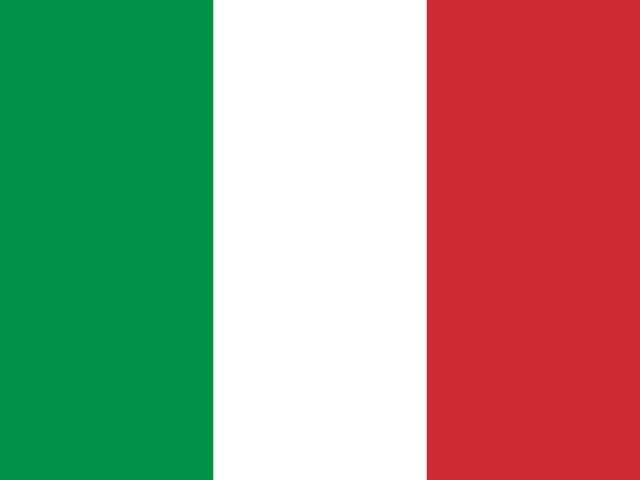
Flag protocol in Italy
Published Written by Flagpole Guides
This page is an English translation of the Italian original. Where the two versions differ, the Italian text is the original.
When several flags are flown together, their order follows precise rules. In Italy the basic rules are in article 2 of D.P.R. no. 121/2000, and the State Ceremonial Office illustrates them with examples for the buildings of the State, the regions and the municipalities. This guide summarises the place of honour, the position of the European flag and local banners, the order with foreign guests and the order at ceremonies.
The place of honour
| Rule | Source |
|---|---|
| National and European flags of equal size and material, side by side on staffs at the same height | D.P.R. no. 121/2000, article 2, paragraph 1 |
| The national flag is raised first and lowered last | article 2, paragraph 2 |
| Place of honour on the right, or in the centre with an odd number of flags | article 2, paragraph 2 |
| With three fixed poles and two flags, the centre pole stays empty | article 2, paragraph 2 |
| The European flag takes second position, also when several flags are flown | article 2, paragraph 3 |
| One flag per staff | article 9, paragraph 2 |
The right is that of the person flying the flag. In its answers to frequently asked questions, the Ceremonial Office explains that this is the right of someone looking out from the balcony or window, which corresponds to the left for someone watching from the street.
Regions, provinces and municipalities
Under article 12 of the regulation, the national and European flags are flown together with the authority's banner or gonfalone whenever that is displayed, respecting the priority dignity of the national flag. In the State Ceremonial Office's examples:
- three poles: the Tricolore in the centre, the flag of the European Union on its right and the banner of the region, province or municipality on its left;
- four poles, on the buildings of provinces or municipalities that also fly the regional flag: the arrangement is shown in a diagram in the Ceremonial Office's publication "La Bandiera", always with the Tricolore in the position of greatest dignity.
The regional laws of Liguria, Friuli Venezia Giulia, Sicily and Apulia describe the same three-pole arrangement: Tricolore in the centre, European flag on its right and regional flag on its left. In Piedmont and Friuli Venezia Giulia, the flag of the community concerned may also be flown on the public buildings of municipalities where linguistic minorities live.
Foreign guests
The State Ceremonial Office illustrates two cases for visits by a head of state:
- guest from a country outside the European Union: the Tricolore stays in the centre, the guest's flag goes on its right and the European flag on its left;
- guest from a member state of the European Union: the European flag goes in the centre, the guest's flag on its right and the Tricolore on its left.
On a local authority building with four poles, during a visit by a foreign guest of equal or higher rank than the host, the guest's flag goes between the European and Italian flags, and the banner of the region, province or municipality moves to fourth position. The rules for the flags of other countries are described in the guide to foreign flags in Italy.
The order at ceremonies
Under article 5 of the regulation, when the national flag is carried at public ceremonies it takes first place. In its answers to frequently asked questions, the Ceremonial Office gives this order:
- war flags;
- decorated national flags;
- undecorated national flags;
- decorated gonfalons;
- decorated medal banners and labari;
- gonfalons of regions, provinces and municipalities;
- insignia of associations.
When entering a hall the order is reversed, while on leaving it is the normal order.
Inside offices
In the offices listed in article 6 of the regulation, such as those of ministers and directors-general, the national and European flags are displayed on floor-standing staffs behind the desk, with the national flag in the place of honour on the right or in the centre. In a hall, according to the Ceremonial Office, the flag is placed to the right of the presiding table or in the centre of the most important wall.
Businesses and private individuals
In its answers to frequently asked questions, the Ceremonial Office states that a company that also flies its own flag places it at a point separate from the national flag. Only official public flags may be flown on institutional public buildings. Solutions for company premises are described in the guide to flagpoles for businesses.
Frequently asked questions
What is the place of honour of the Italian flag?
Under article 2 of D.P.R. no. 121/2000, the national flag takes the place of honour on the right or, when an odd number of flags is flown, in the centre. The State Ceremonial Office explains that the right is that of a person looking out from the balcony or window, which is the left for someone watching from the street.
What happens with three poles and two flags?
D.P.R. no. 121/2000 provides that where three fixed poles are available and two flags are to be flown, the centre pole is left empty.
Where does the regional or municipal flag go?
According to the State Ceremonial Office, on the buildings of regions, provinces and municipalities the Tricolore is in the centre, the flag of the European Union on its right and the authority's banner on its left. Several regional laws set out the same arrangement.
Are the flags the same size?
Article 2 of D.P.R. no. 121/2000 provides that the national and European flags are of equal size and material and are flown side by side on staffs or poles at the same height.
Sources
This guide is based on the following sources, most of them in Italian:
- D.P.R. 7 aprile 2000, n. 121 (articoli 2, 5, 8 e 12) – Normattiva
- La Bandiera: cenni storici e norme per l'esposizione – Presidenza del Consiglio dei Ministri, Ufficio del Cerimoniale di Stato
- Risposte a domande frequenti: bandiere – Presidenza del Consiglio dei Ministri, Ufficio del Cerimoniale di Stato
- La Bandiera: dove si espongono le bandiere – Presidenza del Consiglio dei Ministri, Ufficio del Cerimoniale di Stato
Related guides
- Foreign flagsFlying the flags of other countries in Italy: private individuals, hotels and companies, public buildings, embassies, order with the Tricolore and article 299.
- Flag rulesThe rules on using the Tricolore in Italy: who flies it, flying hours, dignity of the flag, one flag per staff, private use and protection under criminal law.
- Flag typesThe flags used in Italy: the Tricolore, the European flag, regional flags, gonfalons, naval ensigns, the presidential standard and indoor flags.
- Flagpoles for businessesFlagpoles and flags for companies and hotels in Italy: the Tricolore, foreign and company flags, advertising flags, the single levy and the Highway Code.
- Half-mastHalf-mast in Italy: what D.P.R. 121/2000 provides, the two strips of black crêpe, who orders half-mast and how flags are draped in mourning indoors.