Flagpoles and flag rules in the Netherlands
Published Written by Flagpole Guides
This page is an English translation of the Dutch original. Where the two versions differ, the Dutch text is the original.
In the Netherlands anyone may fly the flag, on any day of the year. Even so, flag flying is not a free-for-all: there is a flag instruction for government buildings that many municipalities, businesses and private individuals follow as a guideline, and there are established customs for raising the flag, for flying it at half-mast and for the orange pennant. This page brings together information on flags and flagpoles in the Netherlands, based on the Dutch government, the Royal House, Dutch legislation and the bodies concerned.
The essentials in brief
- Flag days: The general flag instruction lists ten fixed days, from Princess Beatrix’s birthday on 31 January to Kingdom Day on 15 December. All dates are in the guide to flag days.
- Times: The custom is not to leave the flag out between sunset and sunrise unless it is lit. More is in the guide to flag rules.
- Half-mast: The flag is first raised to the top and then lowered until the middle of the flag is at half the normal height. On 4 May the flag flies at half-mast. This is described in the guide to half-mast.
- Orange pennant: Only on King’s Day and the birthdays of Queen Máxima, Princess Beatrix and the Princess of Orange. More about pennants is in the guide to flag types.
- Size: There are no rules, only the proportions 2:3. The flag size calculator shows common sizes for each pole length.
- Price: What affects the price of a flagpole and a flag is described in the guides to buying a flagpole and buying a flag.
- Permit: Under the Buildings (Living Environment) Decree, one flagpole of no more than 6 metres in the yard of a building needs no permit. More is in the guide to flagpole installation.
Rules and authorities
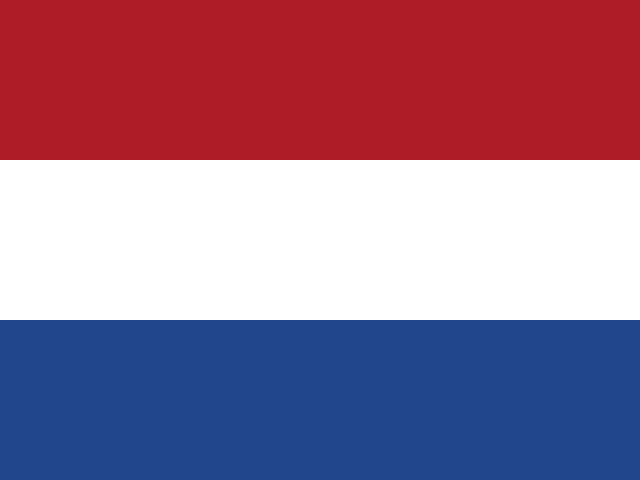
According to the Dutch government (Rijksoverheid), no law prohibits flag flying or prescribes how it is done. What is fixed is the flag’s appearance: a Royal Decree of 19 February 1937 set the colours of the flag of the Kingdom as red, white and blue. The Royal House describes them as bright vermilion, bright white and cobalt blue.
Government buildings follow the general flag instruction (algemene vlaginstructie), which is issued by the Prime Minister. According to the government, the current version dates from 2013. Provinces, municipalities and water authorities are asked to follow the instruction. For citizens, businesses and organisations it is a guideline, not an obligation. For special events, such as a birth or death in the Royal House or a disaster, the Prime Minister can issue a special flag instruction.
The practical customs are set out in the Handleiding voor het gebruik van de Nederlandse vlag (guidance on the use of the Dutch flag), which the Ministry of the Interior and Kingdom Relations published in the Government Gazette in 2009 together with the flag instruction. It covers, among other things, the flag’s proportions, flying at half-mast and the order of several flags.
For the flagpole, the rules for structures under the Environment and Planning Act (Omgevingswet) apply. The Buildings (Living Environment) Decree (Besluit bouwwerken leefomgeving, Bbl) sets out when a pole needs no permit, and the municipality’s environment plan (omgevingsplan) may contain further rules. According to the Land Registry (Kadaster), anyone digging for the foundation with a machine makes a KLIC notification beforehand.
The flagpole in the Netherlands
According to a Dutch flagpole supplier, poles of 6, 7 or 8 metres are common at many homes, and a pole often looks right when its top ends half a metre to a metre below the ridge of the house. Most poles are aluminium or polyester, and wooden poles are also available. Because a pole of no more than 6 metres can be permit-free, that height is widespread at homes. More is in the guides to types of flagpoles and flagpole heights.
On the façade, a flagstaff in a bracket is the most common way to fly a flag. The Handleiding asks for a staff long enough that the flag, even at half-mast, never touches the ground or obstructs traffic.
About the guides
The guides are grouped by subject. Each guide covers one defined topic, ends with frequently asked questions and lists its sources and the date of the last update. The dates of flag days that move from year to year, such as Veterans’ Day and Prinsjesdag, have been calculated for 2026 and 2027. Provinces and municipalities have their own flags; they are covered in the guide to flag types.
All guides
Flag flying and rules
When, how and why flags are flown in the Netherlands: from the fixed flag days and 4 May to mourning, celebrations and flags of other countries.
- Flag daysAll flag days in the Netherlands for 2026 and 2027 under the flag instruction, with extended or limited flying, the orange pennant and 4 May at half-mast.
- Flag rulesFlag rules in the Netherlands: who may fly the flag, flying from sunrise to sunset, raising and lowering, the place of honour and what official guidance says.
- Half-mastHalf-mast in the Netherlands: how the flag is flown at half-mast under the official guidance, 4 May, special flag instructions and half-mast after a death.
- Flags in mourningFlags in mourning in the Netherlands: half-mast after a death and at a funeral, special flag instructions for national mourning and practice at municipalities.
- Flags on holidaysFlying the flag on holidays in the Netherlands: King’s Day, Liberation Day, flags for a wedding, birthday or passed exam, and the Christian holidays.
- Flag protocolFlag protocol in the Netherlands: the position of honour, the order of Dutch, provincial, municipal and foreign flags, state visits and commemorations.
- Foreign flags in the NetherlandsFlags of other countries in the Netherlands: the Dutch flag’s position of honour, ordering by French country name, the European flag and the Kingdom’s flags.
The flag
Types of flags, sizes and proportions, the meaning of red, white and blue, what affects the price of a flag and a calculator for the flag size on a given pole.
- Flag typesTypes of flags in the Netherlands: the tricolour, the orange pennant, the Royal Standard, provincial and municipal flags, banners and façade flags.
- Flag sizesFlag sizes in the Netherlands: the 2:3 proportions, common sizes by pole length, one size up for the tricolour and sizes for façade staffs and banners.
- Flag size calculatorFlag size calculator for the Netherlands: the standard size, the size for the tricolour and the 2:3 rule of thumb, for a pole of 4 to 15 metres.
- Flag symbolismThe Dutch flag: red, white and blue under the Royal Decree of 1937, its orange origins in the Prince’s Flag, the orange pennant and the flag as a symbol.
- Buying a flagThe price of a flag in the Netherlands: how size, fabric, finish, printing and the orange pennant affect it, plus the cooling-off period and warranty.
The flagpole
Types of flagpole, materials, heights, accessories, lighting and what affects the price of a flagpole, and the history of the flag in the Netherlands.
- Types of flagpolesTypes of flagpoles in the Netherlands: free-standing poles, cylindrical or tapered, tilting poles, wall-mounted poles, façade flagstaffs and banner poles.
- Flagpole materialsFlagpole materials in the Netherlands: aluminium, polyester and wood compared on appearance, shape, maintenance and durability, according to suppliers.
- Flagpole heightsFlagpole heights in the Netherlands: common lengths at homes and businesses, the relation to the roof ridge, visible height and no permit up to 6 metres.
- Flagpole accessoriesFlagpole accessories in the Netherlands: finial, pulley, halyard, cleat, counterweight, ground fixings, wall brackets, façade brackets and the orange pennant.
- Flagpole mechanicsHow a flagpole works: raising and lowering with halyard and pulley, the cleat, an internal winch with counterweight, half-mast and tilting the pole.
- Flag lightingFlag lighting in the Netherlands: why a lit flag may stay out at night, what the official guidance and the Dutch government say and how a flag is lit.
- History of the flagpoleThe history of the Dutch flag and the flagpole: from the Prince’s Flag of 1572 and the Batavian Republic to the decree of 1937 and today’s flag instruction.
- Buying a flagpoleThe price of a flagpole in the Netherlands: how height, material, hoisting system, ground fixing, delivery and installation affect it, and what the law says.
Installation, safety and care
Permit-free building, foundations, the KLIC notification, safety, maintenance and transport, for homes, businesses and municipalities.
- Flagpole installationInstalling a flagpole in the Netherlands: no permit up to 6 metres under the Bbl, listed buildings, the KLIC notification, location and foundation.
- Flagpole safetyFlagpole safety in the Netherlands: wind and storms, cables and pipes, tilting and working at height, the duty of care in the Bbl and Civil Code liability.
- Flagpole maintenanceFlagpole maintenance in the Netherlands: checking the halyard, pulley and finial, maintaining wood, the foundation, and washing, drying and storing the flag.
- Flagpole repairFlagpole repair in the Netherlands: a broken or runaway halyard, a seized pulley, a slapping halyard, a leaning pole and what the warranty covers.
- Flagpole lifespanHow long a flagpole and a flag last in the Netherlands: aluminium, polyester and wood, wearing parts, the Dutch climate and the statutory warranty.
- Flagpole transportTransporting a flagpole in the Netherlands: how far a load may overhang a car or trailer, marker boards and delivery by suppliers to the islands.
- Flagpoles for businessesFlagpoles at businesses, municipalities and institutions in the Netherlands: several poles and permits, company flags, flag instructions and the order of flags.
Frequently asked questions
Are there rules for flying the flag in the Netherlands?
According to the Dutch government, the Netherlands has no statutory rules on the use of the flag. Anyone may fly the flag on any day of the year. Government buildings follow the general flag instruction, which citizens, businesses and organisations can follow as a guideline.
On which days is the flag flown in the Netherlands?
The flag instruction lists ten fixed days, including King’s Day on 27 April, National Remembrance Day on 4 May (at half-mast), Liberation Day on 5 May, Veterans’ Day and Kingdom Day on 15 December. If a date falls on a Sunday or a Christian holiday, another date applies.
When does the orange pennant fly above the flag?
Under the flag instruction, the flag flies with the orange pennant on King’s Day and on the birthdays of Queen Máxima, Princess Beatrix and the Princess of Orange. On all other occasions the flag flies without the pennant.
Does a flagpole in the Netherlands need a permit?
Under the Buildings (Living Environment) Decree, a flagpole in the yard of a building needs no permit if it is no higher than 6 metres and there is no more than one pole in that yard. Other rules apply at listed buildings, in protected townscapes and for taller poles.
What size of flag suits a flagpole?
There are no rules on this. A rule of thumb in the trade puts the flag’s height at about a quarter of the pole’s length. A 6 metre pole then often carries a flag of 150 × 225 centimetres.
Sources
This guide is based on the following sources, most of them in Dutch:
- Wanneer kan ik de Nederlandse vlag uithangen? – Rijksoverheid
- Vlaginstructie – Het Koninklijk Huis
- Nederlandse vlag – Het Koninklijk Huis
- Vlaginstructie en Handleiding voor het gebruik van de Nederlandse vlag (Staatscourant 2009, 116) – Ministerie van Binnenlandse Zaken en Koninkrijksrelaties
- Besluit bouwwerken leefomgeving – Overheid.nl (wetten.overheid.nl)
- Advies van de expert: zo kies je het juiste formaat vlag bij jouw vlaggenmast – DVC Dokkumer Vlaggen Centrale (vlaggenleverancier)