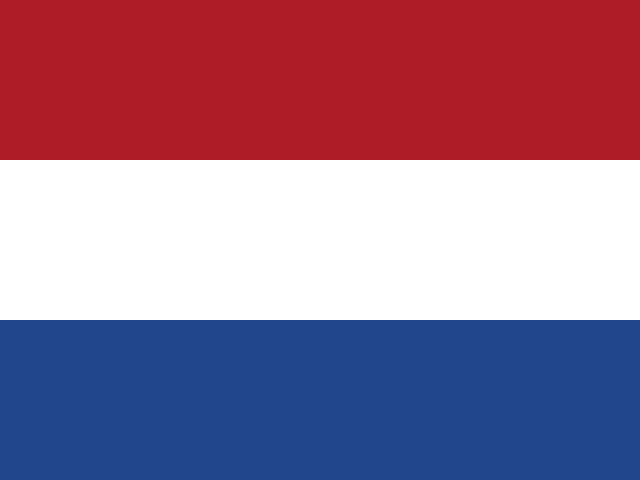
The Dutch tricolour: colours and meaning
Published Written by Flagpole Guides
This page is an English translation of the Dutch original. Where the two versions differ, the Dutch text is the original.
The Dutch flag is one of the oldest tricolours in the world. Red, white and blue may seem self-evident, but the colours were only officially laid down in 1937, and their origin lies in the orange of the Princes of Orange. This guide describes the colours, where they come from and what the flag symbolises according to the official sources.
Red, white and blue
By Royal Decree of 19 February 1937, Queen Wilhelmina determined that the colours of the flag of the Kingdom of the Netherlands are red, white and blue. The Royal House describes the three colours as bright vermilion (red), bright white and cobalt blue. The same description appears in the Handleiding voor het gebruik van de Nederlandse vlag. The stripes are horizontal, with red at the top and blue at the bottom.
There is no rule for the proportions. According to the Handleiding, the length generally relates to the width as 3:2. More is in the guide to flag sizes.
The orange origins
According to the Royal House, the first mention of the Dutch flag dates from 1572. The colours were then orange, white and blue, and the orange derived from the Principality of Orange, the principality from which the House of Orange-Nassau takes its name. This flag is known as the Prince’s Flag (Prinsenvlag).
Around the seventeenth century the orange was gradually replaced by red. According to the Royal House, the story goes that orange was less visible at sea. After 1813 both red-white-blue and orange-white-blue could be flown, because the colours had not been officially set. Red, white and blue was preferred and flew on government buildings. The Royal Decree of 1937 ended that uncertainty. The full history is in the guide to the history of the flag and flagpole.
Orange lives on
Orange has gone from the flag, but not from flag flying. According to the Royal House, the custom of raising the orange pennant on royal occasions dates from the period after 1813, when the House of Orange returned. The pennant flies on King’s Day and the birthdays of Queen Máxima, Princess Beatrix and the Princess of Orange. The Royal Standard also refers to Orange: its blue hunting horns come from the arms of the Principality of Orange. More is in the guide to flag types.
The flag as a symbol
According to the Handleiding, the Dutch flag is the symbol of the unity and independence of the Kingdom of the Netherlands. The customs around the flag follow from this:
- On Dutch territory the flag has the position of honour when it flies beside other flags.
- No decoration or addition belongs on the flag, and a flag is not used purely as decoration.
- A raised flag does not touch the ground and does not fly in the dark unless it is lit.
The Kingdom consists of four countries: the Netherlands, Aruba, Curaçao and Sint Maarten. Under the Royal Decree of 1937 the red, white and blue flag is the flag of the Kingdom; Aruba, Curaçao and Sint Maarten each also have a flag of their own.
Law and respect
The Netherlands has no flag law. According to the Dutch government, no law prohibits flag flying or prescribes how it is done. The customs in the Handleiding are therefore not punishable rules but a description of how the flag is treated with respect. The fixed days on which the flag flies are in the guide to flag days.
Frequently asked questions
What are the official colours of the Dutch flag?
A Royal Decree of 19 February 1937 set the colours of the flag of the Kingdom as red, white and blue. The Royal House and the Handleiding voor het gebruik van de Nederlandse vlag describe them as bright vermilion, bright white and cobalt blue.
Why was the flag once orange, white and blue?
According to the Royal House, when the flag was first mentioned in 1572 its colours were orange, white and blue, derived from the Principality of Orange. Around the seventeenth century the orange was gradually replaced by red; the story goes that orange was less visible at sea.
What does the Dutch flag stand for?
According to the Handleiding voor het gebruik van de Nederlandse vlag, the flag is the symbol of the unity and independence of the Kingdom of the Netherlands. That is why it ought to have the position of honour on Dutch territory.
Sources
This guide is based on the following sources, most of them in Dutch:
- Nederlandse vlag – Het Koninklijk Huis
- Vlaggen en vlaginstructie – Het Koninklijk Huis
- Vlaginstructie en Handleiding voor het gebruik van de Nederlandse vlag (Staatscourant 2009, 116) – Ministerie van Binnenlandse Zaken en Koninkrijksrelaties
- Wanneer kan ik de Nederlandse vlag uithangen? – Rijksoverheid
Related guides
- History of the flagpoleThe history of the Dutch flag and the flagpole: from the Prince’s Flag of 1572 and the Batavian Republic to the decree of 1937 and today’s flag instruction.
- Flag typesTypes of flags in the Netherlands: the tricolour, the orange pennant, the Royal Standard, provincial and municipal flags, banners and façade flags.
- Flag sizesFlag sizes in the Netherlands: the 2:3 proportions, common sizes by pole length, one size up for the tricolour and sizes for façade staffs and banners.
- Flag daysAll flag days in the Netherlands for 2026 and 2027 under the flag instruction, with extended or limited flying, the orange pennant and 4 May at half-mast.