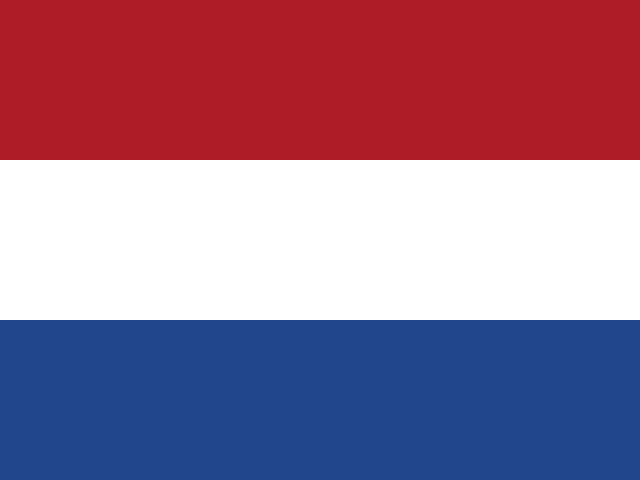
Flag sizes in the Netherlands: the flag compared with the pole
Published Written by Flagpole Guides
This page is an English translation of the Dutch original. Where the two versions differ, the Dutch text is the original.
No law or authority in the Netherlands lays down what size of flag suits a flagpole. The Handleiding voor het gebruik van de Nederlandse vlag only gives the proportions. In practice, suppliers use fixed standard sizes and a rule of thumb. This guide describes both, as well as the exceptions for the Dutch flag, façade staffs and banners.
The 2:3 proportions
According to the Handleiding there are no rules on the flag’s dimensions. In general, though, its length relates to its width as 3:2. A flag is therefore one and a half times as long as it is high. The common standard sizes in the trade follow these proportions: 100 × 150, 120 × 180, 150 × 225 and 200 × 300 centimetres. Some larger sizes, such as 225 × 350 cm, deviate slightly. Sizes are usually given as height × length.
The rule of thumb
According to the Dutch flag supplier DVC, the flag’s height is about a quarter of the pole’s length. An 8 metre pole then carries a flag of 2 × 3 metres. If the exact size does not exist, the supplier rounds down, and on poles taller than 13 metres a smaller size is usually chosen. Another Dutch flagpole supplier notes that the flag size is matched to the visible height above ground, because with a ground sleeve part of the pole stands in the ground.
Common sizes by pole length
The supplier DVC uses this table for company, provincial, municipal and national flags:
| Pole length | Flag size (height × length) |
|---|---|
| 5 metres | 120 × 180 cm |
| 6 and 7 metres | 150 × 225 cm |
| 8 and 9 metres | 200 × 300 cm |
| 10 and 11 metres | 225 × 350 cm |
| 12 and 13 metres | 300 × 450 cm |
| 14 metres and over | 300 × 500 cm |
One size up for the tricolour
For the Dutch flag, the same supplier gives a different scale. Private individuals who fly the flag only on holidays and flag days round up for the tricolour instead. On a 7 metre pole that becomes 200 × 300 cm, on 8 metres 225 × 350 cm and on 9 metres 300 × 450 cm. For those who want to go further, the supplier names yet another size up, known as flying “royally”. If several flags fly side by side or the tricolour flies every day, the supplier says the ordinary table is usual.
Several flags
When several flags fly side by side, the Handleiding has them the same size. The municipality of Zaanstad, for example, uses flags of 120 × 180 cm for the three poles on the town hall balcony. The shortest pole then often determines the size of all the flags.
Façade staffs
Smaller flags hang from a façade staff. DVC gives these sizes:
| Length of staff | Flag size |
|---|---|
| 1 metre | 70 × 100 cm |
| 1.5 metres | 80 × 120 cm |
| 2 metres | 100 × 150 cm |
| 2.5 metres | 120 × 180 cm |
The Handleiding asks for a staff long enough that the flag never touches the ground or obstructs traffic, even at half-mast. More is in the guide to half-mast.
Banners and vertical flags
According to DVC, a banner or vertical flag usually reaches halfway down the pole: 300 cm high on a 6 metre pole, 400 cm on 8 metres. The width is a matter of taste. In windy locations owners sometimes choose a size smaller.
Wind and wear
A large flag catches more wind and puts more load on the pole, halyard and pulley. According to DVC, a larger flag wears faster, so a flag that flies every day is not too large. The pole’s manufacturer states what flag size the pole can take; that statement takes precedence over the rule of thumb. The common sizes for a given pole can be worked out with the flag size calculator, and the choice of pole height is covered in the guide to flagpole heights.
Frequently asked questions
Is the size of the Dutch flag prescribed?
No. According to the Handleiding voor het gebruik van de Nederlandse vlag there are no rules on the dimensions. In general the length relates to the width as 3:2, as with 100 × 150 or 150 × 225 centimetres.
What size of flag flies on a 6 metre pole?
According to the table of a Dutch flag supplier, 150 × 225 centimetres is common on a 6 or 7 metre pole. For the Dutch flag, the same supplier gives one size up on a 7 metre pole, 200 × 300 centimetres.
Why is a larger flag sometimes discouraged?
A larger flag catches more wind. According to the flag supplier, a larger flag wears faster, so a flag that flies every day is not too large. The pole’s manufacturer states what flag size the pole can take.
Sources
This guide is based on the following sources, most of them in Dutch:
- Vlaginstructie en Handleiding voor het gebruik van de Nederlandse vlag (Staatscourant 2009, 116) – Ministerie van Binnenlandse Zaken en Koninkrijksrelaties
- Advies van de expert: zo kies je het juiste formaat vlag bij jouw vlaggenmast – DVC Dokkumer Vlaggen Centrale (vlaggenleverancier)
- Welk formaat vlag past bij jouw gevelstok of vlaggenmast? – DVC Dokkumer Vlaggen Centrale (vlaggenleverancier)
- Welke lengte vlaggenmast? – Vlaggenmasten.nl (leverancier)
- Vlaginstructie gemeente Zaanstad 2021 – Gemeente Zaanstad (Gemeenteblad)
Related guides
- Flag size calculatorFlag size calculator for the Netherlands: the standard size, the size for the tricolour and the 2:3 rule of thumb, for a pole of 4 to 15 metres.
- Flagpole heightsFlagpole heights in the Netherlands: common lengths at homes and businesses, the relation to the roof ridge, visible height and no permit up to 6 metres.
- Flag typesTypes of flags in the Netherlands: the tricolour, the orange pennant, the Royal Standard, provincial and municipal flags, banners and façade flags.
- Half-mastHalf-mast in the Netherlands: how the flag is flown at half-mast under the official guidance, 4 May, special flag instructions and half-mast after a death.
- Buying a flagThe price of a flag in the Netherlands: how size, fabric, finish, printing and the orange pennant affect it, plus the cooling-off period and warranty.