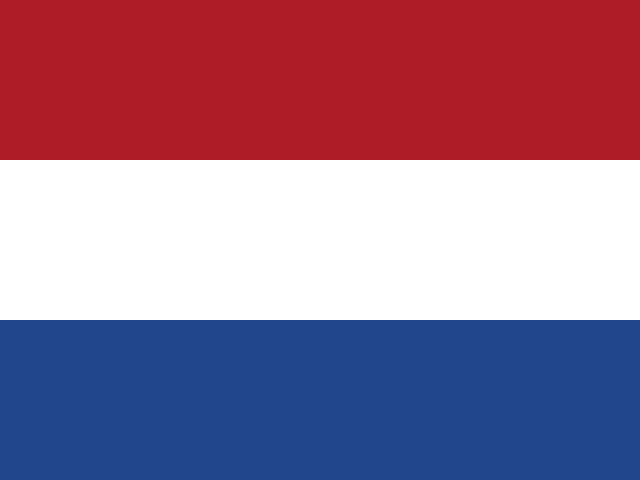
Flag lighting: flying the flag at night in the Netherlands
Published Written by Flagpole Guides
This page is an English translation of the Dutch original. Where the two versions differ, the Dutch text is the original.
In the Netherlands the flag flies from sunrise to sunset. Anyone who wants to leave the flag out longer, for example at a business or during an evening celebration, can light it. This guide describes what the official sources say and what is taken into account with lighting.
What the Handleiding says
According to the Handleiding voor het gebruik van de Nederlandse vlag, Dutch and foreign flags ought not to be raised or left flying between sunset and sunrise. Every raised flag is therefore lowered at sunset and, where needed, raised again the next day after sunrise. The Handleiding makes one exception: when the flag is lit so that its colours are clearly visible.
The Dutch government and the Royal House describe the same thing as custom: it is usual not to leave the flag out between sunset and sunrise, and if the flag stays out at night it is good practice to light it, so that its colours are clearly visible. The National 4 and 5 May Committee says the same for 5 May.
Not an obligation
The Netherlands has no flag law. According to the Dutch government, no law prohibits flag flying or prescribes how it is done. An unlit flag that stays out at night is therefore not an offence, but it departs from custom. Government buildings follow the flag instruction, which expressly names sunset as the end time on 4 May.
When lighting is used
- Businesses and institutions that leave the flag out day and night often light it with a fixed spotlight.
- Celebrations that continue after sunset, such as King’s Day or a wedding.
- Winter, when the sun sets early and the flag would otherwise be lowered in the late afternoon.
- Memorial sites where a flag flies for a longer period.
How a flag is lit
Common options are a spotlight at the foot of the pole, angled up at the flag, or a lamp at the top of the pole shining down. A spotlight on the ground spans the full height of the pole and lights the flag in every position, even as it changes direction in the wind. A lamp at the top lights the flag from close by. The Handleiding sets only one requirement: the colours are clearly visible.
Connection and cable
A lamp on or near the pole needs an electrical connection, usually via a cable in the ground. Anyone digging for that cable with a machine makes a KLIC notification beforehand, according to the Land Registry (Kadaster); digging by hand is not subject to notification, but the Kadaster points out that cables and pipes can be damaged then too. The cable is often laid at the same time as the foundation. More is in the guide to flagpole installation.
Taking the surroundings into account
A bright spotlight can disturb neighbours or traffic. The Handleiding already notes, for flag flying, that the flag ought never to obstruct traffic. Municipalities may have rules on light and advertising in the environment plan; the municipality can say what applies at a given location. More about flags at businesses is in the guide to flagpoles for businesses, and about the times in the guide to flag rules.
Frequently asked questions
May the flag stay out at night?
According to the Handleiding voor het gebruik van de Nederlandse vlag, flags ought not to fly between sunset and sunrise, with the exception of a flag lit so that its colours are clearly visible. The Dutch government calls it good practice to light the flag if it stays out at night.
Is lighting the flag compulsory?
No. The Netherlands has no flag law, and according to the Dutch government nobody who flies the flag commits an offence. Lighting a flag that stays out at night is a custom described by the Dutch government and the Royal House.
How is a flag lit?
Usually with a spotlight at the foot of the pole or a lamp at the top, aimed at the flag. According to the Handleiding, the aim is for the colours to be clearly visible. The usual rules apply to the electrical connection and to digging for a cable.
Sources
This guide is based on the following sources, most of them in Dutch:
- Vlaginstructie en Handleiding voor het gebruik van de Nederlandse vlag (Staatscourant 2009, 116) – Ministerie van Binnenlandse Zaken en Koninkrijksrelaties
- Wanneer kan ik de Nederlandse vlag uithangen? – Rijksoverheid
- Nederlandse vlag – Het Koninklijk Huis
- Vlagprotocol 4 en 5 mei – Nationaal Comité 4 en 5 mei
- KLIC-melding (Graafmelding) – Kadaster
Related guides
- Flag rulesFlag rules in the Netherlands: who may fly the flag, flying from sunrise to sunset, raising and lowering, the place of honour and what official guidance says.
- Flagpole accessoriesFlagpole accessories in the Netherlands: finial, pulley, halyard, cleat, counterweight, ground fixings, wall brackets, façade brackets and the orange pennant.
- Flagpoles for businessesFlagpoles at businesses, municipalities and institutions in the Netherlands: several poles and permits, company flags, flag instructions and the order of flags.
- Flagpole installationInstalling a flagpole in the Netherlands: no permit up to 6 metres under the Bbl, listed buildings, the KLIC notification, location and foundation.