Flag rules in the Netherlands
Published Written by Flagpole Guides
This page is an English translation of the Dutch original. Where the two versions differ, the Dutch text is the original.
The Netherlands has no flag law. What is laid down about flag flying is in the general flag instruction for government buildings and in the Handleiding voor het gebruik van de Nederlandse vlag (guidance on the use of the Dutch flag), which the Ministry of the Interior and Kingdom Relations published in the Government Gazette in 2009. The Dutch government and the Royal House also describe the customs that apply to everyone. This guide sets them out.
Who may fly the flag?
According to the Dutch government, anyone may fly the flag on any day of the year: citizens, businesses and organisations. That can be for a festive occasion, such as a wedding or passing an exam, and also at half-mast after a death. No law prohibits flag flying or prescribes how it is done, so flying the flag is never a punishable offence.
The flag instruction only determines when and how the flag is flown from central government buildings. Provinces, municipalities and water authorities are asked to follow it. There is no instruction for private individuals and businesses, but the Royal House writes that they are asked to follow the flag instruction for government buildings. The dates are in the guide to flag days.
From sunrise to sunset
The Handleiding says that Dutch and foreign flags ought not to be raised or left flying between sunset and sunrise. A raised flag is therefore lowered at sunset and, where needed, raised again the next morning after sunrise. An exception is possible if the flag is lit so that its colours are clearly visible. The Dutch government describes this as custom and good practice, not as an obligation. More is in the guide to flag lighting.
There is no set time for raising the flag, except on 4 May, when the flag instruction has the flag at half-mast from 18.00 until sunset.
Raising and lowering
According to the Handleiding, the flag is flown from a staff or pole long enough that the flag, even at half-mast, never touches the ground or can obstruct traffic. The Dutch government and the Royal House name the same custom: a raised flag never touches the ground.
When flying at half-mast, the flag first goes all the way up and is then lowered slowly and with dignity. When a flag at half-mast is taken down, it first goes back to the top. This is described in detail in the guide to half-mast.
Municipalities also describe how the flag is looked after once it is down. According to Zaanstad’s flag instruction, a flag is stored folded, with the blue stripe on the outside, and a flag that is worn, torn, badly faded or can no longer be cleaned is replaced.
The flag itself
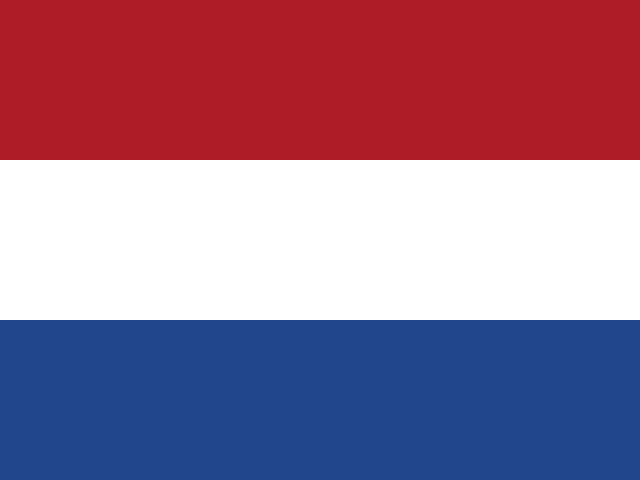
According to the Handleiding, the Dutch flag is the symbol of the unity and independence of the Kingdom of the Netherlands and ought to have the position of honour on Dutch territory. The colours are bright vermilion, bright white and cobalt blue, set by Royal Decree in 1937. There are no rules on its dimensions, but in general its length relates to its width as 3:2.
According to the Handleiding, no decoration or addition belongs on the Dutch flag. Using a flag purely as decoration ought to be avoided. Red, white and blue flag fabric may be used for decoration, for example as draperies.
Several flags
When several flags are flown, the Handleiding has them the same size and, where possible, at the same height. The position of honour is on the right, counted with one’s back to the flags:
- Two flags: the Dutch flag on the right.
- Three flags: the Dutch flag in the middle.
- With provincial and municipal flags: municipal flag on the left, Dutch flag in the middle, provincial flag on the right. For a municipal occasion the order is reversed.
The order with flags of other countries is described in the guides to foreign flags in the Netherlands and flag protocol.
The orange pennant
On King’s Day and the birthdays of Queen Máxima, Princess Beatrix and the Princess of Orange, the flag flies with the orange pennant. The Royal House writes that on all other occasions the flag flies without it. According to Zaanstad’s flag instruction, the flag is never flown at half-mast with the pennant. The pennant and other flags are covered in the guide to flag types.
Frequently asked questions
May anyone fly the flag in the Netherlands?
Yes. According to the Dutch government, citizens, businesses and organisations may fly the flag on any day of the year, and no law prohibits flag flying or prescribes how it is done. Flying the flag is therefore never a punishable offence.
May the flag stay out at night?
According to the Dutch government, the custom is not to leave the flag out between sunset and sunrise. If the flag stays out at night, it is good practice to light it so that its colours are clearly visible.
May anything be added to the Dutch flag?
According to the Handleiding voor het gebruik van de Nederlandse vlag, no decoration or addition belongs on the flag. Using a flag purely as decoration is also discouraged; flag fabric for draperies is permitted.
Where does the Dutch flag go next to another flag?
With two flags, the Handleiding places the position of honour on the right, counted with one’s back to the flags, and that is where the Dutch flag goes. With three flags, the Dutch flag flies in the middle.
Sources
This guide is based on the following sources, most of them in Dutch:
- Wanneer kan ik de Nederlandse vlag uithangen? – Rijksoverheid
- Nederlandse vlag – Het Koninklijk Huis
- Vlaginstructie en Handleiding voor het gebruik van de Nederlandse vlag (Staatscourant 2009, 116) – Ministerie van Binnenlandse Zaken en Koninkrijksrelaties
- Vlaginstructie gemeente Zaanstad 2021 – Gemeente Zaanstad (Gemeenteblad)
Related guides
- Flag daysAll flag days in the Netherlands for 2026 and 2027 under the flag instruction, with extended or limited flying, the orange pennant and 4 May at half-mast.
- Half-mastHalf-mast in the Netherlands: how the flag is flown at half-mast under the official guidance, 4 May, special flag instructions and half-mast after a death.
- Flag lightingFlag lighting in the Netherlands: why a lit flag may stay out at night, what the official guidance and the Dutch government say and how a flag is lit.
- Flag typesTypes of flags in the Netherlands: the tricolour, the orange pennant, the Royal Standard, provincial and municipal flags, banners and façade flags.