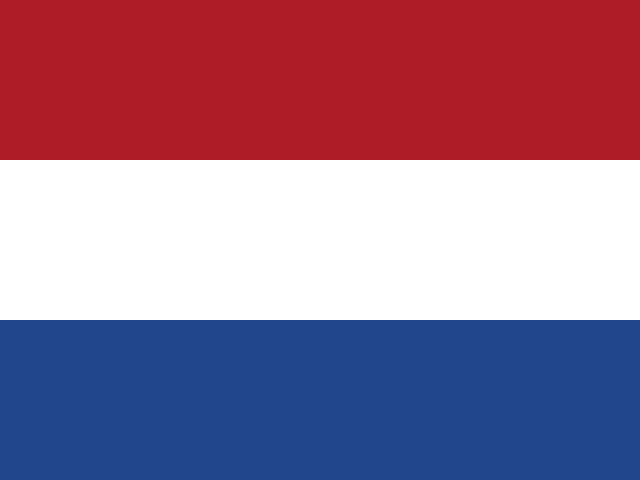
History of the flag and the flagpole in the Netherlands
Published Written by Flagpole Guides
This page is an English translation of the Dutch original. Where the two versions differ, the Dutch text is the original.
The Dutch tricolour is more than four centuries old, but its colours have only been officially fixed since 1937, and the rules for flying the flag from government buildings are younger still. This guide traces the history of the flag, the flag days and the flagpole in the Netherlands, based on the Royal House, the Government Gazette and the bodies concerned.
1572: the Prince’s Flag
According to the Royal House, the first mention of the Dutch flag dates from 1572, at the time of the Dutch Revolt. The colours were then orange, white and blue, derived from the Principality of Orange, the principality of William of Orange. Around the seventeenth century the orange was gradually replaced by red. According to the Royal House, the story goes that orange was less visible at sea.
The Batavian period and French rule
After the French invasion at the end of the eighteenth century the red, white and blue flag was kept, but according to the Royal House the red stripe was given an image of a Dutch maiden with a lion at her feet, a shield with the Roman fasces and a lance topped with the cap of liberty. King Louis Napoleon (1806–1810) abolished the maiden of liberty and restored the old tricolour. After annexation by France in 1810, the national flag was replaced by the French imperial flag.
1813: the return of Orange
In 1813 the Netherlands became independent again and the House of Orange returned. The colours of the flag were not officially set, so both red-white-blue and orange-white-blue could be flown. Red, white and blue was preferred and flew on government buildings. According to the Royal House, the custom of raising the orange pennant on royal occasions also dates from this period.
1908 and 1937: standard and colours
In 1908 Queen Wilhelmina introduced the Royal Standard, the monarch’s flag. On 19 February 1937 she determined by Royal Decree that the colours of the flag of the Kingdom are red, white and blue. That settled the choice between red and orange for good. The Royal House describes the colours as bright vermilion, bright white and cobalt blue. More is in the guide to flag symbolism.
Provincial and municipal flags
Many provincial and municipal flags were adopted in the twentieth century. According to the province of Fryslân, the Frisian flag was recognised by the Provincial Executive in 1897, first flew officially on the provincial house in 1927 and was adopted by the Provincial Council in 1957. According to the High Council of Nobility, the Minister of the Interior asked provinces in 1948, municipalities in 1957 and water authorities in 1961 to seek the Council’s advice when adopting a flag.
The flag instruction
Government buildings follow a general flag instruction, which according to Zaanstad’s flag instruction goes back to an instruction from the Prime Minister of 22 December 1980. The instruction has since been updated several times:
- In 2009, Veterans’ Day became a fixed flag day, every year on the last Saturday of June. Before that, a separate instruction was issued each year. With that change the ministry also published the Handleiding voor het gebruik van de Nederlandse vlag in the Government Gazette.
- In 2013, after the royal succession, the annual flag days were set anew. Queen’s Day on 30 April was dropped and the King’s birthday on 27 April became King’s Day, with extended flying. The birthdays on 31 January, 17 May and 7 December remained flag days, now as those of Princess Beatrix, Queen Máxima and the Princess of Orange. According to the Dutch government, the current instruction dates from 2013.
Today’s fixed days are in the guide to flag days.
The flagpole
The flagpole in the garden is younger in the Netherlands than the flag itself. For a long time the flag flew mainly from ships, church towers and government buildings, and at homes from a staff on the façade. According to a Dutch supplier, the wooden pole is the classic choice. Today mostly aluminium and polyester poles are sold, and wooden poles of laminated pine are chosen for their natural look. Municipalities sometimes still fly the flag from church towers: Zaanstad lists five municipally owned church towers in its flag instruction from which the flag is flown. More about the materials is in the guide to flagpole materials, and about the types of flags in the guide to flag types.
Frequently asked questions
How old is the Dutch flag?
According to the Royal House, the first mention of the Dutch flag dates from 1572, when its colours were orange, white and blue. The colours red, white and blue were officially set by Royal Decree of 19 February 1937.
When was the flag instruction last changed?
According to the Dutch government, the current general flag instruction dates from 2013. After the royal succession the annual flag days were set anew, including King’s Day on 27 April in place of Queen’s Day on 30 April.
Since when has Veterans’ Day been a flag day?
According to the Minister of the Interior’s letter in the 2009 Government Gazette, the flag has been flown every year on the last Saturday of June for Veterans’ Day since June 2009. Before that, a separate flag instruction was issued each year.
Sources
This guide is based on the following sources, most of them in Dutch:
- Nederlandse vlag – Het Koninklijk Huis
- Koninklijke standaard – Het Koninklijk Huis
- Vlaginstructie en Handleiding voor het gebruik van de Nederlandse vlag (Staatscourant 2009, 116) – Ministerie van Binnenlandse Zaken en Koninkrijksrelaties
- Wanneer kan ik de Nederlandse vlag uithangen? – Rijksoverheid
- Vlaggen – Hoge Raad van Adel
- Friese vlag – Provincie Fryslân
- Vlaginstructie gemeente Zaanstad 2021 – Gemeente Zaanstad (Gemeenteblad)
- Houten, aluminium of polyester vlaggenmast? – Vlaggenmasten.nl (leverancier)
Related guides
- Flag symbolismThe Dutch flag: red, white and blue under the Royal Decree of 1937, its orange origins in the Prince’s Flag, the orange pennant and the flag as a symbol.
- Flag daysAll flag days in the Netherlands for 2026 and 2027 under the flag instruction, with extended or limited flying, the orange pennant and 4 May at half-mast.
- Flagpole materialsFlagpole materials in the Netherlands: aluminium, polyester and wood compared on appearance, shape, maintenance and durability, according to suppliers.
- Flag typesTypes of flags in the Netherlands: the tricolour, the orange pennant, the Royal Standard, provincial and municipal flags, banners and façade flags.