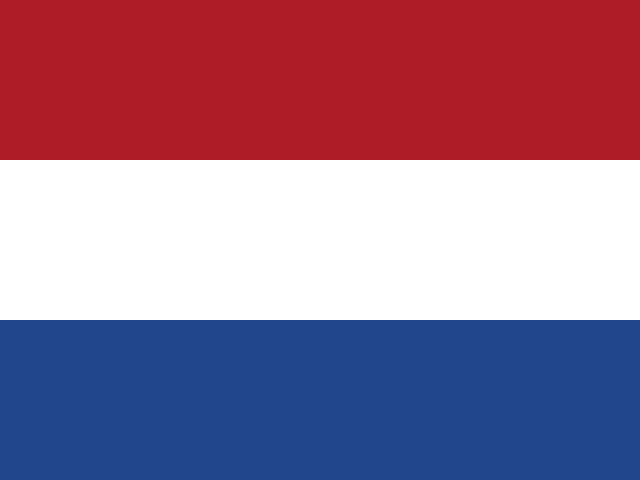
Flagpoles for businesses and public buildings in the Netherlands
Published Written by Flagpole Guides
This page is an English translation of the Dutch original. Where the two versions differ, the Dutch text is the original.
At businesses, hotels, schools and town halls several flagpoles often stand side by side, with company flags, the tricolour and sometimes flags of other countries. The same building rules apply to these poles as at a home, but the limit of one permit-free pole comes into play sooner. This guide describes the rules and customs for flagpoles at businesses and public buildings.
Several poles and the permit
The Buildings (Living Environment) Decree makes a flagpole in the yard of a building permit-free if it is no higher than 6 metres and there is no more than one pole per yard. A row of three poles at the entrance therefore does not qualify. A second or further pole, a pole taller than 6 metres or a pole on a site that is not the yard of a building may need an environmental permit. Whether it does depends on the municipality’s environment plan. The municipality can give a definitive answer in a specific case. More is in the guide to flagpole installation.
Height at business premises
According to a Dutch flagpole supplier, visibility plays a larger role at business premises, and a large building is often suited to a pole of 8 metres or more. For prestigious entrances and large sites the supplier names poles of 10 to 12 metres. On open ground the wind load is greater, and the pole, diameter and foundation are matched to it. More is in the guide to flagpole safety.
Company flags and banners
No flag rules apply to company flags. According to the flag supplier DVC, the height of a landscape flag is about a quarter of the pole’s length, and for company flags the size is rounded down. A company flag that flies every day is, according to DVC, not too large, because a larger flag wears faster. Banners stay visible even in still weather and, according to DVC, are widely used at businesses, shops and events. Municipalities may have rules on advertising in the environment plan or a by-law; a company flag along the road may fall under them.
Flag days at businesses
The general flag instruction applies to government buildings. Provinces, municipalities and water authorities are asked to follow it, and for businesses and organisations it is, according to the Dutch government, a guideline and not an obligation. Those who follow the instruction raise the tricolour on the fixed days, with the orange pennant on King’s Day and the royal birthdays, and at half-mast on 4 May. The dates are in the guide to flag days.
The order of the flags
When the Dutch flag flies beside company flags or flags of other countries, according to the Handleiding voor het gebruik van de Nederlandse vlag it has the position of honour: on the right with two flags, counted with one’s back to the flags, and in the middle with three. The flags are the same size and, where possible, fly at the same height. For flags of several countries, the first letter of the French country name determines the order. More is in the guides to flag protocol and foreign flags in the Netherlands.
Municipalities and public buildings
Municipalities set out in their own flag instruction where and when they fly the flag. The flag instruction of Zaanstad is an example: the town hall is the main building, for extended flying the flag also flies from other municipal buildings and from municipally owned church towers, and on 4 May the flag also flies at half-mast at monuments and cemeteries. Zaanstad also flies flags on days of its own choosing, such as Europe Day with the European flag. Requests to fly the flag on other days are assessed by the municipal executive.
Flying day and night
Businesses often leave the flag out day and night. According to the Handleiding, flags ought not to fly between sunset and sunrise unless they are lit so that their colours are clearly visible. More is in the guide to flag lighting. For poles in daily use, replacing flags and halyards is a regular part of maintenance, as described in the guide to flagpole maintenance.
Frequently asked questions
Do several flagpoles at a business need a permit?
The Buildings (Living Environment) Decree makes one flagpole of no more than 6 metres per building yard permit-free. A second or third pole, or a taller pole, may need an environmental permit, depending on the municipality’s environment plan.
Do businesses follow the flag instruction?
The flag instruction applies to government buildings, and provinces, municipalities and water authorities are asked to follow it. For businesses and organisations it is, according to the Dutch government, a guideline and not an obligation.
Where does the Dutch flag fly next to a company flag?
According to the Handleiding voor het gebruik van de Nederlandse vlag, the Dutch flag has the position of honour: on the right with two flags, counted with one’s back to the flags, and in the middle with three. The flags are the same size and, where possible, fly at the same height.
Sources
This guide is based on the following sources, most of them in Dutch:
- Besluit bouwwerken leefomgeving – Overheid.nl (wetten.overheid.nl)
- Wanneer kan ik de Nederlandse vlag uithangen? – Rijksoverheid
- Vlaginstructie en Handleiding voor het gebruik van de Nederlandse vlag (Staatscourant 2009, 116) – Ministerie van Binnenlandse Zaken en Koninkrijksrelaties
- Vlaginstructie gemeente Zaanstad 2021 – Gemeente Zaanstad (Gemeenteblad)
- Advies van de expert: zo kies je het juiste formaat vlag bij jouw vlaggenmast – DVC Dokkumer Vlaggen Centrale (vlaggenleverancier)
- Welke lengte vlaggenmast? – Vlaggenmasten.nl (leverancier)
Related guides
- Foreign flags in the NetherlandsFlags of other countries in the Netherlands: the Dutch flag’s position of honour, ordering by French country name, the European flag and the Kingdom’s flags.
- Flag lightingFlag lighting in the Netherlands: why a lit flag may stay out at night, what the official guidance and the Dutch government say and how a flag is lit.
- Flag protocolFlag protocol in the Netherlands: the position of honour, the order of Dutch, provincial, municipal and foreign flags, state visits and commemorations.
- Flagpole safetyFlagpole safety in the Netherlands: wind and storms, cables and pipes, tilting and working at height, the duty of care in the Bbl and Civil Code liability.