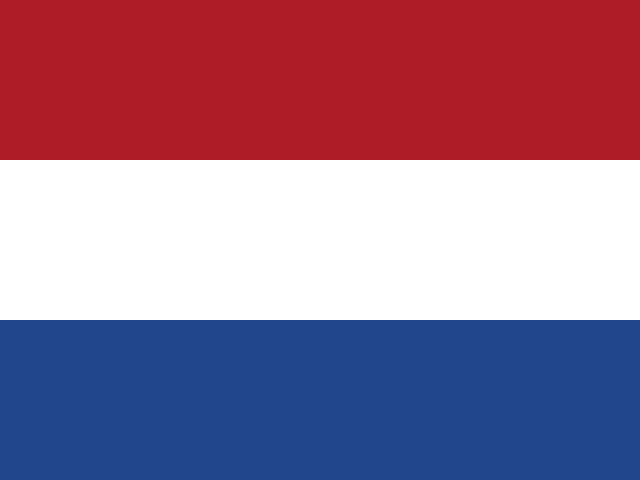
Flag protocol at ceremonies in the Netherlands
Published Written by Flagpole Guides
This page is an English translation of the Dutch original. Where the two versions differ, the Dutch text is the original.
At an official ceremony, a commemoration or a reception for foreign guests, several flags often fly side by side. The Netherlands has fixed rules for the order and the position of the Dutch flag, laid down in the Handleiding voor het gebruik van de Nederlandse vlag. Municipalities work these rules out in their own flag instructions. This guide describes the protocol.
The position of honour
According to the Handleiding, the Dutch flag ought always to have the position of honour on Dutch territory. To count left and right, the Handleiding takes someone standing with their back to the flags, facing the same way as the building.
- Two flags: the position of honour is on the right. The Dutch flag flies there.
- Three flags: the Dutch flag flies in the middle.
For a spectator looking at the building, the Dutch flag in a pair therefore flies on the left.
Equal size and height
When several flags fly, the Handleiding has them the same size and, where possible, at the same height. No flag then flies above another. The municipality of Zaanstad, for example, uses three flags of 120 × 180 cm for the three poles on the town hall balcony. More about sizes is in the guide to flag sizes.
Dutch, provincial and municipal flags
When the provincial flag and the municipal flag fly beside the Dutch flag, the Handleiding gives this arrangement, with one’s back to the flags:
| Left | Middle | Right |
|---|---|---|
| municipal flag | Dutch flag | provincial flag |
Only for a municipal occasion is the order reversed: the municipal flag then flies on the right. When only the Dutch flag and the municipal flag fly, the Dutch flag is on the right. Zaanstad’s flag instruction follows these rules for the town hall.
Flags of other countries
When flags of other countries fly beside the Dutch flag, the Handleiding says the order among them is generally determined by the first letter of the country names in French. For the details, the Handleiding refers to the Protocol Department of the Ministry of Foreign Affairs. Zaanstad describes how this works at its town hall: the Dutch flag stays in the middle, the municipal flag is left out, and the foreign flags fly on either side in the alphabetical order of their French names, the first country on the right. More is in the guide to foreign flags in the Netherlands.
State visits and visits by the Royal House
During an official visit by a foreign head of state, the flag instruction has the flag flown only in the places visited. According to Zaanstad, the national flag instruction contains no rules for a visit by members of the Royal House to a municipality; Zaanstad itself then flies the flag on an extended basis with the orange pennant. For an official visit by the King’s Commissioner, Zaanstad flies the provincial flag.
In 2016 the Prime Minister adopted Instructions on protocol (Aanwijzingen inzake protocol) for the central government service. Their explanatory notes expressly name the flag as one of the symbols to be used efficiently and soberly in protocol.
Commemorations
At commemorations the flag often flies at half-mast. On 4 May, according to the National 4 and 5 May Committee, other flags such as the municipal flag can also fly at half-mast beside the tricolour. The order of the flags follows the same rules as at other ceremonies. How the flag goes to half-mast is described in the guide to half-mast, and the customs after a death in the guide to flags in mourning.
At businesses and institutions
Businesses with several poles often follow the same order: the Dutch flag in the position of honour, with company flags or flags of other countries beside it. For businesses this is a custom, not an obligation. More is in the guide to flagpoles for businesses.
Frequently asked questions
Where is the position of honour with two flags?
According to the Handleiding voor het gebruik van de Nederlandse vlag, the position of honour is on the right, counted with one’s back to the flags. The Dutch flag flies there. For someone standing in front and looking at the flags, that is the left.
In which order do provincial and municipal flags fly?
According to the Handleiding, with one’s back to the flags, the municipal flag flies on the left, the Dutch flag in the middle and the provincial flag on the right. For a municipal occasion the order of the provincial and municipal flags is reversed.
How are the flags of several countries arranged?
According to the Handleiding, the order is generally determined by the first letter of the country names in French. For the details, the Handleiding refers to the Protocol Department of the Ministry of Foreign Affairs.
Is the flag flown everywhere during a state visit?
No. Under the flag instruction, during an official visit by a foreign head of state the flag is flown only in the places visited.
Sources
This guide is based on the following sources, most of them in Dutch:
- Vlaginstructie en Handleiding voor het gebruik van de Nederlandse vlag (Staatscourant 2009, 116) – Ministerie van Binnenlandse Zaken en Koninkrijksrelaties
- Vlaginstructie – Het Koninklijk Huis
- Aanwijzingen inzake protocol (Staatscourant 2016, 38170) – Ministerie van Algemene Zaken
- Vlaginstructie gemeente Zaanstad 2021 – Gemeente Zaanstad (Gemeenteblad)
- Vlagprotocol 4 en 5 mei – Nationaal Comité 4 en 5 mei
Related guides
- Foreign flags in the NetherlandsFlags of other countries in the Netherlands: the Dutch flag’s position of honour, ordering by French country name, the European flag and the Kingdom’s flags.
- Flags in mourningFlags in mourning in the Netherlands: half-mast after a death and at a funeral, special flag instructions for national mourning and practice at municipalities.
- Flag typesTypes of flags in the Netherlands: the tricolour, the orange pennant, the Royal Standard, provincial and municipal flags, banners and façade flags.
- Flagpoles for businessesFlagpoles at businesses, municipalities and institutions in the Netherlands: several poles and permits, company flags, flag instructions and the order of flags.