Types of flags and their use in the Netherlands
Published Written by Flagpole Guides
This page is an English translation of the Dutch original. Where the two versions differ, the Dutch text is the original.
Beside the red, white and blue tricolour, many other flags fly in the Netherlands: the orange pennant on royal occasions, provincial and municipal flags, company flags at businesses and banners along the road. Some are set by the authorities, others are free. This guide describes the main types and who is responsible for them.
The Dutch flag
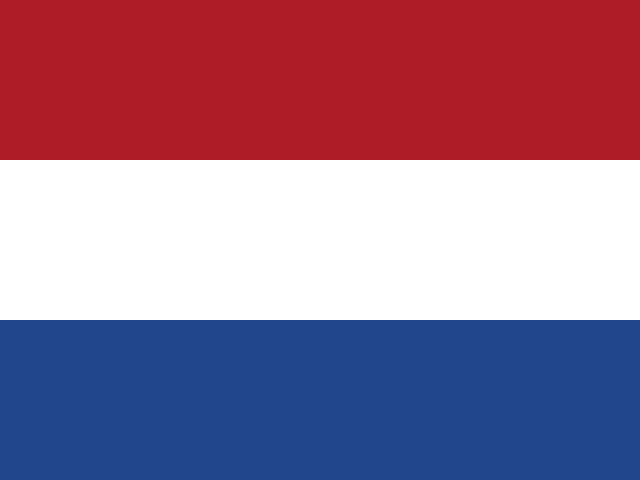
The tricolour has three horizontal stripes in red, white and blue. The colours were set by Royal Decree in 1937; the Royal House describes them as bright vermilion, bright white and cobalt blue. According to the Handleiding voor het gebruik van de Nederlandse vlag there are no rules on the dimensions, but in general the length relates to the width as 3:2. No decoration or addition belongs on the flag. More about the colours is in the guide to flag symbolism.
The orange pennant
The orange pennant (oranje wimpel) is a long, narrow orange streamer that flies above the Dutch flag. According to the flag instruction and the Royal House, the flag flies with the pennant on King’s Day and the birthdays of Queen Máxima, Princess Beatrix and the Princess of Orange, and without it on all other occasions. According to the Royal House, the custom dates from the period after 1813, when the Netherlands became independent again and the House of Orange returned. The pennant never flies at half-mast. More is in the guide to flag rules.
The Royal Standard and personal flags
The Royal Standard is the King’s flag. According to the Royal House, it is raised on the working palace and the residence when the King is in the Netherlands. The flag has a Nassau blue cross dividing it into four quarters, with blue hunting horns from the arms of the Principality of Orange, and in the centre the Royal Arms with the Royal Crown. Queen Wilhelmina introduced the standard in 1908.
The other members of the Royal House have their own personal flags. Like their coats of arms, these are set by Royal Decree.
Provincial, municipal and water authority flags
Every province and most municipalities have a flag of their own. According to the High Council of Nobility (Hoge Raad van Adel), flags of public bodies are adopted by the body’s own board. The Minister of the Interior asked provinces (in 1948), municipalities (in 1957) and water authorities (in 1961) to seek the Council’s advice when doing so. The Council keeps a register of flags with the description, a coloured drawing and the board’s decision.
A well-known example is the Frisian flag: according to the province of Fryslân, four blue and three white diagonal stripes with seven red pompeblêden, the leaves of the yellow water lily, which stand for the seven sea lands. The Provincial Executive recognised the flag in 1897, it first flew officially on the provincial house in 1927, and the Provincial Council adopted it in 1957. How provincial and municipal flags fly beside the tricolour is described in the guide to flag protocol.
Company flags, banners and vertical flags
Businesses, clubs and private individuals also use flags with a logo or their own design. No flag rules apply to them. A Dutch flag supplier distinguishes:
- Landscape flag: the ordinary rectangular flag in 2:3 proportions that flies from the pole.
- Vertical flag: an upright flag attached to the pole only along its vertical side, which according to the supplier usually reaches halfway down the pole.
- Banner: an upright flag on a pole with a horizontal arm at the top, so that it stays visible even with little wind.
Façade flags and celebration flags
On the façade, the flag hangs from a flagstaff in a bracket. For the staff, the Handleiding asks for a length at which the flag never touches the ground or obstructs traffic. There are also celebration flags, such as birthday flags and the flag for passing exams. These are separate from the tricolour, on which no text or decoration belongs. More about occasions is in the guide to flags on holidays, and about sizes in the guide to flag sizes.
Frequently asked questions
What is the orange pennant?
A long orange pennant that flies above the Dutch flag on King’s Day and the birthdays of Queen Máxima, Princess Beatrix and the Princess of Orange. According to the Royal House, the custom dates from the period after 1813, when the House of Orange returned.
Who adopts a municipal or provincial flag?
The board of the province, municipality or water authority itself. According to the High Council of Nobility, the Minister of the Interior asked those boards to seek the Council’s advice. The Council keeps a register of flags.
May anyone raise the Royal Standard?
According to the Royal House, the Royal Standard is the King’s flag and is raised on the working palace and the residence when the King is in the Netherlands. Other members of the Royal House have their own personal flags, set by Royal Decree.
Sources
This guide is based on the following sources, most of them in Dutch:
- Nederlandse vlag – Het Koninklijk Huis
- Koninklijke standaard – Het Koninklijk Huis
- Vlaggen – Hoge Raad van Adel
- Friese vlag – Provincie Fryslân
- Vlaginstructie en Handleiding voor het gebruik van de Nederlandse vlag (Staatscourant 2009, 116) – Ministerie van Binnenlandse Zaken en Koninkrijksrelaties
- Advies van de expert: zo kies je het juiste formaat vlag bij jouw vlaggenmast – DVC Dokkumer Vlaggen Centrale (vlaggenleverancier)
Related guides
- Flag sizesFlag sizes in the Netherlands: the 2:3 proportions, common sizes by pole length, one size up for the tricolour and sizes for façade staffs and banners.
- Flag symbolismThe Dutch flag: red, white and blue under the Royal Decree of 1937, its orange origins in the Prince’s Flag, the orange pennant and the flag as a symbol.
- Flag rulesFlag rules in the Netherlands: who may fly the flag, flying from sunrise to sunset, raising and lowering, the place of honour and what official guidance says.
- Flag size calculatorFlag size calculator for the Netherlands: the standard size, the size for the tricolour and the 2:3 rule of thumb, for a pole of 4 to 15 metres.
- Buying a flagThe price of a flag in the Netherlands: how size, fabric, finish, printing and the orange pennant affect it, plus the cooling-off period and warranty.