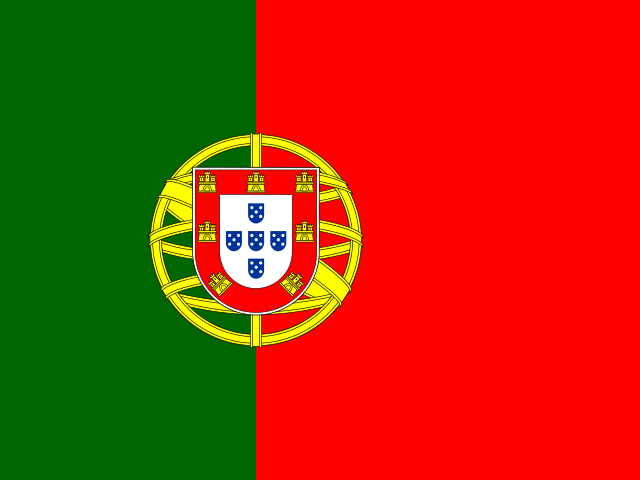
Flagpoles and national flag rules in Portugal
Published Written by Flagpole Guides
This page is an English translation of the Portuguese original. Where the two versions differ, the Portuguese text is the original.
In Portugal the green and red flag is seen on public buildings, schools, fire stations, company headquarters and on many houses and farms. The use of the national flag is governed by law: there are rules on the days and hours it is flown, on half-mast during national mourning and on the place of honour when it flies with other flags. This page gathers information on the flag and on flagpoles in Portugal, based on Portuguese legislation and the authorities responsible.
The essentials in brief
- Days: Under Decreto-Lei n.º 150/87, the national flag is flown on Sundays and public holidays and on days of official ceremonies. All the dates are in the guide to flag days.
- Hours: The decree provides for the flag to fly between 9.00 and sunset, and to be lit when it stays up at night. More information is in the guide to flag rules.
- National mourning: When the Government declares national mourning, the national flag is flown at half-mast for the days set. The subject is covered in the guides to half-mast and national mourning.
- Size: No law sets the size of the flag according to the pole. The flag’s height is commonly between one seventh and one fifth of the pole’s height, and the flag size calculator shows the usual sizes.
- Price: The factors that affect the price are described in the guides to buying a flagpole and buying a flag.
- Permits: Putting up a flagpole is governed by the legal regime for urban development and building and by the municipal regulations. The subject is covered in the guide to flagpole installation.
Legislation and authorities
Article 11 of the Constitution defines the national flag as the symbol of the sovereignty of the Republic and of the independence, unity and integrity of Portugal, and as the flag adopted by the Republic established by the Revolution of 5 October 1910. The decree of the Constituent National Assembly of 19 June 1911 describes the flag, and the decree published in the Diário do Governo of 30 June 1911 sets its proportions: the length one and a half times the height, two fifths green at the hoist and three fifths red.
Decreto-Lei n.º 150/87 of 30 March brings together the general rules for the use of the national flag throughout the country, without prejudice to the specific rules for military and maritime use. According to the Presidency of the Republic, it updated scattered legislation dating in some cases from the beginning of the twentieth century. Article 332 of the Penal Code punishes insulting the national flag or anthem with up to two years in prison or a fine of up to 240 days, and with a lighter penalty for regional symbols.
National mourning is declared by the Government by decree, under article 42 of Lei n.º 40/2006 (the Law on the Precedence of the Protocol of the Portuguese State). The autonomous regions of the Azores and Madeira have their own flags, with rules of use set in regional legislation, and municipalities and parishes use heraldic flags under Lei n.º 53/91.
There is no specific law on flagpoles. They fall under the legal regime for urban development and building (Decreto-Lei n.º 555/99), the municipal urban development and building regulations of each municipality and, for advertising flags, Lei n.º 97/88 on the display of advertising messages.
The flagpole in Portugal
Under article 9 of Decreto-Lei n.º 150/87, flagpoles are placed in a place of honour, on the ground, on façades or on top of buildings. Public buildings often have two or three poles side by side, for the national flag, the flag of the European Union and the flag of the municipality or region. At houses, a pole in the garden or a bracket pole on the façade is most common. More information is in the guides to types of flagpoles and flagpole heights.
The country’s largest flagpole in a public space stands at the top of Parque Eduardo VII in Lisbon. According to RTP, the flag measuring 20 by 12 metres was raised in September 2005 on a pole 35 metres high. The story is told in the guide to the history of the flagpole.
About the guides
The guides are grouped by subject. Each guide covers one defined topic, ends with frequently asked questions, lists its sources and shows the date of its latest update. The dates of movable holidays, such as Good Friday and Corpus Christi, have been calculated for 2026 and 2027. The rules specific to the Azores and Madeira are mentioned in the guides where they apply, above all in the guides to flag types and flag days.
All guides
Flag flying and rules
When, how and why the national flag is flown in Portugal – from Sundays and holidays to national mourning, protocol and the flags of other countries.
- Flag daysWhen the national flag is flown in Portugal: Sundays, the national and regional holidays of 2026 and 2027, official ceremonies and days set by the Government.
- Flag rulesThe rules for the Portuguese national flag: who may fly it, flying hours from 9.00 to sunset, lighting, good condition, place of honour and legal protection.
- Half-mastHalf-mast in Portugal: when it applies, raising the flag to the top before half-mast, what happens to other flags and the difference from municipal mourning.
- National mourningNational mourning in Portugal: who declares it, in which cases, how long it lasts, what changes for the flag and events, and how municipal mourning differs.
- Flags on holidaysThe national flag on Portuguese public holidays: the meaning of 25 April, 10 June, 5 October and 1 December, and the regional and municipal holidays.
- Flag protocolFlag protocol in Portugal: the place of honour of the national flag with two, three or more poles, and the European, regional and municipal flags.
- Foreign flagsFlags of other countries in Portugal: flying a foreign flag, the national flag’s place of honour, the size rule and the criminal protection of foreign symbols.
The flag
The flag’s proportions, sizes and symbolism, what affects the price of a flag, and a calculator that shows the size of flag for a given pole.
- Flag typesTypes of flags in Portugal: the national flag, the naval jack and pennants, the flags of the Azores and Madeira, and municipal and parish flags.
- Flag sizesFlag sizes in Portugal: the official proportions of 1911, the usual sizes, the relationship with the height of the pole and the rules of the Azores and the GNR.
- Flag size calculatorThe calculator shows the size of flag for the height of the pole, using a Portuguese supplier’s table, the GNR reference and the rule of the Azores.
- Flag symbolismThe meaning of the Portuguese flag: green and red according to the 1910 commission, the armillary sphere, the quinas, the seven castles and official colours.
- Buying a flagThe price of a flag in Portugal: how size, fabric, making, the official pattern and customisation affect it, and the consumer’s rights when buying.
The flagpole
Types, materials, heights, accessories, lighting and what affects the price of a flagpole – and the history of the flagpole in Portugal.
- Types of flagpolesThe types of flagpoles: ground-mounted poles, façade poles, rooftop poles, poles with a yard, telescopic poles and internal halyards, and where each is used.
- Flagpole materialsFlagpole materials in Portugal: aluminium, fibreglass, steel and wood, their properties, resistance to sea air and the effect on price.
- Flagpole heightsFlagpole heights in Portugal: usual heights for houses, businesses and public buildings, the relationship with the flag, half-mast and municipal permits.
- Flagpole accessoriesFlagpole accessories: finial, pulley, halyard, snap hooks, cleat, counterweight, tilting base, yard and lighting, and what each of them is for.
- Flagpole mechanicsHow a flagpole works: external and internal halyards, pulley, counterweight, rotating arm and raising the flag to the top before half-mast as the law provides.
- Flag lightingThe flag flown at night in Portugal: what Decreto-Lei n.º 150/87 provides on floodlights, the Azores rule for gala holidays and the usual lighting solutions.
- History of the flagpoleThe history of the flag and the flagpole in Portugal: from ships’ masts and the 1910 revolution to the Azorean autonomy flag and the pole in Parque Eduardo VII.
- Buying a flagpoleThe price of a flagpole in Portugal: how height, material, halyard, base, transport and installation affect it, and what consumer law says.
Installation, safety and care
Municipal permits, foundations, safety, maintenance and transport – for houses, condominiums, businesses and local authorities.
- Flagpole installationPutting up a flagpole in Portugal: what the RJUE says, the municipal regulations, listed buildings, condominiums, the foundation and buried cables.
- Flagpole safetyFlagpole safety in Portugal: wind zones, IPMA warnings, distances to power lines, buried cables and work at height.
- Flagpole maintenanceMaintenance of the flagpole and the flag: halyard, pulley, foundation, cleaning and sea air, and the good condition required by Decreto-Lei n.º 150/87.
- Flagpole repairCommon flagpole faults and repairs: broken halyard, stuck pulley, wrapped flag, corrosion, loose base, leaning pole and the legal guarantee.
- Flagpole lifespanHow long a flagpole lasts in Portugal: the lifespan of aluminium, fibreglass, steel and wood, the effect of sea air and sun, and how long flags last.
- Flagpole transportTransporting a flagpole in Portugal: article 56 of the Road Code on loads, the maximum height of 4 metres, the fines and delivery by the supplier.
- Flagpoles for businessesFlagpoles for businesses in Portugal: the national flag at the headquarters, logo flags and Lei n.º 97/88, municipal permits, protocol and several poles.
Frequently asked questions
Is permission needed to fly the Portuguese national flag?
No. Under article 4 of Decreto-Lei n.º 150/87, the national flag can be flown by private institutions and individuals, provided the legal and protocol procedures in force are respected.
Which legislation governs the Portuguese national flag?
Article 11 of the Constitution defines the national flag as the one adopted by the Republic established on 5 October 1910. Its design was set by the decree of the Constituent National Assembly of 19 June 1911, and the rules of use are in Decreto-Lei n.º 150/87 of 30 March. Article 332 of the Penal Code protects the flag against insult.
On which days is the national flag flown in Portugal?
Under article 3 of Decreto-Lei n.º 150/87, the national flag is flown on Sundays and public holidays and on days of official ceremonies or other solemn public acts or sessions. The Prime Minister can set further days, and on the seats of the organs of sovereignty the flag may be flown every day.
At what time is the flag raised and lowered?
Article 6 of Decreto-Lei n.º 150/87 provides for the national flag to remain flying between 9.00 and sunset. When it stays up during the night, the decree provides for it to be lit by floodlights whenever possible.
Is a municipal permit needed to put up a flagpole?
The legal regime for urban development and building (RJUE) does not mention flagpoles expressly. Each municipality’s regulations can classify certain works as of minor urban relevance and exempt from prior control, and the rules are stricter near listed buildings. The câmara municipal can give an answer in each individual case.
Sources
This guide is based on the following sources, most of them in Portuguese:
- Símbolos Nacionais – Presidência da República
- Decreto-Lei n.º 150/87, de 30 de março (uso da Bandeira Nacional) – Presidência da República
- Decreto da Assembleia Nacional Constituinte de 19 de junho de 1911 – Presidência da República
- Código Penal – Diário da República
- Regime Jurídico da Urbanização e Edificação – Diário da República