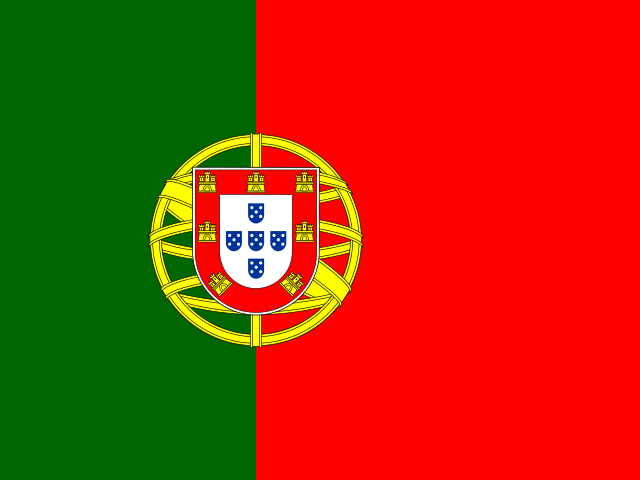
Flag protocol in Portugal
Published Written by Flagpole Guides
This page is an English translation of the Portuguese original. Where the two versions differ, the Portuguese text is the original.
When the national flag flies with other flags, Portuguese or foreign, it always takes the place of honour. The rule is in article 8 of Decreto-Lei n.º 150/87, which describes the flag’s place with two, three or more poles. This guide summarises those rules, the rules of the Azores and Madeira and the practice followed by local authorities. The flags of other countries are covered in the guide to foreign flags in Portugal.
Right and left in protocol
The decree describes the right from the point of view of a person facing outwards, that is, standing with their back to the building. The memorandum on flags of the Câmara Municipal do Sabugal sums up the convention: in protocol, the right is always the left of the person looking at it from the front. For someone arriving at the building, the place of honour is therefore on the left.
The rules of article 8
| Situation | Place of the national flag |
|---|---|
| Two poles | The one on the right of a person facing outwards |
| Three poles | The centre one |
| More than three poles, on a building | The centre one if there is an odd number; the first to the right of the central point if there is an even number |
| More than three poles, in other cases | The first on the right, with the other flags to its left |
| Poles of different heights | Always the tallest, placed so as to respect the rules above |
| Poles with a yard | At the top of the pole, or on the right-hand side when the top is not prepared for use |
At the premises of international organisations based in Portugal and at international meetings, the decree provides for the national flag to be placed according to the protocol rule in use for such cases. Article 8(3) adds that the national flag is not smaller than the other flags flown with it.
Local authority practice
The Câmara Municipal do Sabugal memorandum describes the practice followed in a municipality with the national flag, the European Union flag, the municipal flag and the parish flags:
- The national flag is normally followed by the European Union flag and only then by the others.
- With an even number of flags, the place of honour is to the right of an imaginary central line inside a building, or on the right-hand side, with the others in linear order, outside.
- With more than five flags outside, the national flag is flown on the first pole on the right, so that it stands out more than it would in the centre.
- The poles stand to the right of the main door, that is, to the left of someone looking at it. When they are perpendicular to the door, the one closest to the door is for the national flag.
- When two flags are flown on the same pole, the national flag is at the top.
The Azores and Madeira
- Azores: Decreto Regulamentar Regional n.º 13/79/A provides that, on public buildings and at official ceremonies, the Azorean flag is always flown with the national flag. With two poles, the national flag takes the one on the right and the Azorean flag the one on the left; with three, the national flag takes the centre one and the Azorean flag the one on the right; with more than three, the national flag takes the first on the right and the Azorean flag the next one.
- Madeira: Decreto Regional n.º 30/78/M provides that the institutions and services under the regional government place a pole for the regional flag to the left of the national flag’s pole, and that the regional flag is flown with the national flag.
In both cases the regional flag takes the position subordinate to the national flag. The regional flags are described in the guide to flag types.
At ceremonies and indoors
According to the Sabugal memorandum, on a stage behind a presiding table the national flag is placed so that it can be seen from any angle, and in a procession it takes the right-hand side if there are only two flags. The national flag is not compulsory at a private event, but the memorandum notes that tradition almost always includes it when official figures are present.
The precedence of the persons present at an official ceremony, for example the place of the President of the Republic, ministers or mayors, is governed by Lei n.º 40/2006, the Law on the Precedence of the Protocol of the Portuguese State.
Mourning
During national mourning, all the flags flown with the national flag are at half-mast, and the order stays the same. The procedure is described in the guide to half-mast. The arrangement of poles at a company’s premises is covered in the guide to flagpoles for businesses.
Frequently asked questions
Where does the national flag go when there are two poles?
Under article 8 of Decreto-Lei n.º 150/87, with two poles the one on the right of a person facing outwards is reserved for the national flag. For someone facing the building, the national flag is therefore on the left.
And with three poles?
With three poles, the national flag takes the centre one, under article 8 of the decree. The European Union flag and the flag of the region or municipality commonly take the other two.
Does the European Union flag come right after the national flag?
According to the memorandum on flags of the Câmara Municipal do Sabugal, the national flag, which always presides on national territory, is normally followed by the European Union flag and only then by the others. Decreto-Lei n.º 150/87 does not mention the European flag.
Can the national flag be smaller than the others?
No. Article 8(3) of Decreto-Lei n.º 150/87 provides that the national flag, when flown with other flags, is not smaller than they are.
What are the rules for poles of different heights?
When the poles differ in height, the decree provides for the national flag always to take the tallest pole, placed so as to respect the rules of position. On poles with a yard, the flag is flown at the top of the pole or on the right-hand side when the top is not prepared for use.
Sources
This guide is based on the following sources, most of them in Portuguese:
- Decreto-Lei n.º 150/87, de 30 de março (uso da Bandeira Nacional) – Presidência da República
- Memorando: colocação de bandeiras – Câmara Municipal do Sabugal
- Decreto Regulamentar Regional n.º 13/79/A, de 18 de maio – Diário da República
- Decreto Regional n.º 30/78/M, de 12 de setembro – Diário da República
- Lei n.º 40/2006, de 25 de agosto (Lei das Precedências do Protocolo do Estado Português) – Diário da República
Related guides
- Foreign flagsFlags of other countries in Portugal: flying a foreign flag, the national flag’s place of honour, the size rule and the criminal protection of foreign symbols.
- Flag rulesThe rules for the Portuguese national flag: who may fly it, flying hours from 9.00 to sunset, lighting, good condition, place of honour and legal protection.
- Flag typesTypes of flags in Portugal: the national flag, the naval jack and pennants, the flags of the Azores and Madeira, and municipal and parish flags.
- Flagpoles for businessesFlagpoles for businesses in Portugal: the national flag at the headquarters, logo flags and Lei n.º 97/88, municipal permits, protocol and several poles.
- Half-mastHalf-mast in Portugal: when it applies, raising the flag to the top before half-mast, what happens to other flags and the difference from municipal mourning.