Flagpoles for businesses in Portugal
Published Written by Flagpole Guides
This page is an English translation of the Portuguese original. Where the two versions differ, the Portuguese text is the original.
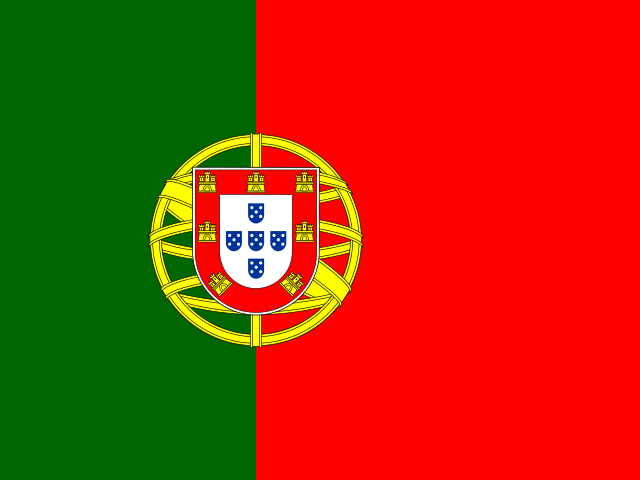
For many companies, the poles at the entrance to their headquarters are a calling card: the national flag, the company flag and sometimes the flags of their customers’ countries. A company that flies flags meets three sets of rules: Decreto-Lei n.º 150/87 on the national flag, Lei n.º 97/88 on advertising messages and the municipal permit for the work. This guide summarises all three.
The national flag at the company
Article 4 of Decreto-Lei n.º 150/87 distinguishes:
- Public companies and public institutes: the national flag is flown at their headquarters, and may also be flown elsewhere.
- Private institutions: the national flag may be flown, provided the legal and protocol procedures in force are respected.
Article 3 allows the heads of private institutions to set further days for flying the flag, beyond Sundays, holidays and days of official ceremonies. The dates are in the guide to flag days.
Logo flags
A flag with the company logo is, legally, a commercial advertising message. Under article 1 of Lei n.º 97/88, as worded by Decreto-Lei n.º 48/2011, displaying advertising messages requires prior licensing, with exceptions:
| Situation | Regime |
|---|---|
| On company property, not visible from public space | No licence |
| On company property, advertising the establishment’s distinctive signs or the goods and services sold there, even if visible from public space | No licence, subject to the criteria set by the municipality |
| On public space next to the façade, advertising the establishment itself | No licence, without prejudice to the rules on use of public space |
| Other cases | Prior licence from the câmara municipal |
Under the same law, the licensing criteria aim, among other things, not to spoil the look of places, not to harm monuments, not to affect road traffic safety and not to use shapes or colours that could be confused with traffic signs. Displaying advertising without the consent of the owner of the property is prohibited.
Permit for the pole
The pole is a piece of works, and its status depends on the municipal urban development and building regulations, as described in the guide to flagpole installation. Under Lei n.º 97/88, when advertising requires building works subject to a licence, both licences are obtained cumulatively. In a building divided into flats, article 1422 of the Civil Code requires the authorisation of the condominium assembly for works that change the architectural line or the aesthetic appearance.
Several poles
With two or more poles, the protocol rules of article 8 of Decreto-Lei n.º 150/87 apply:
- The national flag always takes the place of honour: with two poles, the one on the right of a person facing outwards; with three, the centre one.
- The national flag is not smaller than the other flags.
- With poles of different heights, it takes the tallest.
According to the memorandum on flags of the Câmara Municipal do Sabugal, the poles stand to the right of the main door, that is, to the left of someone looking at it, and when they are perpendicular to the door, the one closest to the door is for the national flag. The full rules are in the guide to flag protocol.
Flags of customers and partners
Hotels, exporting companies and event organisers often fly the flags of other countries. With the national flag, the national flag keeps the place of honour. The subject is covered in the guide to foreign flags in Portugal.
National mourning
During national mourning, all the flags flown with the national flag are at half-mast, including the company flag. Half-mast is only possible on a pole with a halyard. The choice of pole type is in the guide to types of flagpoles, and the price in the guide to buying a flagpole.
Frequently asked questions
Can a company fly the Portuguese national flag?
Yes. Under article 4 of Decreto-Lei n.º 150/87, the national flag may be flown by private institutions, provided the legal and protocol procedures in force are respected. Public companies fly it at their headquarters.
Does a logo flag need a licence?
A logo flag is an advertising message. Under Lei n.º 97/88, it needs no licence when it is displayed on the company’s own property and advertises the establishment’s distinctive signs or the goods and services sold there, even if visible from public space. The municipalities set the criteria that apply in those cases.
And an advertising flag on public space?
Outside the exempt cases, the display of commercial advertising messages requires prior licensing by the câmara municipal, under Lei n.º 97/88. The câmaras set the licensing criteria in their municipality.
With the national flag, can the company flag be larger?
No. Article 8 of Decreto-Lei n.º 150/87 provides that the national flag, when flown with other flags, always takes the place of honour and is not smaller than the other flags.
Sources
This guide is based on the following sources, most of them in Portuguese:
- Decreto-Lei n.º 150/87, de 30 de março (uso da Bandeira Nacional) – Presidência da República
- Lei n.º 97/88 (afixação e inscrição de mensagens de publicidade e propaganda) – Diário da República
- Regime Jurídico da Urbanização e Edificação – Diário da República
- Memorando: colocação de bandeiras – Câmara Municipal do Sabugal
- Código Civil (artigo 1422.º) – Diário da República
Related guides
- Flag protocolFlag protocol in Portugal: the place of honour of the national flag with two, three or more poles, and the European, regional and municipal flags.
- Flagpole installationPutting up a flagpole in Portugal: what the RJUE says, the municipal regulations, listed buildings, condominiums, the foundation and buried cables.
- Foreign flagsFlags of other countries in Portugal: flying a foreign flag, the national flag’s place of honour, the size rule and the criminal protection of foreign symbols.
- Types of flagpolesThe types of flagpoles: ground-mounted poles, façade poles, rooftop poles, poles with a yard, telescopic poles and internal halyards, and where each is used.
- Buying a flagpoleThe price of a flagpole in Portugal: how height, material, halyard, base, transport and installation affect it, and what consumer law says.
- Flag typesTypes of flags in Portugal: the national flag, the naval jack and pennants, the flags of the Azores and Madeira, and municipal and parish flags.