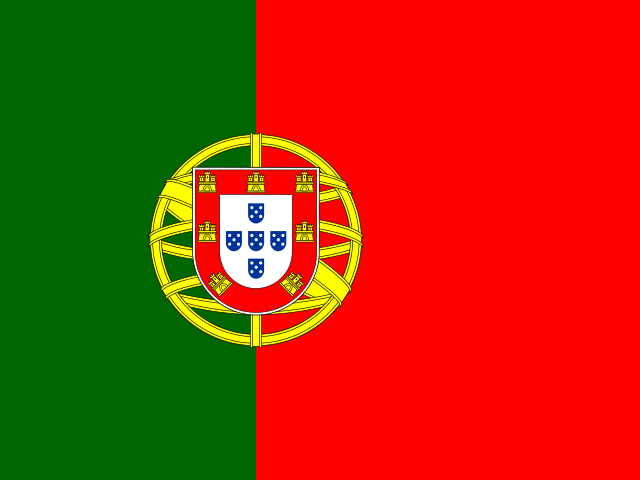
Rules for the national flag in Portugal
Published Written by Flagpole Guides
This page is an English translation of the Portuguese original. Where the two versions differ, the Portuguese text is the original.
The general rules for the use of the national flag are brought together in Decreto-Lei n.º 150/87 of 30 March. The decree applies throughout the country, without prejudice to the specific rules for military and maritime use. This guide summarises what the decree says about who flies the flag, the flying hours, the condition of the flag and the respect due to it. The rules for several flags together are in the guide to flag protocol.
Who may fly the flag?
Article 4 of the decree distinguishes two cases. The national flag is flown on buildings classified as national monuments, on public buildings housing services of the central, regional and local administration and of the autonomous regions, and on the headquarters of public institutes and public companies. The flag may also be flown by private institutions and individuals, provided the legal and protocol procedures in force are respected.
No permission is needed for a private individual to fly the national flag on their own pole. The memorandum on flags of the Câmara Municipal do Sabugal summarises the same rule: any private entity may fly the national flag as long as it complies with the legal and protocol requirements.
Flying hours
| Situation | Rule of Decreto-Lei n.º 150/87 |
|---|---|
| Normal hours | Between 9.00 and sunset (article 6(1)) |
| Flag flown at night | Lit by floodlights whenever possible (article 6(2)) |
| Seats of the organs of sovereignty | May be flown every day as of right (article 3(3)) |
| National mourning | At half-mast for the days set (article 7) |
In the Azores, Decreto Regulamentar Regional n.º 13/79/A provides for the regional flag to be flown from morning to sunset, and on gala holidays to stay up until midnight on buildings that are lit. Lighting is covered in the guide to flag lighting.
Raising and lowering
The decree does not describe step by step how the flag is raised, with one exception: to fly at half-mast, the flag goes to the top before being lowered to half-mast, and the same procedure is repeated when it is taken down. Since the flag is the symbol of the nation, raising and lowering it are usually done with the same dignity that the decree requires for the flag itself. Half-mast is covered in the guide to half-mast.
Official pattern and good condition
Article 2 provides for the national flag to be displayed according to the official pattern and in good condition, so as to preserve the dignity due to it. According to the Presidency of the Republic, the official pattern is the one defined in article 11 of the Constitution, that is, the flag adopted by the Republic in 1910. The Sabugal memorandum adds that there is only one official pattern and that a flag that is fraying, torn or faded is usually replaced.
The proportions and colours of the official pattern are described in the guide to flag sizes, and care in the guide to flagpole maintenance.
Where the poles stand
Under article 9, flagpoles are placed in a place of honour on the ground, on façades or on top of buildings, and the heads of the services concerned approve the form and place of fixing. At public events, when the flag is not flown on a pole, article 10 allows it to be hung in a place of honour where it is clearly visible.
The flag is not decoration
Article 10 provides that the national flag is never used as decoration, as a covering or for any purpose that could affect the respect due to it. The flag of Madeira is a different case: Decreto Regional n.º 30/78/M allows it to be used as a decorative element in the street, in public venues, homes or private establishments, as long as this is not disrespectful.
What criminal law says
Article 1 of Decreto-Lei n.º 150/87 provides for the national flag to be respected by all citizens, subject to the penalties laid down in criminal law. Article 332 of the Penal Code punishes anyone who publicly, by words, gestures, writing or other means of communication with the public, insults the Republic, the national flag or anthem, or the arms or emblems of Portuguese sovereignty, or fails to show them due respect:
- National symbols: up to two years in prison or a fine of up to 240 days.
- Regional symbols: up to one year in prison or a fine of up to 120 days, when the acts target the autonomous regions, the regional flags or anthems or the emblems of their autonomy.
According to the Presidency of the Republic, the criminal protection of the flag goes back to a decree of 28 December 1910. The flags of other countries have their own protection under article 323, described in the guide to foreign flags in Portugal.
Frequently asked questions
At what time is the flag lowered in Portugal?
Under article 6 of Decreto-Lei n.º 150/87, the national flag flies between 9.00 and sunset. It is usually lowered then, unless it stays up during the night with lighting.
Can the Portuguese flag stay up overnight?
Yes. The decree provides that, when the national flag stays up during the night, it is lit by floodlights whenever possible. On the seats of the organs of sovereignty, the flag may be flown every day.
Can a torn or faded flag be flown?
Article 2 of Decreto-Lei n.º 150/87 provides for the national flag to be displayed according to the official pattern and in good condition, so as to preserve the dignity due to it. A torn or faded flag is therefore commonly replaced.
Can the national flag be used as decoration?
Article 10 of the decree allows the flag, at public events, to be hung in a place of honour when it is not flown on a pole, but never to be used as decoration, as a covering or for any purpose that could affect the respect due to it.
What penalty does the law set for insulting the flag?
Article 332 of the Penal Code punishes anyone who publicly insults the national flag or anthem, or fails to show them due respect, with up to two years in prison or a fine of up to 240 days. For the regional flags, the penalty is up to one year in prison or a fine of up to 120 days.
Sources
This guide is based on the following sources, most of them in Portuguese:
- Decreto-Lei n.º 150/87, de 30 de março (uso da Bandeira Nacional) – Presidência da República
- Símbolos Nacionais – Presidência da República
- Código Penal (artigo 332.º) – Diário da República
- Memorando: colocação de bandeiras – Câmara Municipal do Sabugal
Related guides
- Flag daysWhen the national flag is flown in Portugal: Sundays, the national and regional holidays of 2026 and 2027, official ceremonies and days set by the Government.
- Half-mastHalf-mast in Portugal: when it applies, raising the flag to the top before half-mast, what happens to other flags and the difference from municipal mourning.
- Flag protocolFlag protocol in Portugal: the place of honour of the national flag with two, three or more poles, and the European, regional and municipal flags.
- Flag lightingThe flag flown at night in Portugal: what Decreto-Lei n.º 150/87 provides on floodlights, the Azores rule for gala holidays and the usual lighting solutions.
- Flag typesTypes of flags in Portugal: the national flag, the naval jack and pennants, the flags of the Azores and Madeira, and municipal and parish flags.