Types of flags in Portugal
Published Written by Flagpole Guides
This page is an English translation of the Portuguese original. Where the two versions differ, the Portuguese text is the original.
In Portugal the best-known flag is the green and red national flag, but it is not the only one with official status. The autonomous regions have their own flags, municipalities and parishes use heraldic flags, and the Armed Forces and security forces have standards and unit flags. This guide presents the most common types and the rules for each.
The national flag
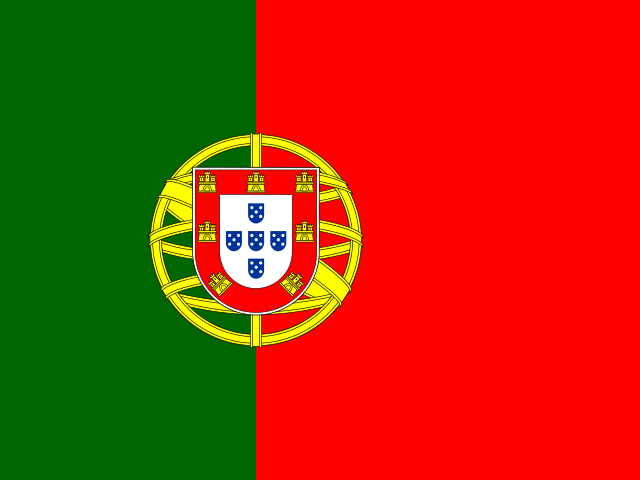
Under article 11 of the Constitution, the national flag is the one adopted by the Republic established by the Revolution of 5 October 1910. The 1911 decree describes it as divided vertically into dark green and scarlet, with the green at the hoist, and with the shield of the national arms, edged in white, on the Manueline armillary sphere in yellow, in the centre over the join between the two colours.
The length is one and a half times the height of the hoist, green takes two fifths of the length and red three fifths, and the central emblem is half the height. The measurements are in the guide to flag sizes, and the meaning of the elements in the guide to flag symbolism.
Military and naval flags
The decree of 30 June 1911 also set the flags of military units, in silk, in which the gold armillary sphere is surrounded by two laurel branches and a scroll with the line from Camões "Esta é a ditosa pátria minha amada". For ships it set the jack, with a green border and a scarlet centre, and the pennants, in green and red. Decreto-Lei n.º 150/87 keeps the specific rules for the use of the flag in military and maritime settings.
The security forces have their own heraldry regulations. The GNR Heraldry Regulations (Portaria n.º 1194/2009), for example, provide for square flags for flying, standards, guidons, pennants and small pennants.
Flag of the Azores
According to the Legislative Assembly of the Autonomous Region of the Azores, the first autonomy flag was raised in November 1897 at Lomba dos Gagos, in the municipality of Ponta Delgada. It had the colours of the national flag of the time, blue and white, with a flying goshawk under nine stars in the centre, and served as the model for today’s flag, approved in 1979. The official version is in Decreto Regulamentar Regional n.º 13/79/A, which also governs its use:
- On public buildings and at official ceremonies, the Azorean flag is always flown with the national flag.
- It is flown on Sundays and holidays, from morning to sunset.
- The flag is no more than half and no less than a quarter of the height of the pole.
Flag of Madeira
Decreto Regional n.º 30/78/M defines the flag of Madeira as rectangular, its height two thirds of its width, and divided into three equal rectangles: blue at the hoist and at the far end and gold in the middle, with the cross of the Order of Christ. According to the preamble, blue reflects the environment that makes up the islands’ insularity and gold the mild climate, and the cross recalls that the archipelago belonged to the Order of Christ from its discovery.
Unlike the national flag, the flag of Madeira may be used as a decorative element in the street, in public venues, homes and private establishments, as long as this is not disrespectful.
Flags of municipalities and parishes
Lei n.º 53/91 governs the heraldry of local authorities. Administrative regions, municipalities, parishes, cities, towns and public-interest legal persons are entitled to heraldic symbols, and the national shield may not be included in them. The law distinguishes two types of flag:
| Type | Form and material |
|---|---|
| Standard | Square with 1 m sides, in embroidered silk, a parade flag |
| Flag for flying | Rectangular, length one and a half times the hoist, in bunting or equivalent fabric |
Under the law, the standards of cities are gyronny of eight and those of towns and parishes quarterly, or of a single colour, with the coat of arms in the centre. The flag for flying follows the design of the standard.
The European Union flag
The blue flag with twelve gold stars is seen on many Portuguese public buildings, beside the national flag. Decreto-Lei n.º 150/87 does not mention it, but according to the memorandum on flags of the Câmara Municipal do Sabugal it normally comes right after the national flag. The subject is covered in the guide to flag protocol.
Advertising flags
Many companies fly flags with their logo. These are not official symbols but advertising messages, and their display is governed by Lei n.º 97/88. The rules are in the guide to flagpoles for businesses, and the choice of fabric and finish in the guide to buying a flag.
Frequently asked questions
Which flags are official in Portugal?
The national flag, defined in article 11 of the Constitution, the flags of the autonomous regions of the Azores and Madeira, set in regional legislation, and the heraldic flags of municipalities and parishes, governed by Lei n.º 53/91. The Armed Forces and the security forces also have their own flags and standards.
What does the flag of the Azores look like?
According to the Legislative Assembly of the Azores, the regional flag takes up the autonomy flag raised in 1897, in blue and white with a flying goshawk under nine stars in the centre. The official version was approved by Decreto Regulamentar Regional n.º 13/79/A.
What does the flag of Madeira look like?
Under Decreto Regional n.º 30/78/M, the flag of Madeira is rectangular, its height two thirds of its width, and divided into three equal rectangles: blue at the hoist and at the far end, gold in the middle, with the cross of the Order of Christ.
What is the difference between a standard and a flag for flying?
In local authority heraldry, Lei n.º 53/91 distinguishes the standard, a square parade flag with 1 metre sides in embroidered silk, and the flag for flying, rectangular with a length one and a half times the hoist, in bunting or an equivalent fabric.
Sources
This guide is based on the following sources, most of them in Portuguese:
- Símbolos Nacionais – Presidência da República
- Decreto de 30 de junho de 1911 (medidas e proporções da Bandeira Nacional) – Presidência da República
- Decreto Regulamentar Regional n.º 13/79/A, de 18 de maio – Diário da República
- Novembro de 1897 – Primeira Bandeira Autonómica – Assembleia Legislativa da Região Autónoma dos Açores
- Decreto Regional n.º 30/78/M, de 12 de setembro – Diário da República
- Lei n.º 53/91, de 7 de agosto (heráldica autárquica) – Diário da República
- Portaria n.º 1194/2009, de 8 de outubro (Regulamento de Heráldica da GNR) – Diário da República
- Memorando: colocação de bandeiras – Câmara Municipal do Sabugal
Related guides
- Flag symbolismThe meaning of the Portuguese flag: green and red according to the 1910 commission, the armillary sphere, the quinas, the seven castles and official colours.
- Flag sizesFlag sizes in Portugal: the official proportions of 1911, the usual sizes, the relationship with the height of the pole and the rules of the Azores and the GNR.
- Flag protocolFlag protocol in Portugal: the place of honour of the national flag with two, three or more poles, and the European, regional and municipal flags.
- Flag rulesThe rules for the Portuguese national flag: who may fly it, flying hours from 9.00 to sunset, lighting, good condition, place of honour and legal protection.
- Buying a flagThe price of a flag in Portugal: how size, fabric, making, the official pattern and customisation affect it, and the consumer’s rights when buying.