Flag sizes in Portugal – the flag and the pole
Published Written by Flagpole Guides
This page is an English translation of the Portuguese original. Where the two versions differ, the Portuguese text is the original.
The size of a flag depends on two things: the proportions set by law and the relationship with the pole, which the law leaves open. The proportions of the national flag have been fixed since 1911. The size of flag for each pole, on the other hand, comes from practice, with some partial official references. This guide brings both together. The size for a particular pole can be worked out with the flag size calculator.
The official proportions
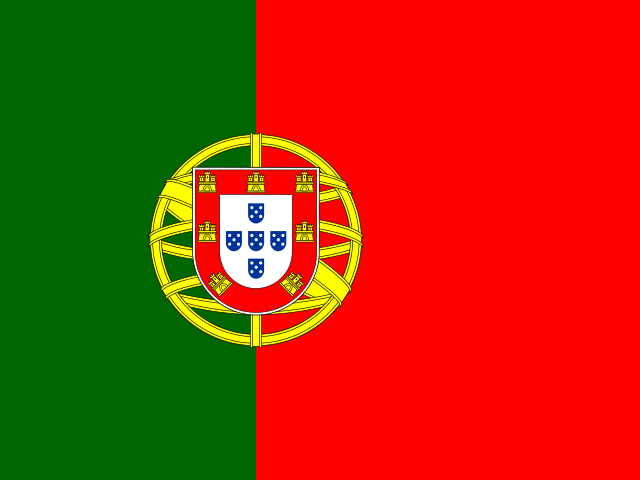
The decree published in the Diário do Governo of 30 June 1911, implementing the decree of the Constituent National Assembly of 19 June, sets the measurements of the national flag:
| Element | Measurement |
|---|---|
| Length | One and a half times the height of the hoist (ratio 2 : 3) |
| Green, at the hoist | Two fifths of the length |
| Red | Three fifths of the length |
| Central emblem | Half the height of the hoist, equidistant from the top and bottom edges |
The hoist is the side of the flag next to the pole. On a flag 100 centimetres high, the length is 150 centimetres, green takes 60 centimetres and red 90. The Presidency of the Republic’s archive adds, in its drawing instructions, that the diameter of the armillary sphere is half the height of the flag and that the shield is seven tenths of the sphere’s diameter high.
Usual sizes
Flags are sold in standard sizes, given as height × length. According to a Portuguese supplier, the most common sizes of the national flag are:
| Height | Length |
|---|---|
| 60 cm | 90 cm |
| 80 cm | 120 cm |
| 100 cm | 150 cm |
| 120 cm | 180 cm |
| 150 cm | 225 cm |
| 200 cm | 300 cm |
The area grows quickly: according to the same supplier, a 200 × 300 cm flag has four times the area of a 100 × 150 cm one, and the wind load on the pole increases accordingly.
The flag and the pole
No Portuguese law links the size of the national flag to the height of the pole. Decreto-Lei n.º 150/87 only provides that the national flag, when flown with other flags, is not smaller than they are. There are, however, two partial official references:
- GNR: The GNR Heraldry Regulations (Portaria n.º 1194/2009) state that the side of its flags for flying, which are square, is proportional to the height of the pole and can, as a reference, be between one fifth and one seventh of the pole’s height.
- Azores: Decreto Regulamentar Regional n.º 13/79/A provides that the flag of the Azores is no more than half and no less than a quarter of the pole’s height.
In commercial practice, the same one-seventh-to-one-fifth rule appears in a Portuguese flag supplier’s table:
| Height of the pole | Most common size | Alternative in the same table |
|---|---|---|
| 3 to 4 m | 60 × 90 cm | 50 × 75 cm on an exposed site |
| 5 m | 80 × 120 cm | 100 × 150 cm on a sheltered site |
| 6 m | 100 × 150 cm | 120 × 180 cm for greater visibility |
| 8 m | 120 × 180 cm | 150 × 225 cm on a sheltered site |
| 10 m | 150 × 225 cm | 200 × 300 cm on a sheltered site |
| 12 m | 200 × 300 cm | 240 × 360 cm for large installations |
According to the supplier, the smaller size in the range is the more common one in coastal areas and windy sites, and the limit set by the pole’s manufacturer takes precedence over any general guidance. The height of the pole is covered in the guide to flagpole heights.
Façade poles
On an angled façade pole, the flag needs room to move without touching the wall, windows or trees. In the same supplier’s table, a pole of 1.2 to 1.5 metres takes a flag of 50 × 75 or 60 × 90 cm, and a pole of 2 to 2.5 metres a flag of 80 × 120 cm.
Flags with different proportions
Not all flags have the proportions 2 : 3. The flag of Madeira also has a height two thirds of its width, under Decreto Regional n.º 30/78/M, but the GNR’s flags for flying are square, and so are local authority standards. When flags of different proportions fly side by side, it is common to choose sizes of the same height, so that the national flag is not smaller. The rules are in the guide to flag protocol.
Frequently asked questions
What are the proportions of the Portuguese flag?
Under the decree of 30 June 1911, the length of the flag is one and a half times the height of the hoist, a ratio of 2 to 3. Green takes two fifths of the length and red three fifths, and the central emblem is half the height of the hoist.
Is there a compulsory flag size for each pole in Portugal?
No. No Portuguese law links the size of the national flag to the height of the pole. Decreto-Lei n.º 150/87 only provides that the national flag is not smaller than the flags flown with it.
What size of flag is used on a 6 metre pole?
In a Portuguese supplier’s table, the most common size for a 6 metre pole is 100 × 150 centimetres, with 120 × 180 centimetres as the alternative for greater visibility. That corresponds to a height between one seventh and one fifth of the pole’s height.
Is there any official rule on the proportion between flag and pole?
There are two partial official references. The GNR Heraldry Regulations give, as a reference for their flags for flying, a side between one fifth and one seventh of the pole’s height. In the Azores, Decreto Regulamentar Regional n.º 13/79/A provides that the regional flag is no more than half and no less than a quarter of the pole’s height.
Sources
This guide is based on the following sources, most of them in Portuguese:
- Decreto de 30 de junho de 1911 (medidas e proporções da Bandeira Nacional) – Presidência da República
- Bandeira nacional da República Portuguesa — desenho – Presidência da República
- Decreto-Lei n.º 150/87, de 30 de março (uso da Bandeira Nacional) – Presidência da República
- Portaria n.º 1194/2009, de 8 de outubro (Regulamento de Heráldica da GNR) – Diário da República
- Decreto Regulamentar Regional n.º 13/79/A, de 18 de maio – Diário da República
- Decreto Regional n.º 30/78/M, de 12 de setembro – Diário da República
- Como escolher o tamanho da bandeira para o mastro – Mundo das Bandeiras
Related guides
- Flag size calculatorThe calculator shows the size of flag for the height of the pole, using a Portuguese supplier’s table, the GNR reference and the rule of the Azores.
- Flagpole heightsFlagpole heights in Portugal: usual heights for houses, businesses and public buildings, the relationship with the flag, half-mast and municipal permits.
- Flag typesTypes of flags in Portugal: the national flag, the naval jack and pennants, the flags of the Azores and Madeira, and municipal and parish flags.
- Buying a flagThe price of a flag in Portugal: how size, fabric, making, the official pattern and customisation affect it, and the consumer’s rights when buying.
- Flag protocolFlag protocol in Portugal: the place of honour of the national flag with two, three or more poles, and the European, regional and municipal flags.