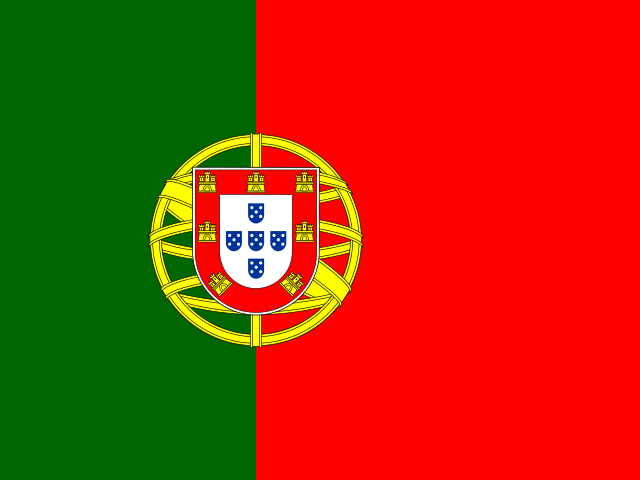
History of the flagpole and the flag in Portugal
Published Written by Flagpole Guides
This page is an English translation of the Portuguese original. Where the two versions differ, the Portuguese text is the original.
In Portugal the flagpole has maritime roots. Flags and pennants on ships’ masts identified nationality and sent signals, and the vocabulary of flag flying, with words such as adriça (halyard), verga (yard) and a tope (at the top), comes from the language of the sea. On land, the flagpole gained importance with the Republic, when the new flag was raised on barracks, castles and public buildings. This guide traces that history.
The flag at sea
The decree of 30 June 1911, which set the measurements of the new national flag, dealt at the same time with the flags of the sea: the ships’ jack, with a green border and a scarlet centre, and the pennants, in green and red. Decreto-Lei n.º 150/87 still keeps the specific rules for the use of the flag at sea, which follow different rules from those on land.
The flag of the revolution
According to the Presidency of the Republic, the green and red colour scheme goes back to the republican movement of 31 January 1891 in Porto. On 5 October 1910, the colours were used by Machado Santos at the Rotunda and then at all the barracks and on top of São Jorge Castle, still with the red at the hoist and the larger part green.
The Provisional Government appointed a commission for the new flag on 15 October and approved its design on 29 November 1910. Two days later, on 1 December, it established the Festival of the Flag, the Republic’s first great civic celebration, organised by the Lisbon City Council. The Constituent National Assembly sanctioned the flag at its opening session on 19 June 1911. The meaning of the colours is in the guide to flag symbolism.
The early years
Acceptance was not immediate. According to the Museum of the Presidency of the Republic, the "flag quarrel" set the supporters of the monarchy’s blue and white against those of green and red in the newspapers, and for many the new flag remained linked to the revolution. It was the First World War that, according to the museum, united the Portuguese under the new symbol.
The Azorean autonomy flag
According to the Legislative Assembly of the Autonomous Region of the Azores, the first autonomy flag was raised in November 1897 on a property of José Maria Raposo de Amaral Júnior, one of the leaders of the autonomy movement, at Lomba dos Gagos, in the parish of Ginetes, municipality of Ponta Delgada. It had the colours of the national flag of the time, blue and white, a flying goshawk under nine stars and, in the upper corner, the national shield. It served as the model for the flag of the Azores approved in 1979. The regional flags are described in the guide to flag types.
The rules of 1987
For decades the rules on the use of the flag were scattered across several pieces of legislation. Decreto-Lei n.º 150/87 brought them together in 1987. Its preamble explains that the legislation was scattered and incomplete, "dating in some cases from the beginning of the century", and the decree set the flying hours, half-mast, the place of honour and the placing of flagpoles in a place of honour on the ground, on façades or on top of buildings.
The pole in Parque Eduardo VII
The country’s largest flagpole in a public space stands at the top of Parque Eduardo VII in Lisbon. According to RTP, the flag measuring 20 by 12 metres and 240 square metres was raised in September 2005 on a pole 35 metres high, by the President of the Lisbon City Council, and was then the largest national flag in the country.
The flagpole today
Today aluminium and fibreglass poles have replaced wooden ones, and many have an internal halyard and a tilting base. The technical development is described in the guides to types of flagpoles and materials, and the flag’s calendar in the guide to flags on holidays.
Frequently asked questions
Since when has the green and red flag existed?
According to the Museum of the Presidency of the Republic, the green and red flag was approved by the Provisional Government on 29 November 1910 and ratified by the Constituent National Assembly on 19 June 1911. The colours go back to the republican movement of 31 January 1891.
Where was the republican flag raised on 5 October 1910?
According to the Presidency of the Republic, green and red were used on 5 October by Machado Santos at the Rotunda and then at all the barracks and on top of São Jorge Castle, still with the red at the hoist and the larger part green.
What is the tallest flagpole in Portugal?
The pole at the top of Parque Eduardo VII in Lisbon is 35 metres high. According to RTP, the flag measuring 20 by 12 metres and 240 square metres was raised in September 2005 and was then the largest national flag in the country.
Since when has the flag of the Azores existed?
According to the Legislative Assembly of the Azores, the first autonomy flag was raised in November 1897 at Lomba dos Gagos, in the municipality of Ponta Delgada, and served as the model for today’s flag, approved in 1979.
Sources
This guide is based on the following sources, most of them in Portuguese:
- Bandeira Nacional – Presidência da República
- Bandeira Nacional – Museu da Presidência da República
- Decreto de 30 de junho de 1911 (medidas e proporções da Bandeira Nacional) – Presidência da República
- Novembro de 1897 – Primeira Bandeira Autonómica – Assembleia Legislativa da Região Autónoma dos Açores
- Decreto-Lei n.º 150/87, de 30 de março (uso da Bandeira Nacional) – Presidência da República
- Presidente da Câmara de Lisboa hasteia mega bandeira nacional no Parque Eduardo VII – RTP
Related guides
- Flag symbolismThe meaning of the Portuguese flag: green and red according to the 1910 commission, the armillary sphere, the quinas, the seven castles and official colours.
- Flag typesTypes of flags in Portugal: the national flag, the naval jack and pennants, the flags of the Azores and Madeira, and municipal and parish flags.
- Types of flagpolesThe types of flagpoles: ground-mounted poles, façade poles, rooftop poles, poles with a yard, telescopic poles and internal halyards, and where each is used.
- Flags on holidaysThe national flag on Portuguese public holidays: the meaning of 25 April, 10 June, 5 October and 1 December, and the regional and municipal holidays.