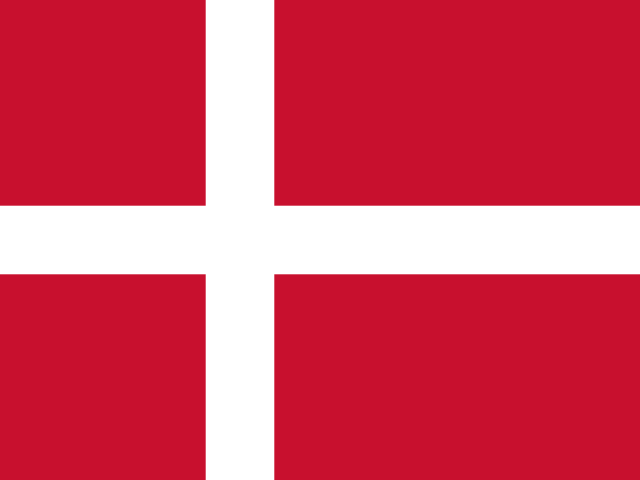
Flagpoles and flag flying in Denmark
Published Written by Flagpole Guides
This page is an English translation of the Danish original. Where the two versions differ, the Danish text is the original.
Danes fly their flag a great deal. Dannebrog flies in suburban gardens, summer-house areas, allotments, at businesses and on town halls, and small paper flags decorate birthday cakes and Christmas trees. Even so, there are surprisingly few rules for individuals: the Flag Act is about which flags may be raised, and the official flag days apply to state authorities. The rest is custom. This page brings together the essentials of flag flying and flagpoles in Denmark, with sources from legislation, circulars, authorities and Dannebrogs-Samfundet, the Danish flag society.
The essentials in brief
- Flag days: A 2024 circular from the Ministry of Justice sets 21 official flag days, among them Constitution Day, Valdemar’s Day, royal birthdays and the church festivals. All dates are in the guide to flag days.
- Flag times: According to Dannebrogs-Samfundet, the flag is raised no earlier than 8 a.m. or sunrise and lowered at sunset at the latest. More in the guide to flag rules.
- Half-mast: The flag is first raised to the top and then lowered. On Good Friday it flies at half-mast all day, on 9 April until noon. More in the guide to half-mast.
- Which flag: Anyone can use the rectangular flag. The swallow-tailed flag is reserved for the state and the royal family. More in the guide to flag types.
- Other countries’ flags: Since 1 January 2025 they are prohibited as a rule, with exceptions including the Nordic and German flags. More in the guide to foreign flags in Denmark.
- Size: The rule of thumb and Dannebrogs-Samfundet’s table are shown in the flag size calculator.
- Buying: What affects the price is covered in the guides to buying a flagpole and buying a flag.
- Flagpole and municipality: The Building Regulations do not mention flagpoles, but local plans and easements can contain provisions. More in the guide to flagpole installation.
Legislation, circulars and authorities
The Flag Act (Act no. 1449 of 10 December 2024) came into force on 1 January 2025. It states that Dannebrog is the national flag of the Realm of Denmark, that the swallow-tailed flag is flown by the royal family, the Folketing, state authorities and the courts, and that, as a rule, flying other countries’ national and regional flags is prohibited. The Act falls under the Ministry of Justice, and the police can grant permission to fly a flag covered by the ban. The Act does not apply in the Faroe Islands and Greenland.
The circular on official flag days of 19 December 2024 sets the days on which state authorities fly the swallow-tailed flag. According to the Ministry of Justice, private individuals, businesses and organisations are under no obligation to fly the flag on the official flag days.
There are no statutory rules for private use of the rectangular flag. Flag times, half-mast, the size of the flag and the order of flags rest on long-established practice, which Dannebrogs-Samfundet describes in its publication »Sådan bruges Dannebrog« (How Dannebrog is used). The Ministry of Justice itself refers to the publication on its page about flag flying.
The flagpole in Denmark
There is no specific law on the flagpole itself. The Building Regulations do not mention flagpoles, but according to the guidance on section 6 D of the Building Act, the Act’s concept of building also covers fixed structures such as a flagpole. Local plans, registered easements and the coastal protection line can matter for position and height.
In Danish gardens, flagpoles of 7 to 10 metres are common, and Bolius, the Danish homeowners’ knowledge centre, mentions that the pole typically rises one and a half to two metres above the roof ridge. The white flagpole with a red, half-round finial is the classic picture. More in the guides to types of flagpoles and flagpole heights.
About the guides
The guides below are arranged by topic. Each guide covers one defined topic, ends with frequently asked questions, lists its sources and shows when it was last updated. The flag days are calculated for 2026 and 2027, including Easter, Ascension Day and Whitsun, which move from year to year.
All guides
Flag flying and rules
When, how and why flags are flown in Denmark – from the official flag days and flag times to half-mast, mourning and the flags of other countries.
- Flag daysAll official flag days in Denmark for 2026 and 2027 with date and weekday under the Ministry of Justice circular – with half-mast days, Erfalasorput and Merkið.
- Flag rulesFlag rules in Denmark: the Flag Act, flag times from 8 a.m. to sunset, the swallow-tailed and rectangular flags, wind, flying at night and good flag etiquette.
- Half-mastHalf-mast in Denmark: where the flag sits, how it is raised and lowered, Good Friday, 9 April, deaths and funerals – according to the authorities and custom.
- Flags in mourningFlags in mourning in Denmark: deaths, funerals, memorial services, scattering of ashes and Dannebrog on the coffin – the customs and their sources.
- Flags on holidaysFlags on holidays and special days in Denmark: Easter, Whitsun, Christmas, Constitution Day, Valdemar’s Day, 9 April, 5 May and private occasions.
- Flag protocolFlag protocol in Denmark: where Dannebrog goes, the order of the Nordic flags, alphabetical order by French names and the EU and UN flags.
- Foreign flagsForeign flags in Denmark under the 2025 Flag Act: permitted flags, police permission, fines, fantasy flags, the EU and UN flags and the history of the ban.
The flag
The rectangular flag, the swallow-tailed flag, the pennant and the stander, flag sizes and what affects the price – and a calculator that shows which size suits which pole.
- Flag typesDanish flag types: the rectangular flag, the swallow-tailed flag, the naval ensign, the yacht flag, the storm flag, the pennant and the stander.
- Flag sizesDanish flag sizes: Dannebrog’s 28:37 proportions and Dannebrogs-Samfundet’s table of flags, pennants and standers for flagpoles from 2 to 20 metres.
- Flag size calculatorFlag size calculator for Dannebrog: flag, pennant and stander sizes for flagpoles from 2 to 20 metres, from Dannebrogs-Samfundet’s table and the one-fifth rule.
- Flag symbolismThe symbolism of Dannebrog: the white cross on red, Dannebrog red, the meaning of the name, the legend of 1219 and the flags of Greenland and the Faroes.
- Buying a flagBuying a Danish flag: what affects the price of Dannebrog – size, fabric, sewn or printed cross, pennant and stander – and buyers’ rights under Danish law.
The flagpole
Types, materials, heights, accessories, lighting and what affects the price of a flagpole – and the history of Dannebrog and the flagpole.
- Types of flagpolesTypes of flagpoles in Denmark: free-standing poles with a base or tilting bracket, external and internal halyards, poles on buildings and flag avenues.
- Flagpole materialsFlagpole materials in Denmark: glass fibre, wood, aluminium and steel – maintenance, durability, appearance and price compared.
- Flagpole heightsFlagpole heights in Denmark: 7–10 metres at detached houses, the pole above the roof ridge, consideration for neighbours, local plans and the size of the flag.
- Flagpole accessoriesFlagpole accessories in Denmark: finial, pulley, flag line, flag clips, cleat, base, tilting bracket, pennant and stander – the parts and what they do.
- Flagpole mechanicsFlagpole mechanics in Denmark: how the flag line, pulley, internal winch, flag weight and tilting bracket work – and how a flagpole is lowered.
- Flag lightingFlag lighting in Denmark: when the flag can fly after sunset, which lighting counts as sufficient, the pennant at night and consideration for neighbours.
- History of the flagpoleThe history of Dannebrog and the flagpole in Denmark: from the king’s banner and the swallow-tailed flag to the 1833 ban, freedom in 1854 and the 2025 Flag Act.
- Buying a flagpoleBuying a flagpole in Denmark: what affects the price – height, material, halyard, base, delivery and installation – and buyers’ rights under Danish law.
Installation, safety and care
Local plans, the Building Act, foundations, safety, maintenance and transport – for detached houses, summer houses, housing associations, businesses and municipalities.
- Flagpole installationFlagpole installation in Denmark: the Building Act, local plans and easements, coastal protection, distance to the boundary, foundation and position.
- Flagpole safetyFlagpole safety in Denmark: wind and storm flags, the foundation, lowering the pole, liability for damage and the rules for working at height.
- Flagpole maintenanceFlagpole maintenance in Denmark: painting wooden poles, cleaning glass fibre, checking pulley and line, caring for the flag and disposing of worn flags.
- Flagpole repairFlagpole repair: a broken or stuck flag line, faulty pulley, peeling paint, cracks, a leaning pole and a loose base – causes and common solutions in Denmark.
- Lifespan and sustainabilityLifespan and sustainability of flagpole and flag in Denmark: what wears wood, glass fibre and metal, how flags last longer, and disposal of worn flags.
- Flagpole transportTransporting a flagpole in Denmark: marking loads projecting more than 1 metre, lights in the dark, an escort beyond 2 metres and poles in sections.
- Flagpoles for businessesFlagpoles for businesses in Denmark: company flags, Dannebrog in logos, foreign flags at hotels, municipal orders under the Building Act and liability.
Frequently asked questions
May anyone fly Dannebrog?
Yes. According to Den Store Danske, a royal resolution of 7 July 1854 allowed the population to fly Dannebrog. Private individuals fly the rectangular flag (stutflag). Under section 1(2) of the Flag Act, the swallow-tailed flag is reserved for the royal family, the Folketing, state authorities, the courts and institutions with special permission.
Which rules govern flag flying in Denmark?
The Flag Act, in force since 1 January 2025, states that Dannebrog is the national flag of the Realm and, as a rule, prohibits flying the flags of other countries. A circular from the Ministry of Justice sets the official flag days for state authorities. There are no statutory rules for private use of the rectangular flag, but a number of long-established customs.
Does a flagpole in Denmark need a building permit?
Flagpoles are not mentioned in the Building Regulations. According to the guidance on section 6 D of the Building Act, however, the Act’s concept of building also covers fixed structures such as a flagpole, and a local plan or an easement can contain provisions on position and height. The municipality can give information for the individual property.
When is the flag raised and lowered in Denmark?
According to Dannebrogs-Samfundet, the flag is raised no earlier than 8 a.m., and on days when the sun rises later, not until sunrise. It is lowered at sunset at the latest. The flag times are custom, not law, but they are widely followed by authorities and private individuals alike.
Which flag size suits which Danish flagpole?
There is no official rule. According to Dannebrogs-Samfundet, the height of the flag on a free-standing flagpole is about one fifth of the pole’s length. On a 10-metre pole that is a flag about 2 metres high. Dannebrogs-Samfundet’s table of common sizes is shown in the flag size calculator.
Sources
This guide is based on the following sources, most of them in Danish:
- Lov om flagning (LOV nr. 1449 af 10. december 2024) – Retsinformation
- Cirkulæreskrivelse om officielle flagdage (CIS nr. 10155 af 19. december 2024) – Retsinformation
- Vejledning om flagning – Justitsministeriet (Ministry of Justice)
- Sådan bruges Dannebrog, 2nd edition (2019) – Dannebrogs-Samfundet (formerly Danmarks-Samfundet)
- Vejledning om byggelovens § 6 D – Bygningsreglementet.dk
- Dannebrog – Lex – Den Store Danske
- Flagning – Lex – Den Store Danske