Flag rules in Denmark
Published Written by Flagpole Guides
This page is an English translation of the Danish original. Where the two versions differ, the Danish text is the original.
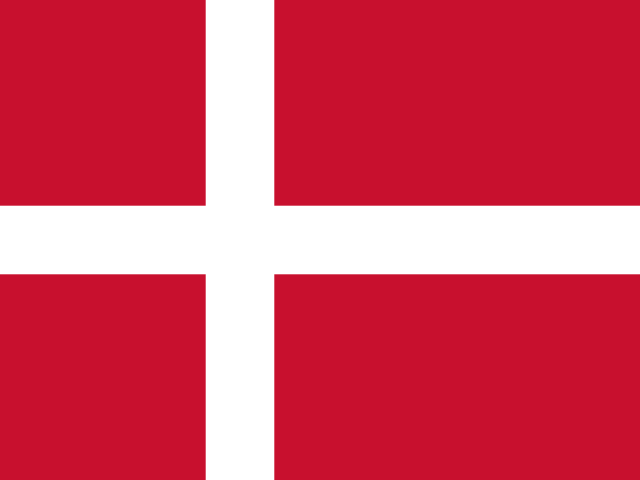
Denmark did not get a Flag Act until December 2024, and it is mostly about which flags may be raised. How Dannebrog is used in practice – flag times, raising the flag, half-mast, size – rests on circulars to the authorities and on customs that go back several hundred years. This guide brings together the rules and the customs described by Dannebrogs-Samfundet and Den Store Danske, the Danish national encyclopaedia.
The Flag Act
The Flag Act came into force on 1 January 2025 and contains three main rules:
- Section 1: The national flag of the Realm of Denmark is Dannebrog. The swallow-tailed flag is flown by the royal family, the Folketing, state authorities and the courts and by institutions with special permission.
- Section 2: Flying other countries’ national and regional flags is prohibited. The Finnish, Faroese, Greenlandic, Icelandic, Norwegian, Swedish and German flags are exempt, and under an executive order so is the Ukrainian flag.
- Section 7: Breaching the ban is punishable by a fine.
According to Den Store Danske, the Act only covers flying a flag from a flagpole, and the police state that it applies to flagpoles of ordinary height, about 4 metres, that are fixed to a property. More in the guide to foreign flags in Denmark.
Flag times
The flag times are not set by law, but they are widely followed. Dannebrogs-Samfundet describes them as follows:
| Situation | Custom |
|---|---|
| Raising | No earlier than 8 a.m. |
| Sunrise after 8 a.m. | The flag is not raised until sunrise |
| Lowering | At sunset at the latest |
| Lowering earlier | In order if more practical |
| After sunset | Only if the flag is directly lit |
Dannebrogs-Samfundet notes that the sun sets about 25 minutes later in Esbjerg than in Åkirkeby on Bornholm, so sunset is a local time. Flying the flag after dark is covered in more detail in the guide to flag lighting.
Raising and lowering
According to Dannebrogs-Samfundet, the flag is raised and lowered at a calm and dignified pace, and those present face the flag. A large flag is often raised by two people: one keeps the flag clear of the ground, the other hoists it. Once the flag is up, the hoisting line is taut, so the flag sits right up at the finial, while the lowering line is slack, so the flag can turn freely with the wind.
The flag does not touch the ground after lowering, and it is not folded while damp. Dannebrogs-Samfundet describes a way of folding in which none of the white cross is visible. Bolius, on the other hand, writes that there is no fixed rule for how the flag is folded.
Wind and weather
Dannebrogs-Samfundet notes that the flag is normally not flown when the wind exceeds 20 metres per second. If the flag is flown all the same, a storm flag can be used: a rectangular flag with the same proportions but half the size, which reduces wear on the flag and the load on the pole.
Good flag etiquette
- Swallow-tailed flag: Private individuals fly the rectangular flag. The swallow-tailed flag is reserved for the state, the royal family and institutions with permission.
- One flag per pole: According to Dannebrogs-Samfundet, several flags are never flown on the same flagpole.
- A clean, whole flag: A torn, dirty or faded flag is not raised.
- No text: Dannebrog carries no text, logo or marks.
- No mourning ribbons: Dannebrog does not show mourning with black crape or ribbons; mourning is shown with half-mast.
- Pennant on an empty pole: When the flag is not up, a pennant or a stander often flies from the pole.
Dannebrogs-Samfundet does not regard small flags of cloth, plastic or paper measuring no more than 30 × 50 cm as flag flying when they are used as decoration, for example on the birthday table or the Christmas tree. The different flags are covered in more detail in the guide to flag types, and the flag days in the guide to flag days.
Frequently asked questions
Does Denmark have a flag law?
Since 1 January 2025 there has been a Flag Act. It states that Dannebrog is the national flag, who flies the swallow-tailed flag, and that flying other countries’ flags is prohibited as a rule. When and how private individuals fly the rectangular flag is not regulated by the Act, but rests on custom.
What are the Danish flag times?
According to Dannebrogs-Samfundet, the flag is not raised before 8 a.m., and on days when the sun rises after 8 a.m., not until sunrise. It is lowered at sunset at the latest and can be taken down earlier. The sun sets about 25 minutes later in Esbjerg than on Bornholm.
Can the flag fly at night?
According to Dannebrogs-Samfundet, flying the flag at night is only in order if the flag is directly lit by a lamp on or close to the flagpole. A pennant or a stander, on the other hand, can stay up day and night without lighting.
May private individuals use the swallow-tailed flag?
No, not without special permission. Under section 1(2) of the Flag Act, the swallow-tailed flag is flown by the royal family, the Folketing, state authorities and the courts and by institutions with special permission. According to Dannebrogs-Samfundet, no private person has received such permission since 1964.
May Dannebrog carry text or print?
According to Dannebrogs-Samfundet, Dannebrog as a rectangular or swallow-tailed flag carries no text, logo or marks. This also applies to small cloth and paper flags used as decoration.
Sources
This guide is based on the following sources, most of them in Danish:
- Lov om flagning (LOV nr. 1449 af 10. december 2024) – Retsinformation
- Flagning med splitflag – Justitsministeriet (Ministry of Justice)
- Sådan bruges Dannebrog, 2nd edition (2019), pp. 9–26 – Dannebrogs-Samfundet (formerly Danmarks-Samfundet)
- Flagning – Lex – Den Store Danske
- Flagstænger og flagregler – Bolius
Related guides
- Flag daysAll official flag days in Denmark for 2026 and 2027 with date and weekday under the Ministry of Justice circular – with half-mast days, Erfalasorput and Merkið.
- Half-mastHalf-mast in Denmark: where the flag sits, how it is raised and lowered, Good Friday, 9 April, deaths and funerals – according to the authorities and custom.
- Flag lightingFlag lighting in Denmark: when the flag can fly after sunset, which lighting counts as sufficient, the pennant at night and consideration for neighbours.
- Flag typesDanish flag types: the rectangular flag, the swallow-tailed flag, the naval ensign, the yacht flag, the storm flag, the pennant and the stander.