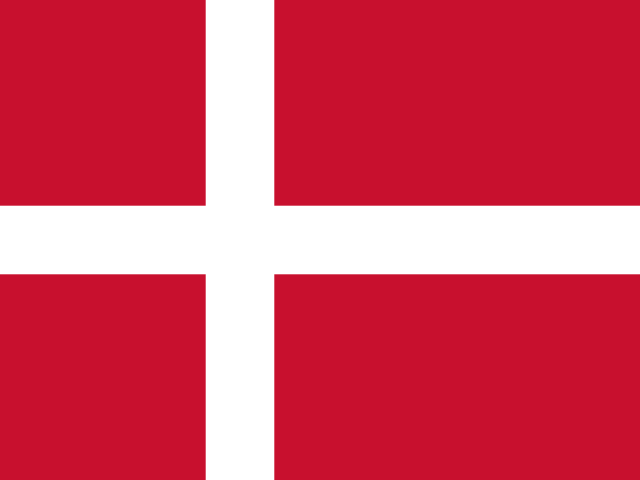
Flag protocol in Denmark: the position of Dannebrog and other flags
Published Written by Flagpole Guides
This page is an English translation of the Danish original. Where the two versions differ, the Danish text is the original.
When several flags are raised together – at a hotel, a sporting event, a business with foreign guests or a town hall – the order is visible to everyone. There is no law on the order of flags in Denmark, but Dannebrogs-Samfundet describes a fixed practice in »Sådan bruges Dannebrog«. The main rule is that within the country’s borders, Dannebrog comes first, highest and foremost.
Dannebrog’s place
| Arrangement | Dannebrog’s place according to Dannebrogs-Samfundet |
|---|---|
| Two flagpoles | The pole on the viewer’s left (heraldic right) |
| Even number of poles | The one of the two middle poles on the viewer’s left |
| Odd number of poles | The middle pole |
| Flags in a row | Furthest to the viewer’s left or in the middle |
| Semicircle or circle | In the middle, with the other flags alternately left and right |
| More than 8 poles | In the middle or furthest to heraldic right |
Dannebrog is raised first and lowered last, and all flags are raised at the same time as Dannebrog.
The Nordic flags
When the flags of the Nordic countries are flown in Denmark, Dannebrogs-Samfundet gives this order:
- Denmark
- Sweden
- Norway
- Finland
- Iceland
- Faroe Islands
- Åland
- Greenland
With a smaller number of poles, Dannebrog stands in the middle, with Sweden and Norway on either side and Finland and Iceland at the ends.
Other countries’ flags
If flags from countries outside the Nordic region are raised, all flags follow Dannebrog in alphabetical order by the countries’ French names, according to Dannebrogs-Samfundet. The order says nothing about one country ranking above another. Some examples where the French name gives a different position from the Danish one:
| Danish name | French name |
|---|---|
| Storbritannien (United Kingdom) | Grande-Bretagne |
| USA | États-Unis d’Amérique |
| Holland (Netherlands) | Pays-Bas |
| Sverige (Sweden) | Suède |
| Færøerne (Faroe Islands) | Îles Féroé |
If there are special reasons, a country’s flag can be placed immediately after Dannebrog, for example during an official visit.
Supranational flags and convention flags
The UN flag, the EU flag, the NATO flag and the flag of the Nordic Council are supranational flags. They are not covered by the ban in the Flag Act, and the police list them among the flags that need no permission. The Red Cross flag is an example of a convention flag. According to Dannebrogs-Samfundet, Dannebrog has the place of honour here too.
Size and proportions
According to Dannebrogs-Samfundet, the flags have at least the same horizontal measurements. Countries’ flags have different proportions: with a flag height of 1 metre, Dannebrog is 1.32 metres long, the flags of Norway and Iceland 1.38 metres, Sweden’s 1.60 metres and that of the United States 1.90 metres. In a group of flags, the sizes can therefore be adjusted so that the flags carry roughly the same weight.
Permission
Flags of countries not exempted in the Flag Act require police permission. According to the police, permission to fly other countries’ flags is as a rule not given for national flag days. More in the guide to foreign flags in Denmark, and about flags at businesses in the guide to flagpoles for businesses.
Frequently asked questions
Where is Dannebrog placed among several flags?
According to Dannebrogs-Samfundet, Dannebrog always has the place of honour in Denmark: with an odd number of poles the middle one, with an even number the one of the two middle poles on the viewer’s left, and with flags in a row the one furthest to the viewer’s left or the middle one.
In which order do the Nordic flags fly?
Dannebrogs-Samfundet gives the order Denmark, Sweden, Norway, Finland, Iceland, the Faroe Islands, Åland and Greenland when the Nordic flags are flown together in Denmark.
How are other countries’ flags arranged?
According to Dannebrogs-Samfundet, they follow Dannebrog in alphabetical order by the countries’ French names. The United Kingdom is therefore placed under G for Grande-Bretagne and Germany under A for Allemagne.
Can two flags fly on the same pole?
According to Dannebrogs-Samfundet, several flags are never flown on the same flagpole. Each flag has its own pole, and Dannebrog is raised first and lowered last.
Do the flags have the same size?
Dannebrogs-Samfundet writes that the flags have at least the same horizontal measurements. As countries’ flags have different proportions, a group of flags can be arranged so that the flags carry roughly the same visual weight.
Sources
This guide is based on the following sources, most of them in Danish:
- Sådan bruges Dannebrog, 2nd edition (2019), pp. 34–41 – Dannebrogs-Samfundet (formerly Danmarks-Samfundet)
- Lov om flagning (LOV nr. 1449 af 10. december 2024) – Retsinformation
- Udenlandske flag – Justitsministeriet (Ministry of Justice)
- Ansøg om tilladelse til flagning med udenlandsk flag – Politiet (Danish Police)
Related guides
- Foreign flagsForeign flags in Denmark under the 2025 Flag Act: permitted flags, police permission, fines, fantasy flags, the EU and UN flags and the history of the ban.
- Flags in mourningFlags in mourning in Denmark: deaths, funerals, memorial services, scattering of ashes and Dannebrog on the coffin – the customs and their sources.
- Flag typesDanish flag types: the rectangular flag, the swallow-tailed flag, the naval ensign, the yacht flag, the storm flag, the pennant and the stander.
- Flagpoles for businessesFlagpoles for businesses in Denmark: company flags, Dannebrog in logos, foreign flags at hotels, municipal orders under the Building Act and liability.