Danish flag types: rectangular flag, swallow-tailed flag, pennant and stander
Published Written by Flagpole Guides
This page is an English translation of the Danish original. Where the two versions differ, the Danish text is the original.
Dannebrog comes in several versions, and they are used by different people. The rectangular flag is the people’s flag, the swallow-tailed flag belongs to the state, the naval ensign to the navy, and the pennant and the stander fly from the pole when the flag is not up. According to Dannebrogs-Samfundet, there are five versions of Dannebrog: the swallow-tailed flag, the rectangular flag, the naval ensign, the stander and the pennant.
Overview
| Flag | Appearance | Users |
|---|---|---|
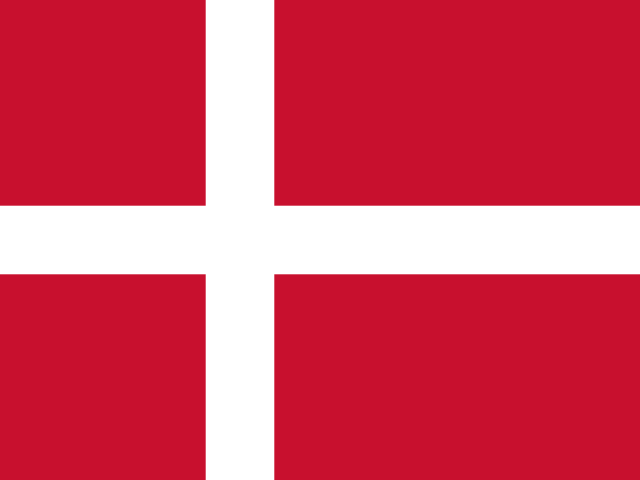
| Rectangular flag (stutflag) | Rectangular, white cross on red | Everyone |
| Swallow-tailed flag (splitflag) | Two pointed tails at the fly | Royal family, Folketing, state, courts, institutions with permission |
| Naval ensign (orlogsflag) | Swallow-tailed flag in the darker naval red | Navy ships |
| Yacht flag | Naval ensign with Y.F. in yellow in the upper canton | Pleasure craft, not on land |
| Storm flag | Rectangular flag at half size | Everyone, in strong wind |
| Dannebrog pennant (vimpel) | Long, narrow triangular cross flag | Everyone, when the flag is not up |
| Dannebrog stander | Shorter, wider triangular cross flag | Everyone, when the flag is not up |
The rectangular flag
The rectangular flag (stutflag) is Dannebrog in rectangular form and Denmark’s national flag. According to Dannebrogs-Samfundet, the rules for its appearance come from a provision of 11 July 1748 on the flag of merchant ships, still in force, which states that the flag is »red with a white cross without split«. According to Den Store Danske, a royal resolution of 7 July 1854 allowed the population to fly Dannebrog. The proportions are in the guide to flag sizes.
The swallow-tailed flag
The swallow-tailed flag (splitflag) is the official Danish flag of authorities and the state. Under section 1(2) of the Flag Act, it is flown by the royal family, the Folketing, state authorities and the courts and by institutions with special permission. The Ministry of Justice writes that any other use is unjustified and therefore unlawful. According to Dannebrogs-Samfundet, a few businesses, organisations and associations still hold royal permission to use a swallow-tailed flag with a special mark, but no private person has received permission since 1964.
The royal family also uses the swallow-tailed flag with a special mark: the royal standard has carried the royal coat of arms in a central square since 1731.
The naval ensign and the yacht flag
The naval ensign is the navy’s swallow-tailed flag in a deeper red, which according to Dannebrogs-Samfundet is called naval red (Pantone 194C) as opposed to Dannebrog red (Pantone 186C). According to the Ministry of Justice, decked boats used solely for pleasure sailing may fly the yacht flag: the naval ensign with the letters Y.F. in yellow in the upper canton next to the pole. The yacht flag may not be used on land, and the permission lapses if the boat is used commercially.
Pennant and stander
According to Dannebrogs-Samfundet, a pennant or a stander is raised when the flagpole has no flag:
- The Dannebrog pennant (vimpel) is a long, tapering triangular cross flag in red and white. Its length is about half the flagpole’s length.
- The Dannebrog stander is a shorter version, always 50 cm wide and about one third of the pole’s length. It is more visible on tall poles and can be used where trees or houses stand close to the pole.
Both can fly day and night without lighting and are used only on a vertical flagpole. They are lowered when the flag is raised and are not flown at half-mast.
The storm flag
According to Dannebrogs-Samfundet, no flag is flown when the wind exceeds 20 metres per second. If the flag is flown on a flag day all the same, a storm flag can be used: a rectangular flag with the same proportions but half the size.
The size that suits the pole is shown in the flag size calculator. The colours and the cross are covered in more detail in the guide to flag symbolism, and flag etiquette in the guide to flag rules.
Frequently asked questions
What is the difference between the rectangular and the swallow-tailed flag?
The rectangular flag (stutflag) is the Dannebrog anyone can use. The swallow-tailed flag (splitflag) ends in two pointed tails and, under section 1(2) of the Flag Act, is reserved for the royal family, the Folketing, state authorities, the courts and institutions with special permission.
What is the difference between a pennant and a stander?
According to Dannebrogs-Samfundet, the Dannebrog pennant (vimpel) is a long, tapering triangular flag, about half as long as the flagpole. The stander is a shorter and wider version, always 50 cm wide and about one third of the pole’s length, which is easier to see on tall poles.
Can the pennant stay up at night?
Yes. According to Dannebrogs-Samfundet, the pennant and the stander can fly day and night without lighting. They are lowered when the flag is raised and are not used at half-mast.
Can the yacht flag be used in the garden?
No. According to the Ministry of Justice, the yacht flag, the naval ensign with the letters Y.F., may be flown by pleasure craft but not used on land. Dannebrogs-Samfundet notes that sailing clubs have been able to use the yacht flag on land since 2005.
What is a storm flag?
According to Dannebrogs-Samfundet, a storm flag is a rectangular flag with the same proportions but half the size. It can be used on flag days with strong wind to reduce wear on the flag and the load on the flagpole.
Sources
This guide is based on the following sources, most of them in Danish:
- Lov om flagning (LOV nr. 1449 af 10. december 2024) – Retsinformation
- Flagning med splitflag – Justitsministeriet (Ministry of Justice)
- Flagning på fartøjer – Justitsministeriet (Ministry of Justice)
- Sådan bruges Dannebrog, 2nd edition (2019), pp. 9–19 – Dannebrogs-Samfundet (formerly Danmarks-Samfundet)
- Dannebrog – Lex – Den Store Danske
Related guides
- Flag sizesDanish flag sizes: Dannebrog’s 28:37 proportions and Dannebrogs-Samfundet’s table of flags, pennants and standers for flagpoles from 2 to 20 metres.
- Flag symbolismThe symbolism of Dannebrog: the white cross on red, Dannebrog red, the meaning of the name, the legend of 1219 and the flags of Greenland and the Faroes.
- Flag rulesFlag rules in Denmark: the Flag Act, flag times from 8 a.m. to sunset, the swallow-tailed and rectangular flags, wind, flying at night and good flag etiquette.
- Flag size calculatorFlag size calculator for Dannebrog: flag, pennant and stander sizes for flagpoles from 2 to 20 metres, from Dannebrogs-Samfundet’s table and the one-fifth rule.
- Buying a flagBuying a Danish flag: what affects the price of Dannebrog – size, fabric, sewn or printed cross, pennant and stander – and buyers’ rights under Danish law.