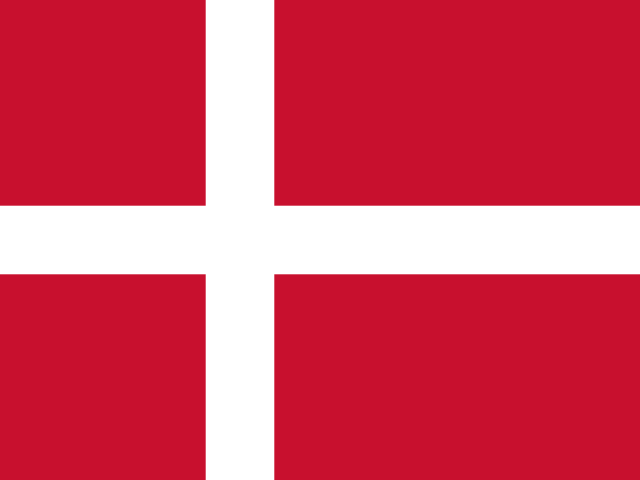
Flags in mourning in Denmark
Published Written by Flagpole Guides
This page is an English translation of the Danish original. Where the two versions differ, the Danish text is the original.
In Denmark, the flag at half-mast is part of the way mourning is shown: in the garden when a family member has died, at the church during the funeral and on public buildings after national tragedies. The customs are not set by law for private individuals, but they are described in detail by Dannebrogs-Samfundet and widely known. This guide brings together the occasions on which the flag is flown in mourning and the customs for each of them.
Occasions
| Occasion | Custom according to Dannebrogs-Samfundet |
|---|---|
| Death | Half-mast on the day of the death, possibly the following day |
| Funeral or cremation service | Half-mast until the coffin is lowered or the hearse has left, then full mast |
| Memorial service | Half-mast from a quarter of an hour before until the service ends |
| Scattering of ashes from a ship | Half-mast at the quay and during the ceremony, full mast while sailing |
| National days of mourning | As ordered by the Ministry of Justice for state authorities |
| Good Friday | Half-mast all day |
Deaths
Flag flying after a death normally takes place on the day of the death. If the death occurs late in the day, shortly before sunset, the flag can also fly at half-mast the following day according to Dannebrogs-Samfundet, and if it occurs after sunset, the flag flies the following day. Local traditions can be decisive. According to Dannebrogs-Samfundet, flying the flag at half-mast in connection with a death takes precedence over flying it at full mast.
Funerals and cremation services
On the day of the funeral or cremation service, the flag flies at half-mast, both at the church and often at home. Once the coffin has been lowered into the ground or the hearse has left the church, the flag is raised to full mast and stays up until sunset. It is up to the church and the parish council when the flag is flown from the church’s flagpole.
Dannebrog on the coffin
If the family wishes, the coffin can be covered with Dannebrog. Dannebrogs-Samfundet describes the custom as follows:
- The two square red fields lie over the head end of the coffin.
- An ordinary Dannebrog flag is used, provided by the family.
- The flag is not covered by a flower arrangement, but flowers from the closest family can be laid on the flag.
- No earth is thrown on the flag; it is folded back to the head end before the earth is cast.
- The flag is not buried or cremated with the coffin. It is folded and handed to the family.
No black ribbons
According to Dannebrogs-Samfundet, Dannebrog does not show mourning. No crape, black ribbons or other black marking is therefore put on the flag, not even on bus flags or banners. Mourning is shown solely by flying the flag at half-mast.
National days of mourning
The Ministry of Justice can order extraordinary flag flying at half-mast for state authorities, for example after terrorist attacks or natural disasters in Denmark or abroad. Private individuals and businesses are under no obligation to follow, but many do. If several flags are flown together, the order described in the guide to flag protocol applies.
Where the flag sits and how it is first raised to the top is described in the guide to half-mast.
Frequently asked questions
When is the flag flown at half-mast after a death?
According to Dannebrogs-Samfundet, the flag normally flies at half-mast on the day of the death. If the death occurs shortly before sunset, the flag can also fly at half-mast the following day, and if it occurs after sunset, the flag flies the following day. Local traditions can matter.
When is the flag raised to full mast at a funeral?
According to Dannebrogs-Samfundet, the flag flies at half-mast until the coffin has been lowered into the ground or the hearse has left the church. After that, the flag is raised to full mast and stays up until sunset.
Can mourning ribbons be put on Dannebrog?
Dannebrogs-Samfundet writes that Dannebrog does not show mourning, and that no crape, black ribbons or other black marking is therefore put on the flag or on banners. Mourning is shown with half-mast.
How does Dannebrog lie on a coffin?
According to Dannebrogs-Samfundet, the two square red fields lie over the head end of the coffin, and an ordinary Dannebrog flag is used. The flag is not buried or cremated with the coffin, but folded and handed to the family.
Is the flag flown for a memorial service?
According to Dannebrogs-Samfundet, the flag flies at full mast until it is lowered to half-mast a quarter of an hour before the memorial service. After the service it is raised to full mast again until sunset. If the memorial service is held after sunset, no flag is flown.
Sources
This guide is based on the following sources, most of them in Danish:
- Sådan bruges Dannebrog, 2nd edition (2019), pp. 27–30 and 65–68 – Dannebrogs-Samfundet (formerly Danmarks-Samfundet)
- Flagning med splitflag – Justitsministeriet (Ministry of Justice)
- Cirkulæreskrivelse om officielle flagdage (CIS nr. 10155 af 19. december 2024) – Retsinformation
- Flagning – Lex – Den Store Danske
Related guides
- Half-mastHalf-mast in Denmark: where the flag sits, how it is raised and lowered, Good Friday, 9 April, deaths and funerals – according to the authorities and custom.
- Flag protocolFlag protocol in Denmark: where Dannebrog goes, the order of the Nordic flags, alphabetical order by French names and the EU and UN flags.
- Flag rulesFlag rules in Denmark: the Flag Act, flag times from 8 a.m. to sunset, the swallow-tailed and rectangular flags, wind, flying at night and good flag etiquette.
- Flag daysAll official flag days in Denmark for 2026 and 2027 with date and weekday under the Ministry of Justice circular – with half-mast days, Erfalasorput and Merkið.