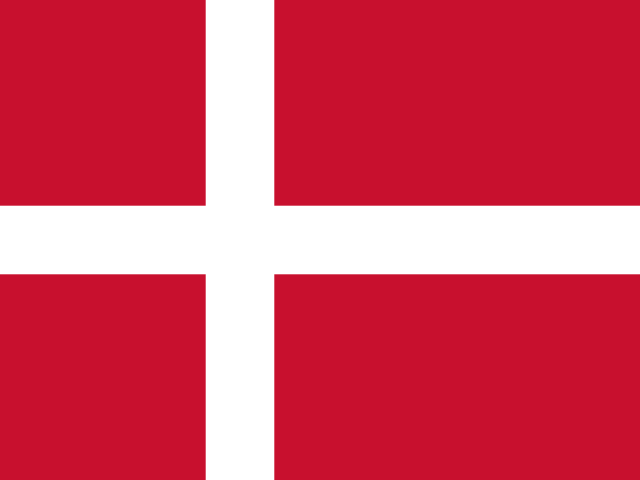
Half-mast in Denmark – rules and procedure
Published Written by Flagpole Guides
This page is an English translation of the Danish original. Where the two versions differ, the Danish text is the original.
Flying the flag at half-mast is the clearest sign of mourning Dannebrog can give. According to Den Store Danske, the custom has been practised in Denmark since 1743, and Dannebrogs-Samfundet links it to the idea that »death’s invisible flag« flies above the flag. There is no law on half-mast for private individuals, but the custom is firmly established, and for state authorities two days a year are set in the circular on official flag days.
Where does the flag sit?
The sources describe the position slightly differently:
| Source | Position on a free-standing vertical pole |
|---|---|
| Dannebrogs-Samfundet, section on church ceremonies and glossary | Upper edge of the flag about one third of the pole’s total length below the finial |
| Dannebrogs-Samfundet, general section | Middle of the flag about halfway up the pole |
| Bolius | Lower edge of the flag level with the middle of the pole |
On slanting, horizontal and vertical flagpoles on buildings, the cross is placed level with the middle of the pole, according to Dannebrogs-Samfundet. What the descriptions have in common is that the flag sits clearly below the top, so it does not look like a flag that has slipped down.
The procedure
Dannebrogs-Samfundet describes the custom as follows: the flag is raised right to the top and stays there for a few seconds, after which it is lowered to half-mast. When it is taken down, the flag is first raised to the top again for a few seconds before being lowered completely. Den Store Danske describes the same custom.
The flag times also apply at half-mast: no earlier than 8 a.m. or sunrise and at sunset at the latest. Pennants and standers are not used at half-mast.
Half-mast on flag days
| Day | Flag flying under the circular |
|---|---|
| Good Friday | Half-mast all day |
| 9 April, Occupation Day | Half-mast until 12.00, then full mast |
| Royal birthday on Good Friday | Half-mast |
Dannebrogs-Samfundet notes that on 9 April the flag is raised to the top at 12.02 where two minutes’ silence is held at 12.00. The Ministry of Justice can also order extraordinary flag flying at half-mast, for example for royal deaths, terrorist attacks or natural disasters.
Deaths and funerals
According to Dannebrogs-Samfundet, the flag flies at half-mast on the day of a death. If the death occurs late in the day or after sunset, the flag can fly at half-mast the following day. At funerals and cremation services, the flag flies at half-mast until the coffin has been lowered into the ground or the hearse has left the church. After that, the flag is raised to full mast until sunset. When the flag returns to full mast, it symbolises the resurrection, according to Dannebrogs-Samfundet.
The customs for deaths, memorial services and the scattering of ashes are covered in the guide to flags in mourning. How the halyard and pulley work is explained in the guide to flagpole mechanics.
Frequently asked questions
How far down does the flag sit at half-mast?
According to Dannebrogs-Samfundet, on a free-standing vertical flagpole the flag is lowered until its upper edge is about one third of the pole’s total length below the finial. On flagpoles mounted on buildings, the cross is placed level with the middle of the pole.
Why is the flag raised to the top first?
It is the custom in Denmark to raise the flag right to the top and leave it there for a few seconds before lowering it to half-mast. When it is taken down, it is raised to the top again before being lowered completely. Dannebrogs-Samfundet describes this as the procedure on church flag days, deaths and memorial ceremonies.
When is there half-mast on official flag days?
Under the Ministry of Justice circular, the flag flies at half-mast all day on Good Friday and until 12.00 on Occupation Day, 9 April, then at full mast. If a royal birthday falls on Good Friday, the flag also flies at half-mast.
Can a pennant be flown at half-mast?
No. According to Dannebrogs-Samfundet, the Dannebrog pennant and stander are not flown at half-mast. Half-mast is marked with the flag.
Who decides on half-mast for national events?
The Ministry of Justice can order extraordinary flag flying at half-mast for state authorities, for example after terrorist attacks or natural disasters in Denmark or abroad. Private individuals decide for themselves whether to follow.
Sources
This guide is based on the following sources, most of them in Danish:
- Cirkulæreskrivelse om officielle flagdage (CIS nr. 10155 af 19. december 2024) – Retsinformation
- Flagning med splitflag – Justitsministeriet (Ministry of Justice)
- Sådan bruges Dannebrog, 2nd edition (2019), pp. 26–30 and 65–67 – Dannebrogs-Samfundet (formerly Danmarks-Samfundet)
- Flagning – Lex – Den Store Danske
- Flagstænger og flagregler – Bolius
Related guides
- Flags in mourningFlags in mourning in Denmark: deaths, funerals, memorial services, scattering of ashes and Dannebrog on the coffin – the customs and their sources.
- Flag rulesFlag rules in Denmark: the Flag Act, flag times from 8 a.m. to sunset, the swallow-tailed and rectangular flags, wind, flying at night and good flag etiquette.
- Flag daysAll official flag days in Denmark for 2026 and 2027 with date and weekday under the Ministry of Justice circular – with half-mast days, Erfalasorput and Merkið.
- Flagpole mechanicsFlagpole mechanics in Denmark: how the flag line, pulley, internal winch, flag weight and tilting bracket work – and how a flagpole is lowered.