Flagpoles for businesses in Denmark: company flags, advertising and liability
Published Written by Flagpole Guides
This page is an English translation of the Danish original. Where the two versions differ, the Danish text is the original.
Flagpoles at businesses, hotels, shopping centres and office buildings often carry Dannebrog, company flags and foreign flags. For businesses, several sets of rules interact: the Flag Act, police permissions, the Building Act’s rules on signs and the working environment rules. This guide brings together what is specific to businesses.
Which flags can a business raise?
| Flag | Rule |
|---|---|
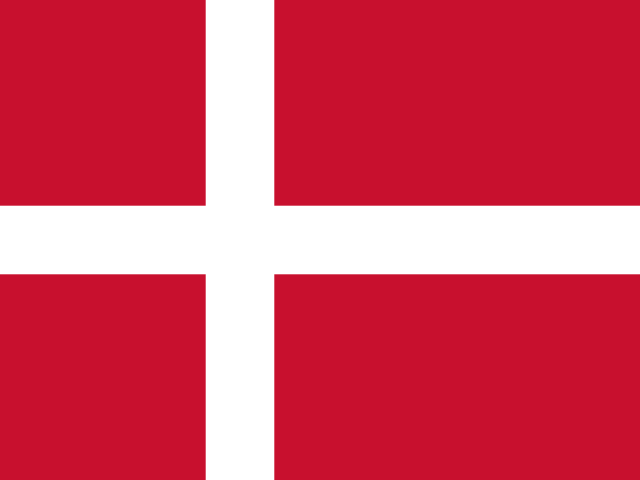
| Dannebrog as a rectangular flag | Permitted for everyone |
| Dannebrog as a swallow-tailed flag | Only with special permission, section 1(2) of the Flag Act |
| Company, logo and advertising flags | Fantasy flags, not covered by the ban |
| Nordic and German flags, Greenland, Faroe Islands, Ukraine | Permitted without permission |
| EU, UN and NATO flags | Permitted without permission according to the police |
| Other countries’ flags | Require police permission, section 5 of the Act |
Company and advertising flags
According to the police and Den Store Danske, company flags are fantasy flags not covered by the ban on foreign flags. Dannebrogs-Samfundet writes that no police permission is needed for company, logo and advertising flags unless they bear significant resemblance to the flags of foreign states. Nor do they bear significant resemblance to Dannebrog, and according to Dannebrogs-Samfundet the Ministry of Justice can decide that a flag resembling Dannebrog too closely is unjustified.
Dannebrog in logos and marketing
According to Dannebrogs-Samfundet, Danish businesses producing goods of Danish origin can use the rectangular flag as a mark on products, in company logos, trademarks, on packaging and in advertising. The flag’s appearance, proportions and colours are kept, and no text or symbols are placed on the flag itself. Using the rectangular flag in logos for foreign businesses or goods of foreign origin is not permitted, according to Dannebrogs-Samfundet.
Foreign flags at hotels and businesses
According to the police, hotels, campsites, marinas, larger businesses, museums, sports grounds and border crossings can apply for permission to fly other countries’ flags for foreign guests, and the permission can be permanent. As a rule, no permission is given to fly other countries’ flags on national flag days. When several flags are flown together, the order in the guide to flag protocol applies.
The municipality and signs
Under section 6 D(2) of the Building Act, the municipality can issue an order or a prohibition where signs, lighting installations and the like are a nuisance or disfigure the surroundings. The guidance from bygningsreglementet.dk mentions removing pylon signs and flagpoles at petrol stations as examples. Orders can be issued regardless of whether a building permit has been applied for. Local plans can also contain provisions on signs and advertising.
Flag avenues and own flag days
According to Dannebrogs-Samfundet, a flag avenue on a public road or a private shared road requires permission from the police and the municipality, and whoever puts up the avenue is liable for accidents with fallen poles. According to Dannebrogs-Samfundet, businesses can have their own flag days, for example for anniversaries, and many have flag regulations.
Liability and working environment
As owner, the business is responsible for the flagpole being soundly installed and maintained. When employees raise flags on tall poles or work on flagpoles on roofs and façades, the Danish Working Environment Authority’s rules on preventing falls from height apply: ladders only for short, light work, and a guard rail, scaffolding or other protection where there is a risk of falling. More in the guide to flagpole safety.
Lighting flags at night is covered in the guide to flag lighting, and the Flag Act in the guide to foreign flags in Denmark.
Frequently asked questions
Can a business fly its own company flag?
Yes. According to the police and Den Store Danske, company flags are fantasy flags not covered by the ban in the Flag Act. According to Dannebrogs-Samfundet, however, company and advertising flags do not bear significant resemblance to Dannebrog or to the flags of foreign states.
Can a business use Dannebrog in its logo?
According to Dannebrogs-Samfundet, Danish businesses producing goods of Danish origin can use the rectangular flag in logos, trademarks, on packaging and in advertising, with the flag’s correct appearance, proportions and colours. For foreign businesses and goods of foreign origin, it is not permitted according to Dannebrogs-Samfundet.
Can a hotel fly its guests’ flags?
According to the police, hotels, campsites, marinas, larger businesses and museums can apply for permission to fly other countries’ flags for foreign guests, also as a permanent permission. The Nordic and German flags need no permission.
Can a business fly the swallow-tailed flag?
Only with special permission. Under section 1(2) of the Flag Act, the swallow-tailed flag is reserved for the royal family, the Folketing, state authorities, the courts and institutions with special permission. According to Dannebrogs-Samfundet, a few businesses and organisations hold royal permission for a swallow-tailed flag with a special mark.
Can the municipality require a flagpole to be removed?
Under section 6 D(2) of the Building Act, according to the guidance, the municipality can issue an order or a prohibition where signs, lighting installations and the like are a nuisance or disfigure the surroundings. The guidance mentions removing flagpoles at petrol stations as an example.
Sources
This guide is based on the following sources, most of them in Danish:
- Lov om flagning (LOV nr. 1449 af 10. december 2024) – Retsinformation
- Ansøg om tilladelse til flagning med udenlandsk flag – Politiet (Danish Police)
- Vejledning om byggelovens § 6 D – Bygningsreglementet.dk
- Sådan bruges Dannebrog, 2nd edition (2019), pp. 12, 33 and 41–45 – Dannebrogs-Samfundet (formerly Danmarks-Samfundet)
- Flagning – Lex – Den Store Danske
- Forebyg fald fra højden – Arbejdstilsynet (Danish Working Environment Authority)
Related guides
- Foreign flagsForeign flags in Denmark under the 2025 Flag Act: permitted flags, police permission, fines, fantasy flags, the EU and UN flags and the history of the ban.
- Flag lightingFlag lighting in Denmark: when the flag can fly after sunset, which lighting counts as sufficient, the pennant at night and consideration for neighbours.
- Flag protocolFlag protocol in Denmark: where Dannebrog goes, the order of the Nordic flags, alphabetical order by French names and the EU and UN flags.
- Flagpole safetyFlagpole safety in Denmark: wind and storm flags, the foundation, lowering the pole, liability for damage and the rules for working at height.