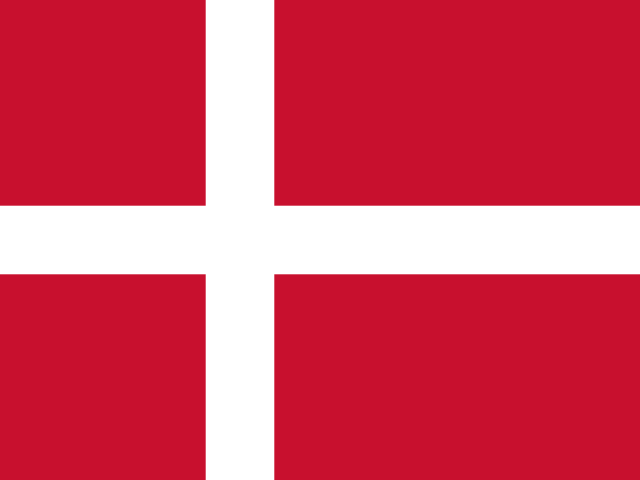
Danish flag sizes: table for flag, pennant and pole
Published Written by Flagpole Guides
This page is an English translation of the Danish original. Where the two versions differ, the Danish text is the original.
A flag that is too small disappears on a tall pole, and a flag that is too large wears quickly and strains the pole. There is no law on how large Dannebrog is in relation to the flagpole, but Dannebrogs-Samfundet has compiled a table from Danish flag makers’ price lists, and the one-fifth rule of thumb is widely known. This guide brings together the proportions, the table and the rules for poles on buildings.
Dannebrog’s proportions
According to Dannebrogs-Samfundet, the rectangular flag has fixed proportions between height and length:
| Measurement | Units |
|---|---|
| Height | 12 + 4 + 12 = 28 |
| Length | 12 + 4 + 21 = 37 |
| Width of the cross | 4 |
The 28:37 ratio means the flag is about 1.32 times as long as it is high. According to Den Store Danske, the width of the cross is 1/7 of the flag’s height, and the extended form of the rectangular flag was permitted in 1893. Bolius refers to the 1748 ordinance with the ratio 3:1:4.5 for the short red field, the cross and the long red field. The swallow-tailed flag has its own proportions.
Table for flag, pennant and stander
The table reproduces Dannebrogs-Samfundet’s guideline relationships. According to Dannebrogs-Samfundet, the lengths and widths are averages of Danish flag makers’ price lists. The rectangular flag is given as length × height.
| Flagpole length | Rectangular flag | Pennant | Stander |
|---|---|---|---|
| 2 m | 75 × 57 cm | 100 cm | – |
| 3 m | 100 × 76 cm | 150 cm | – |
| 4 m | 125 × 93 cm | 250 cm | 150 × 50 cm |
| 5 m | 150 × 114 cm | 250 cm | 200 × 50 cm |
| 6 m | 175 × 133 cm | 300 cm | 200 × 50 cm |
| 7 m | 200 × 150 cm | 350 cm | 250 × 50 cm |
| 8 m | 225 × 170 cm | 400 cm | 300 × 50 cm |
| 9 m | 250 × 189 cm | 450 cm | 350 × 50 cm |
| 10 m | 275 × 208 cm | 500 cm | 350 × 50 cm |
| 11 m | 300 × 227 cm | 550 cm | 400 × 50 cm |
| 12 m | 325 × 245 cm | 600 cm | 400 × 50 cm |
| 13 m | 350 × 265 cm | 650 cm | 450 × 50 cm |
| 14 m | 375 × 283 cm | 700 cm | 450 × 50 cm |
| 15 m | 400 × 300 cm | 750 cm | 500 × 50 cm |
| 16 m | 425 × 320 cm | 800 cm | 500 × 50 cm |
| 17 m | 450 × 337 cm | 850 cm | 600 × 50 cm |
| 18 m | 475 × 358 cm | 900 cm | 600 × 50 cm |
| 20 m | 525 × 400 cm | 1000 cm | 650 × 50 cm |
Rules of thumb by type of pole
| Flagpole | Flag height according to Dannebrogs-Samfundet | Example |
|---|---|---|
| Free-standing | About 1/5 of the pole’s length | 10 m pole: flag about 2 m high |
| Slanting, on a building | About 1/3 of the pole’s length | 3 m pole: flag about 1 m high |
| Horizontal, on a building | About 1/2 of the pole’s length | 4 m pole: flag about 2 m high |
| Vertical, on a building or mound | From 1/3 to 1/2 of the pole’s length | By judgement |
Dannebrogs-Samfundet stresses that the actual size of the flag rests on judgement in each case. Bolius mentions that a flag about 1.5–2 metres high suits a flagpole of 7–10 metres.
Several flags together
When Dannebrog flies together with other countries’ flags, the flags have at least the same horizontal measurements according to Dannebrogs-Samfundet. With a height of 1 metre, Dannebrog is 1.32 metres long, Sweden’s flag 1.60 metres and Germany’s 1.70 metres. More in the guide to flag protocol.
The size for a particular pole is shown in the flag size calculator. The height of the pole is covered in the guide to flagpole heights, and the price of the flag in the guide to buying a flag.
Frequently asked questions
Which flag size suits an 8-metre flagpole?
In Dannebrogs-Samfundet’s table, based on the average of Danish flag makers’ price lists, an 8-metre flagpole goes with a rectangular flag of 225 × 170 cm, a pennant of 400 cm and a stander of 300 × 50 cm.
What is the rule of thumb for the flag’s size?
According to Dannebrogs-Samfundet, the height of the flag on a free-standing flagpole is about one fifth of the pole’s length. On a slanting pole on a building it is about one third, and on a horizontal pole about half. Bolius and Den Store Danske describe the same rule.
What are Dannebrog’s proportions?
According to Dannebrogs-Samfundet, the rectangular flag is 28 units high and 37 units long: 12 + 4 + 12 in height and 12 + 4 + 21 in length. According to Den Store Danske, the width of the cross is 1/7 of the flag’s height.
How long is a pennant?
According to Dannebrogs-Samfundet, the Dannebrog pennant is about half as long as the flagpole. The stander is about one third of the pole’s length and always 50 cm wide.
How is a flag’s size measured?
A flag is measured in length and height. The height is the side along the pole, which Dannebrogs-Samfundet calls the hoist (standerlig). In Dannebrogs-Samfundet’s table, the rectangular flag is given as length × height, for example 225 × 170 cm.
Sources
This guide is based on the following sources, most of them in Danish:
- Sådan bruges Dannebrog, 2nd edition (2019), pp. 11–21 and 40 – Dannebrogs-Samfundet (formerly Danmarks-Samfundet)
- Dannebrog – Lex – Den Store Danske
- Flagning – Lex – Den Store Danske
- Flagstænger og flagregler – Bolius
- Hvor høj skal flagstangen være? – Bolius
Related guides
- Flag size calculatorFlag size calculator for Dannebrog: flag, pennant and stander sizes for flagpoles from 2 to 20 metres, from Dannebrogs-Samfundet’s table and the one-fifth rule.
- Flagpole heightsFlagpole heights in Denmark: 7–10 metres at detached houses, the pole above the roof ridge, consideration for neighbours, local plans and the size of the flag.
- Flag typesDanish flag types: the rectangular flag, the swallow-tailed flag, the naval ensign, the yacht flag, the storm flag, the pennant and the stander.
- Half-mastHalf-mast in Denmark: where the flag sits, how it is raised and lowered, Good Friday, 9 April, deaths and funerals – according to the authorities and custom.
- Buying a flagBuying a Danish flag: what affects the price of Dannebrog – size, fabric, sewn or printed cross, pennant and stander – and buyers’ rights under Danish law.