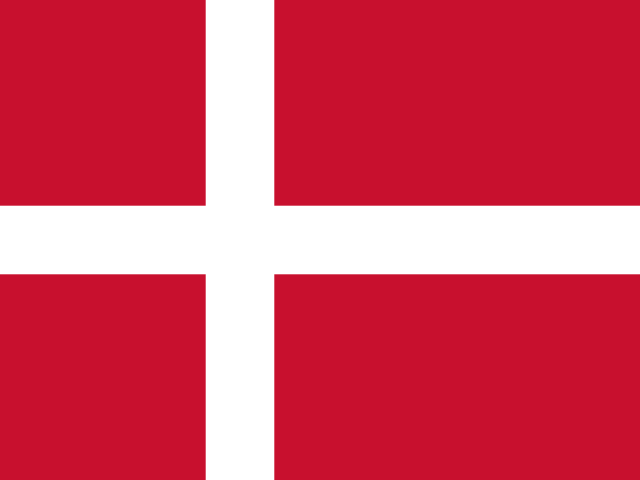
Official flag days in Denmark 2026 and 2027
Published Written by Flagpole Guides
This page is an English translation of the Danish original. Where the two versions differ, the Danish text is the original.
The official flag days are set out in the Ministry of Justice circular on official flag days of 19 December 2024. On these days, state authorities are obliged to fly the swallow-tailed flag from their buildings. The circular does not apply to private individuals, but the flag days are still the calendar most people in Denmark follow, in the garden, at the summer house and at businesses.
The flag days under the circular
| Date | Occasion |
|---|---|
| 1 January | New Year’s Day |
| 5 February | Queen Mary’s birthday |
| 6 February | Princess Marie’s birthday |
| movable | Good Friday – half-mast all day |
| movable | Easter Sunday |
| 9 April | Occupation Day – half-mast until 12.00, then full mast |
| 16 April | Queen Margrethe’s birthday |
| 21 April | Princess Isabella’s birthday |
| 29 April | Princess Benedikte’s birthday |
| movable | Ascension Day |
| 5 May | Liberation Day |
| movable | Whit Sunday |
| 26 May | The King’s birthday |
| 5 June | Constitution Day |
| 7 June | Prince Joachim’s birthday |
| 15 June | Valdemar’s Day and Reunification Day |
| 21 June | Greenland’s National Day – with Erfalasorput |
| 29 July | Faroese National Day, Olai Dag – with Merkið |
| 5 September | Flag Day for Denmark’s deployed personnel |
| 15 October | Crown Prince Christian’s birthday |
| 25 December | Christmas Day |
The circular also states that the flag flies at half-mast if a royal birthday falls on Good Friday, and that special rules apply to military flag days. Beyond the fixed flag days, the Ministry of Justice can decide that state authorities fly the flag for special events, such as state visits or occasions in the royal family, and in special cases at half-mast, for example after terrorist attacks or natural disasters.
All dates for 2026 and 2027
The table shows the flag days with their weekday. Good Friday, Easter Sunday, Ascension Day and Whit Sunday are calculated from Easter.
The flags of Greenland and the Faroe Islands
Two of the flag days are marked with a flag other than Dannebrog. On Greenland’s National Day, 21 June, state authorities fly Erfalasorput, which according to Den Store Danske means »our flag« and was introduced in 1985. On Olai Dag, 29 July, they fly the Faroese flag Merkið. Under the Flag Act, anyone in Denmark can fly both flags without permission. More about them in the guide to foreign flags in Denmark.
Church and military flag days
In »Sådan bruges Dannebrog«, Dannebrogs-Samfundet distinguishes between the official flag days and other days on which the flag is traditionally flown:
- Church holidays on which the flag can be flown: Palm Sunday, Maundy Thursday, Whit Monday and Boxing Day. Great Prayer Day is also on the 2019 list, but has not been a public holiday since 2024.
- Military flag days: days commemorating battles and events in the history of the armed forces, for example the Battle of Dybbøl on 18 April. Special rules apply to them, as the circular notes.
- Own flag days: businesses, associations, schools and municipalities can have their own flag days, for example for an anniversary.
Flying the flag on other days
Private individuals can fly the flag whenever they like, within the flag times. Birthdays, weddings, confirmations, graduation parties and visits are common occasions. More about these customs in the guide to flags on holidays and special days, about the flag times in the guide to flag rules, and about half-mast in the guide to flags in mourning.
Frequently asked questions
How many official flag days does Denmark have?
The Ministry of Justice circular no. 10155 of 19 December 2024 sets 21 official flag days: national days of remembrance, church festivals, royal birthdays and the national days of Greenland and the Faroe Islands.
Are private individuals obliged to fly the flag on flag days?
No. According to the Ministry of Justice, private individuals, businesses and organisations are under no obligation to fly the flag on the official flag days. The obligation applies to state authorities, which fly the swallow-tailed flag.
Why are other flags flown on 21 June and 29 July?
Under the circular, state authorities fly the Greenlandic flag Erfalasorput on Greenland’s National Day, 21 June, and the Faroese flag Merkið on the Faroese national day, Olai Dag, 29 July. Both days have been official flag days since 2016.
Are Great Prayer Day and Whit Monday flag days?
Neither is an official flag day. Dannebrogs-Samfundet lists them among the church holidays on which the flag can be flown. Great Prayer Day is no longer a public holiday; under the Act on the consequences of its abolition, it has been an ordinary working day since 2024.
What happens if a royal birthday falls on Good Friday?
The circular states that the flag then flies at half-mast. According to Dannebrogs-Samfundet, a church flag day takes precedence over a flag day for the royal family.
Sources
This guide is based on the following sources, most of them in Danish:
- Cirkulæreskrivelse om officielle flagdage (CIS nr. 10155 af 19. december 2024) – Retsinformation
- Flagdage – Justitsministeriet (Ministry of Justice)
- Flagning med splitflag – Justitsministeriet (Ministry of Justice)
- Sådan bruges Dannebrog, 2nd edition (2019), pp. 30–33 – Dannebrogs-Samfundet (formerly Danmarks-Samfundet)
- Lov om konsekvenser ved afskaffelsen af store bededag som helligdag – Retsinformation
- Erfalasorput – Grønlands flag – Lex – Den Store Danske
Related guides
- Flag rulesFlag rules in Denmark: the Flag Act, flag times from 8 a.m. to sunset, the swallow-tailed and rectangular flags, wind, flying at night and good flag etiquette.
- Half-mastHalf-mast in Denmark: where the flag sits, how it is raised and lowered, Good Friday, 9 April, deaths and funerals – according to the authorities and custom.
- Flags on holidaysFlags on holidays and special days in Denmark: Easter, Whitsun, Christmas, Constitution Day, Valdemar’s Day, 9 April, 5 May and private occasions.
- Flags in mourningFlags in mourning in Denmark: deaths, funerals, memorial services, scattering of ashes and Dannebrog on the coffin – the customs and their sources.