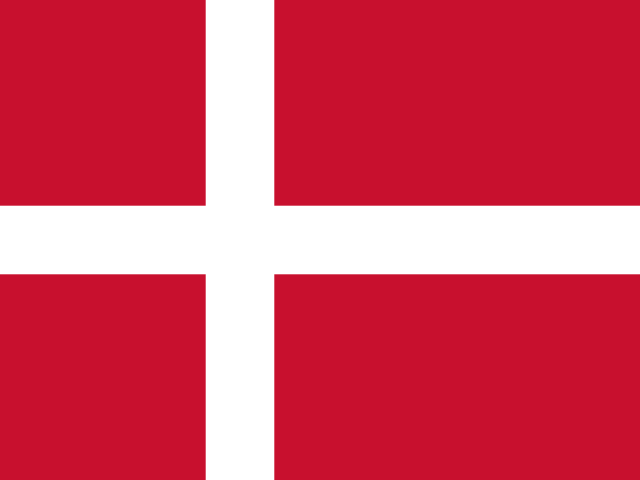
Foreign flags in Denmark – the Flag Act
Published Written by Flagpole Guides
This page is an English translation of the Danish original. Where the two versions differ, the Danish text is the original.
Denmark is one of the few countries where raising another country’s flag on one’s own flagpole is prohibited as a rule. The ban goes back to 1915, was overturned by the Supreme Court in 2023 and was reintroduced by law from 1 January 2025. This guide describes what the Act says, which flags are exempt and when the police can grant permission.
The Flag Act
Section 2 of the Flag Act prohibits flying other countries’ national and regional flags and flags that are equivalent to them. The ban has these exceptions:
| Exception | Legal basis |
|---|---|
| Finnish, Faroese, Greenlandic, Icelandic, Norwegian, Swedish and German flags | Section 2(2) of the Act |
| The Ukrainian flag | Executive order no. 1543 of 2024, under section 4 of the Act |
| Diplomatic missions flying their own country’s flag | Section 3 of the Act |
| The Folketing | Section 2(3) of the Act |
| Other flags with police permission | Section 5 of the Act |
According to Den Store Danske, the exception for German flags reflects consideration for the German minority in Southern Jutland. Breaches are punishable by a fine under section 7. The Act does not apply in the Faroe Islands and Greenland.
Flags not covered
The police list these as flags that need no permission:
- flags of international and regional organisations, for example the UN, the EU, NATO, the OSCE and the Nordic Council
- flags of regions in the exempt countries, for example the Sámi flag, the Åland flag and the flag of Bavaria
- fantasy flags, for example rainbow flags and pirate flags
According to Den Store Danske, the Ministry of Justice also regards company flags, the Olympic flag and flags of political movements that do not represent a territory as fantasy flags.
When the Act applies
According to the police, the Act covers cloth flags of ordinary size raised on a flagpole of ordinary height, about 4 metres, that is fixed to the property, for example with a base or a tilting bracket in the garden, on the roof or on the façade. Smaller poles are covered if they are not intended to be held in the hand, for example in a row of flags along a street. Flags in windows, on balconies, on cars or on hand-held poles are not covered.
Police permission
Under section 5 of the Act, the police can grant permission in special cases and set conditions. According to the police, permission can be granted:
- when foreign nationals visit people living permanently in Denmark
- to hotels, campsites, marinas, larger businesses, museums, sports grounds and border crossings, also as a permanent permission
- for international congresses, exhibitions, rallies and inaugurations
- as part of a political statement or an artistic work
As a rule, no permission is given to fly other countries’ flags on national flag days, and a permission can include a condition not to fly the flag on days of extraordinary flag flying. According to the police, a new application is made if a permission was granted before. Under section 6, police decisions cannot be appealed to the National Police Commissioner or the Ministry of Justice.
The history of the ban
- 1915: During the First World War, an executive order from the Ministry of Justice prohibited flying foreign flags.
- 1957–1989: It became permitted to fly the Nordic flags, the UN flag and the EU flag without permission.
- 22 June 2023: The Supreme Court acquitted a citizen who had raised the American flag, because the ban had no basis in statute. According to Bolius, it was then lawful to raise other countries’ flags.
- 1 January 2025: The Flag Act reintroduced the ban, now with a statutory basis.
According to Den Store Danske, insulting a foreign flag in Denmark is a criminal offence under section 110 e of the Criminal Code, while there is no equivalent rule for Dannebrog.
Placement next to Dannebrog
When a foreign flag is raised together with Dannebrog, Dannebrog has the place of honour according to Dannebrogs-Samfundet. More in the guide to flag protocol, and about flags at hotels and businesses in the guide to flagpoles for businesses.
Frequently asked questions
Which foreign flags can be flown without permission?
Under section 2(2) of the Flag Act, the ban does not cover the Finnish, Faroese, Greenlandic, Icelandic, Norwegian, Swedish and German flags. Under a 2024 executive order, the Ukrainian flag is also permitted. According to the police, flags of international organisations such as the UN, the EU and NATO need no permission either.
How is permission to fly another country’s flag obtained?
Under section 5 of the Flag Act, the police can grant permission in special cases. The police mention, among other things, visits by foreign nationals to people living in Denmark, hotels, campsites and marinas, international events, and political or artistic statements. The police decision cannot be appealed.
What is the penalty for flying a foreign flag unlawfully?
Under section 7 of the Flag Act, breaching the ban is punishable by a fine. Companies and other legal persons can also be held liable.
Can the rainbow flag or a pirate flag be flown?
Yes. According to the police and the Ministry of Justice, fantasy flags such as the rainbow flag and pirate flags are not covered by the ban, and neither are company flags. The ban covers flags that represent a state or a region of a state.
Does the ban apply to flags in windows or on balconies?
According to Den Store Danske and the police, the Act covers flying a flag from a flagpole of ordinary height, about 4 metres, that is fixed to a property, and from smaller poles not intended to be held in the hand. Flags in windows, on cars and on hand-held poles are not covered.
Sources
This guide is based on the following sources, most of them in Danish:
- Lov om flagning (LOV nr. 1449 af 10. december 2024) – Retsinformation
- Bekendtgørelse om flagning med det ukrainske nationalflag (BEK nr. 1543 af 2024) – Retsinformation
- Udenlandske flag – Justitsministeriet (Ministry of Justice)
- Ansøg om tilladelse til flagning med udenlandsk flag – Politiet (Danish Police)
- Flagning – Lex – Den Store Danske
- Sådan bruges Dannebrog, 2nd edition (2019), pp. 34–41 – Dannebrogs-Samfundet (formerly Danmarks-Samfundet)
- Må du hejse andre flag end Dannebrog i haven? – Bolius
Related guides
- Flag protocolFlag protocol in Denmark: where Dannebrog goes, the order of the Nordic flags, alphabetical order by French names and the EU and UN flags.
- Flagpoles for businessesFlagpoles for businesses in Denmark: company flags, Dannebrog in logos, foreign flags at hotels, municipal orders under the Building Act and liability.
- Flag daysAll official flag days in Denmark for 2026 and 2027 with date and weekday under the Ministry of Justice circular – with half-mast days, Erfalasorput and Merkið.
- Flag rulesFlag rules in Denmark: the Flag Act, flag times from 8 a.m. to sunset, the swallow-tailed and rectangular flags, wind, flying at night and good flag etiquette.