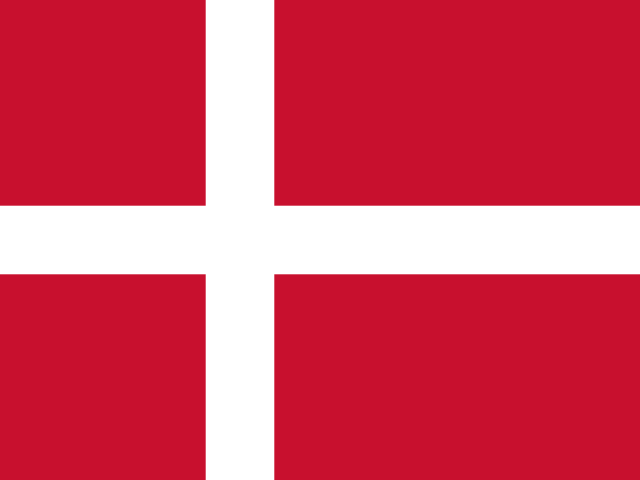
History of the flagpole: Dannebrog and the flagpole in Denmark
Published Written by Flagpole Guides
This page is an English translation of the Danish original. Where the two versions differ, the Danish text is the original.
For centuries, Dannebrog was the flag of the king and the state, and ordinary citizens were forbidden to raise it. Today, a flagpole stands in a great many Danish gardens, and the flag is used for everything from birthdays to funerals. This guide follows the development from the king’s banner to the people’s flag and the flagpole in the garden.
The king’s banner
According to Den Store Danske, the oldest known coloured depiction of Dannebrog is a red banner with a white cross in the Dutch armorial Gelre from after 1370, next to the arms of Valdemar IV. Valdemar IV was king from 1340 to 1375 and was probably the first Danish king to use Dannebrog. The legend of the flag that fell from the sky at Lyndanisse in 1219 is first mentioned in chronicles from the 1520s. At sea, Dannebrog has been flown since the end of the 16th century, according to Den Store Danske.
Swallow-tailed and rectangular flags
| Year | Event according to Den Store Danske and Dannebrogs-Samfundet |
|---|---|
| 1625 | Christian IV reserves the swallow-tailed flag for the king, the navy and the royal possessions |
| 1630–1635 | The swallow-tailed flag is reserved for the navy; merchant ships may not fly it |
| 1696 | The proportions of the swallow-tailed flag are set |
| 1731 | The royal standard gets the royal coat of arms in a central square |
| 1748 | The merchant flag is set as a rectangular flag without split, the stutflag |
| 1893 | The extended form of the rectangular flag is permitted |
Ban and freedom
At the beginning of the 19th century, Dannebrog was still a symbol of royal power. According to Den Store Danske, a royal resolution of 21 December 1833 prohibited private individuals from flying Dannebrog, but the ban was not enforced. During the Schleswig Wars of 1848–1850 the population flew the flag eagerly, and a royal resolution of 7 July 1854 allowed the population to fly Dannebrog – as the rectangular flag. Both resolutions were repealed when the Flag Act came into force on 1 January 2025.
Flag days and flagpoles
With freedom came the flagpole in the garden. According to Den Store Danske, royal birthdays, church festivals and national and military days of remembrance have been flag days since the 1880s:
- 1886: The War Ministry introduces flag flying from military buildings on 13 royal birthdays, Constitution Day and days commemorating battles.
- 1912–1913: Valdemar’s Day, 15 June, is introduced as a flag day on the initiative of Danmarks-Samfundet.
- 1939: The yearbook Hvem-Hvad-Hvor publishes a list of flag days for the first time.
- 2009 and 2016: The flag day for Denmark’s deployed personnel and the flag days for Greenland and the Faroe Islands are introduced.
- 2024: The Ministry of Justice circular sets the current 21 official flag days.
According to Bolius, a wooden flagpole is typically spruce, which is felled, debarked, planed and possibly painted, and it is good flag etiquette to leave the pole painted white or in natural wood. Today glass fibre is widespread, but the white pole with a red finial is the classic picture.
Other countries’ flags
According to Den Store Danske, in 1915, during the First World War, the Ministry of Justice prohibited flying foreign flags. Over time it became permitted to fly the Nordic flags, the UN flag and the EU flag. In 2023 the Supreme Court held that the ban lacked a statutory basis, and from 1 January 2025 the Flag Act reintroduced it. More in the guide to foreign flags in Denmark.
Half-mast
According to Den Store Danske, flying the flag at half-mast has been practised in Denmark since 1743. Dannebrogs-Samfundet writes that the custom has been known since the beginning of the 17th century.
The cross and the colours are covered in more detail in the guide to flag symbolism, the different flags in the guide to flag types, and today’s flag days in the guide to flag days. The materials of today’s flagpoles are described in the guide to flagpole materials.
Frequently asked questions
When were private individuals allowed to fly Dannebrog?
According to Den Store Danske, a royal resolution of 21 December 1833 prohibited private individuals from flying Dannebrog, but the ban was not enforced. A royal resolution of 7 July 1854 allowed the population to fly the flag. Both resolutions were repealed by the Flag Act in 2025.
How old is Dannebrog?
According to Den Store Danske, the oldest known coloured depiction is in the armorial Gelre from after 1370, and the oldest known Dannebrog is linked to Valdemar IV, king from 1340 to 1375. According to legend, the flag fell from the sky on 15 June 1219.
When did the Danish flag days begin?
According to Den Store Danske, in 1886 the War Ministry introduced flag flying from military buildings on royal birthdays, Constitution Day and days commemorating battles. From 1939, the yearbook Hvem-Hvad-Hvor published a list of flag days. Today the Ministry of Justice sets the official flag days in a circular.
How long has the flag been flown at half-mast in Denmark?
According to Den Store Danske, flying the flag at half-mast has been practised since 1743. Dannebrogs-Samfundet writes that the custom has been known since the beginning of the 17th century.
Sources
This guide is based on the following sources, most of them in Danish:
- Dannebrog – Lex – Den Store Danske
- Flagning – Lex – Den Store Danske
- Sådan bruges Dannebrog, 2nd edition (2019), pp. 76–81 – Dannebrogs-Samfundet (formerly Danmarks-Samfundet)
- Lov om flagning (LOV nr. 1449 af 10. december 2024), § 8 – Retsinformation
- Flagstænger og flagregler – Bolius
Related guides
- Flag symbolismThe symbolism of Dannebrog: the white cross on red, Dannebrog red, the meaning of the name, the legend of 1219 and the flags of Greenland and the Faroes.
- Flag daysAll official flag days in Denmark for 2026 and 2027 with date and weekday under the Ministry of Justice circular – with half-mast days, Erfalasorput and Merkið.
- Flag typesDanish flag types: the rectangular flag, the swallow-tailed flag, the naval ensign, the yacht flag, the storm flag, the pennant and the stander.
- Flagpole materialsFlagpole materials in Denmark: glass fibre, wood, aluminium and steel – maintenance, durability, appearance and price compared.