Flag symbolism: the cross, colours and name of Dannebrog
Published Written by Flagpole Guides
This page is an English translation of the Danish original. Where the two versions differ, the Danish text is the original.
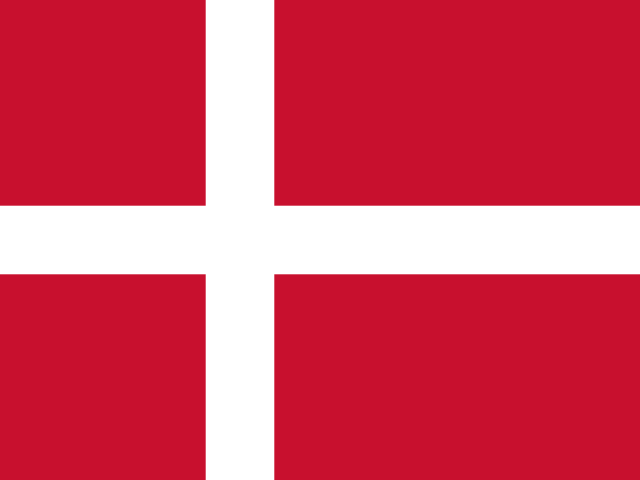
Dannebrog is a white cross extending to the edges on a red field. The simple design made the flag a model for the other Nordic flags, and few countries use their flag as much in everyday life as Denmark. This guide describes what the cross and the colours stand for, where the name comes from and how the legend of the flag from the sky arose.
The cross
The cross is a Christian symbol. According to Den Store Danske, Dannebrog corresponds to the red banner with a white cross that the Holy Roman Emperor raised when he went on crusade, and which became the empire’s banner in the 13th century. Valdemar IV had close ties to the emperor and may have adopted the same emblem as a political signal. Dannebrogs-Samfundet links the flag to the Danish kings’ crusades in the Baltic and calls it a visible crusader’s emblem from around 1200.
The cross in the national flag is straight, while the army’s colours have had a flared cross since 1842. According to Den Store Danske, the cross in the royal coat of arms regained the flared form in 2024.
The colours
| Colour | Name according to Dannebrogs-Samfundet |
|---|---|
| Dannebrog red | Pantone 186C, rectangular and swallow-tailed flags |
| Naval red | Pantone 194C, the navy’s ensign |
| White | No specific Pantone value |
Dannebrogs-Samfundet refers to Danish Standard no. 359 of 2005. Bolius writes that Denmark has no rules on one correct shade, that the 1748 ordinance simply says red, and that Pantone 185 is most often used. According to Dannebrogs-Samfundet, naval red is darker, making the flag easier to see at sea.
The name
According to Den Store Danske, the oldest known source for the name is a Dutch armorial from the 1330s, where »Denenbroec« is written above a red shield with a white cross. The name is probably made up of a word corresponding to Frisian dan, red, and brog, cloth. It therefore refers to the flag’s red fabric, but was early on understood as »the banner of the Danes«.
The legend of 1219
According to legend, Dannebrog fell from the sky during the Battle of Lyndanisse in Estonia on 15 June 1219 and gave Valdemar the Victorious’s army its victory. Den Store Danske writes that the legend is first mentioned in chronicles in the 1520s and that it has nothing to do with historical reality, but that its existence over the centuries is part of Danish history. Valdemar’s Day, 15 June, is an official flag day today.
A popular symbol
Dannebrogs-Samfundet describes Dannebrog as a national emblem of identity and unity that first belonged to the kings, then to the state and now to the people. According to Dannebrogs-Samfundet, Dannebrog does not show mourning, so no black ribbons are put on the flag. Its use on birthday cakes and Christmas trees is a widespread Danish tradition, according to Den Store Danske.
The flags of Greenland and the Faroe Islands
- Erfalasorput, Greenland’s flag, was designed by Thue Christiansen and first raised on 21 June 1985, according to Den Store Danske. The white stands for the snow and ice, the red circle for the sun and the return of light at midsummer.
- Merkið, the Faroese flag, is white with a red cross edged in blue. According to Den Store Danske, it was designed by two Faroese students in 1919 and gained official status in 1948. The cross shows the connection with the Nordic region and Christianity, and the white stands for the foam of the sea and the bright sky.
The history of the flag and the flagpole is covered in the guide to the history of the flagpole, and the different versions of Dannebrog in the guide to flag types.
Frequently asked questions
What does the name Dannebrog mean?
According to Den Store Danske, the name is probably made up of a word corresponding to Frisian dan, meaning red, and brog, meaning cloth. The name thus refers to the flag’s red fabric, but early on it was understood as »the banner of the Danes«.
What does the cross in Dannebrog symbolise?
The cross is a Christian symbol. According to Den Store Danske, Dannebrog corresponds to the red banner with a white cross that the Holy Roman Emperor used on crusades, and Dannebrogs-Samfundet links the cross to the Danish kings’ crusades in the Baltic around the year 1200.
Which red does Dannebrog use?
According to Dannebrogs-Samfundet, Danish Standards has set Dannebrog red as Pantone 186C and naval red as Pantone 194C. Bolius, however, writes that the 1748 ordinance simply says red, and that Pantone 185 is most often used.
Is Dannebrog the world’s oldest flag?
Dannebrogs-Samfundet calls Dannebrog the oldest known flag in the world. According to Den Store Danske, the oldest known coloured depiction is in the armorial Gelre from after 1370, and the oldest known Dannebrog is linked to Valdemar IV, king from 1340 to 1375.
What does Greenland’s flag symbolise?
According to Den Store Danske, the white in Erfalasorput stands for the snow and ice and the red circle for the sun and the return of light at midsummer. The colours red and white show the connection with Denmark and the Nordic region.
Sources
This guide is based on the following sources, most of them in Danish:
- Dannebrog – Lex – Den Store Danske
- Erfalasorput – Grønlands flag – Lex – Den Store Danske
- Færøernes flag – Lex – Den Store Danske
- Sådan bruges Dannebrog, 2nd edition (2019), pp. 4, 10 and 75–82 – Dannebrogs-Samfundet (formerly Danmarks-Samfundet)
- Flagstænger og flagregler – Bolius
Related guides
- History of the flagpoleThe history of Dannebrog and the flagpole in Denmark: from the king’s banner and the swallow-tailed flag to the 1833 ban, freedom in 1854 and the 2025 Flag Act.
- Flag typesDanish flag types: the rectangular flag, the swallow-tailed flag, the naval ensign, the yacht flag, the storm flag, the pennant and the stander.
- Flag sizesDanish flag sizes: Dannebrog’s 28:37 proportions and Dannebrogs-Samfundet’s table of flags, pennants and standers for flagpoles from 2 to 20 metres.
- Flag daysAll official flag days in Denmark for 2026 and 2027 with date and weekday under the Ministry of Justice circular – with half-mast days, Erfalasorput and Merkið.