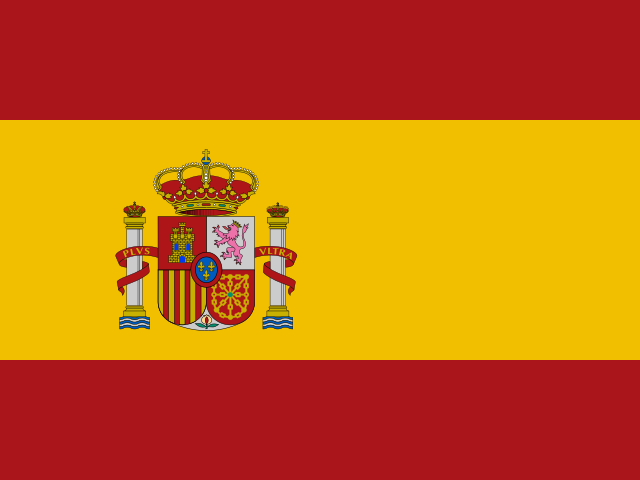
Flagpoles and flags in Spain
Published Written by Flagpole Guides
This page is an English translation of the Spanish original. Where the two versions differ, the Spanish text is the original.
In Spain, the red and yellow flag flies every day on town halls, provincial councils, regional government buildings, barracks and state schools, almost always together with the flag of the autonomous community and often with the European and municipal flags. Many people hang it from their balconies during major sporting events or on 12 October, and businesses, hotels and car dealers raise it next to their corporate flags. Unlike some other countries, Spain has no flag days: the flag on public buildings is not raised on particular dates but every day. This page brings together the rules and customs for flags and flagpoles in Spain, based on the legislation and the authorities responsible.
The essentials
- Every day: under article 3 of Law 39/1981, the flag of Spain flies outside all public buildings. The national holidays and Armed Forces Day are listed in the guide to flag days.
- With other flags: the flag of Spain takes the pre-eminent place, and regional, municipal or foreign flags may not be larger. The guides to flag rules and flag protocol cover this.
- Half-mast: the flag flies at half-mast when the Government, an autonomous community or a municipality declares official mourning. More in the guide to half-mast.
- Coat of arms: on public buildings the flag bears the coat of arms of Spain; a private individual may fly it with or without. The guide to flag types explains the differences.
- Sizes: the Flag Regulation of 1977 sets five flag types for State buildings. The flag size calculator also shows a Spanish maker’s table for a flagpole.
- Price: what determines the price of a flagpole and of a flag is covered in the guides to the price of a flagpole and the price of a flag.
- Installation: a flagpole is building work subject to the planning rules of each autonomous community. More in the guide to flagpole installation.
Laws and authorities
Article 4 of the Constitution of 1978 describes the flag of Spain and allows the Statutes of Autonomy to recognise flags of the autonomous communities. Law 39/1981 of 28 October regulates its use: where it flies, what place it takes next to other flags and which symbols may not be added to it. Royal Decree 441/1981 specifies the colours in the CIELAB system, Law 33/1981 describes the coat of arms and Royal Decree 2964/1981 publishes its official model and its position on the flag.
The Armed Forces are also governed by Royal Decree 1511/1977, which approves the Regulation on Flags and Standards, Guidons, Insignia and Distinguishing Marks, and by the Regulation on Military Honours (Royal Decree 684/2010). Insults to Spain, its autonomous communities or their symbols, made in public, are punishable by a fine of seven to twelve months under article 543 of the Criminal Code.
The flagpole is a separate matter: it is governed by the planning legislation of each autonomous community and the bylaws of the local council, and, depending on the location, by the rules on historic heritage, aviation easements or horizontal property.
The flagpole in Spain
On public buildings, flags usually hang from short poles on the main balcony of the façade, often in groups of three or four: Spain, the autonomous community, the municipality and frequently the European Union. Freestanding flagpoles are found in front of institutional headquarters, barracks, hotels, industrial estates, car dealers and marinas. The guides to types of flagpoles and flagpole heights cover these forms.
Spanish makers mainly offer one-piece tapered flagpoles of fibreglass and aluminium, from 4 to 16 metres, with an external halyard, an internal halyard or a rotating arm. The guide to flagpole materials compares them.
About the guides
The guides are grouped by theme. Each one covers a specific topic, ends with frequently asked questions, cites its sources and shows the date of its last update. State rules apply throughout Spain; the autonomous communities and the cities of Ceuta and Melilla also have their own flag, their own holidays and their own planning legislation, and the guides point out those differences where they matter.
All guides
Flag flying and rules
When and how flags fly in Spain: national holidays, the rules of Law 39/1981, half-mast, official mourning, holidays, protocol and foreign flags.
- Flag daysThe national holidays and flag dates in Spain in 2026 and 2027: 12 October, Constitution Day and Armed Forces Day, with the rule behind each day.
- Flag rulesThe flag rules in Spain: where the flag flies under Law 39/1981, regional and municipal flags, the place of honour, prohibited symbols and insults to the flag.
- Half-mastWhen the flag flies at half-mast in Spain: official mourning by royal decree, regional and municipal mourning, military rules and the black ribbon.
- Flags in mourningHow official mourning is declared in Spain, how long it lasts, what happens to the flag on public buildings, indoors and in the military, with recent examples.
- Flags on holidaysThe flag on public holidays in Spain: 12 October, 6 December, the days of the autonomous communities with their flags and the 2026 holiday calendar.
- Flag protocolThe order of flags in Spain under Law 39/1981: the place of honour with odd and even numbers of flags, regional and municipal flags, indoors and at events.
- Foreign flagsFlags of other countries in Spain: use by private individuals and businesses, embassies, official visits, the international order and the European flag.
The flag
The flag of Spain and the other flags seen in the country: types, sizes, symbolism, history, what determines the price of a flag and a size calculator.
- Flag typesThe types of flags in Spain: with and without the coat of arms, regional, municipal, for pleasure boats, standards, guidons and advertising flags.
- Flag sizesThe dimensions of the flag of Spain: 2:3 proportion, stripes, coat of arms, the five official types of the Flag Regulation and the size for a flagpole.
- Flag size calculatorFlag calculator for Spain: the nearest standard size for the height of the flagpole, the stripe widths and the position of the coat of arms under RD 2964/1981.
- Flag symbolismWhat the flag of Spain symbolises under Law 39/1981, why it is red and yellow, and what the quarters, pillars and crowns of the coat of arms represent.
- Price of a flagThe price of a flag in Spain: how size, fabric, coat of arms, finishing and customisation affect it, and the consumer’s rights of withdrawal and guarantee.
- History of the flagThe history of the flag of Spain: the naval ensign of Charles III in 1785, the Army in 1843, the tricolour of 1931, 1936 and the laws of 1978 and 1981.
The flagpole
Types of flagpoles, materials, height, accessories, mechanics, lighting and what determines the price of a flagpole.
- Types of flagpolesThe types of flagpoles in Spain: external halyard, internal halyard, rotating arm, balcony poles, indoor staffs and portable flagpoles.
- Flagpole materialsFibreglass, aluminium, steel and wood for a flagpole in Spain: heights, behaviour in wind, the coast, earthing and maintenance.
- Flagpole heightsFlagpole heights in Spain: factory heights, the link with flag size, the wind zones of the Building Technical Code, foundations and planning limits.
- Flagpole accessoriesThe accessories of a flagpole in Spain: halyard, cleat, pulley, snap hooks, counterweight, rotating arm, finial, bases and anchoring.
- Flagpole mechanicsHow a flagpole works: external and internal halyard, counterweight, rotating arm, rotating head, raising and lowering the flag and half-mast.
- Flag lightingThe flag at night in Spain: raising times, spotlights and lights, the outdoor lighting regulation and the laws against light pollution.
- Price of a flagpoleThe price of a flagpole in Spain: height, material, hoisting system, anchoring, installation, construction tax and fees, and consumer rights when buying.
Installation, safety and maintenance
Planning permission or a responsible declaration, foundations, easements, safety, maintenance, repair, lifespan and transport, for households, owners’ associations, businesses and councils.
- Flagpole installationInstalling a flagpole in Spain: planning permission or a responsible declaration by region, historic heritage, airports, owners’ associations and foundations.
- Flagpole safetyFlagpole safety in Spain: wind load, flag size, anchoring, earthing and civil liability for damage under the Civil Code.
- Flagpole maintenanceMaintaining a flagpole: fibreglass, aluminium and wood, halyard, pulleys and snap hooks, anchoring, and caring for and replacing the flag.
- Flagpole repairThe most common flagpole faults: broken halyard, seized pulley or rotating head, bent arm, cracks, corrosion and leaning, and the legal guarantee.
- Flagpole lifespanHow long a flagpole lasts in Spain by material, wind and coast, what shortens its life and how long an outdoor flag lasts.
- Flagpole transportHow a flagpole is transported in Spain: how far a load may overhang under the General Traffic Regulation, the V-20 sign and special transport.
- Flagpoles for businessesFlagpoles and flags for businesses in Spain: logos and the flag of Spain, outdoor advertising, roads, paperwork, rotating arms and wind.
Frequently asked questions
Is permission needed to fly a flag in Spain?
Not to hang a flag at home. Law 39/1981 regulates the flag on public buildings and prohibits adding the symbols or initials of parties, trade unions, associations or private entities to the flag of Spain. A new flagpole, on the other hand, is building work subject to the planning rules of the autonomous community and the municipality, and in a block of flats the Horizontal Property Act also applies.
Where is the flag of Spain compulsory?
Under article 3 of Law 39/1981, the flag of Spain flies outside and takes the place of preference inside all buildings and establishments of the central, regional, provincial or island and municipal administrations. At the seats of the constitutional bodies and of the central State administration it is the only flag that flies.
What does the flag of Spain look like?
Article 4.1 of the Constitution describes it as three horizontal stripes, red, yellow and red, with the yellow stripe twice as wide as each red one. The normal proportion is 2:3, and the coat of arms appears on the yellow stripe on the flags of public buildings.
What about the flags of the autonomous communities?
Under article 4.2 of the Constitution, the Statutes of Autonomy may recognise flags of the autonomous communities, which are used together with the flag of Spain on their public buildings and at their official events. Law 39/1981 adds that the flag of Spain takes the pre-eminent place and that the others may not be larger.
When does the flag fly at half-mast in Spain?
When official mourning is declared. The Government declares it by royal decree, which usually states that the national flag will fly at half-mast on all public buildings and Navy ships. Autonomous communities and municipalities can declare their own mourning.
Is planning permission needed for a flagpole?
It depends on the autonomous community and the municipality. Most regional planning laws subject minor works to a responsible declaration; in the Community of Madrid, for example, that is the general rule under article 155 of Law 9/2001. The local council can answer in a specific case.
Sources
This guide is based on the following sources, most of them in Spanish:
- Constitución Española, artículo 4 – Boletín Oficial del Estado
- Ley 39/1981, de 28 de octubre, por la que se regula el uso de la bandera de España y el de otras banderas y enseñas – Boletín Oficial del Estado
- Real Decreto 2964/1981, de 18 de diciembre, por el que se hace público el modelo oficial del Escudo de España – Boletín Oficial del Estado
- Real Decreto 1117/2024, de 30 de octubre, por el que se declara luto oficial – Boletín Oficial del Estado
- Ley 9/2001, de 17 de julio, del Suelo, de la Comunidad de Madrid – Boletín Oficial del Estado
- Símbolos del Estado – Punto de Acceso General de la Administración