Flag rules in Spain: what Law 39/1981 says
Published Written by Flagpole Guides
This page is an English translation of the Spanish original. Where the two versions differ, the Spanish text is the original.
In Spain, the use of the flag is regulated by a law of its own, Law 39/1981 of 28 October. It is short, ten articles, and deals mainly with public buildings: where the flag of Spain flies, how it sits alongside regional and municipal flags and what may not be added to it. For private individuals there are few rules. This guide summarises what the Constitution, Law 39/1981 and the rules that complete it say.
The Constitution and Law 39/1981
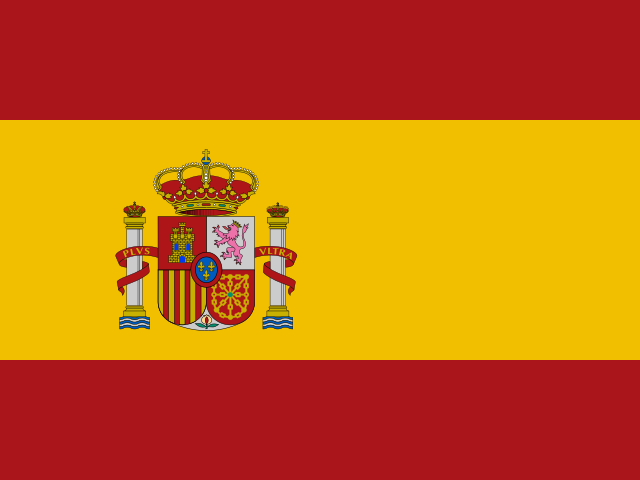
Article 4.1 of the Constitution describes the flag: three horizontal stripes, red, yellow and red, with the yellow stripe twice as wide as each red one. Article 4.2 allows the Statutes of Autonomy to recognise flags and ensigns of the autonomous communities, which are used together with the flag of Spain on their public buildings and at their official events.
Law 39/1981 builds on that. Its article 1 states that the flag of Spain symbolises the nation, is a sign of the sovereignty, independence, unity and integrity of the homeland and represents the higher values expressed in the Constitution. Article 2 repeats the Constitution’s description and adds that the coat of arms of Spain may be placed on the yellow stripe.
Where the flag of Spain flies
Article 3 sets out five cases:
- Public buildings: the flag of Spain flies outside and takes the place of preference inside all buildings and establishments of the central, institutional, regional, provincial or island and municipal administrations.
- State bodies: at the seats of the constitutional bodies and of the central bodies of the State administration it is the only flag that flies and is displayed.
- Armed Forces and security forces: it is the only flag on the flagpole of military buildings, barracks, ships and aircraft.
- Diplomatic missions: the flag and coat of arms of Spain are placed at embassies, consulates and the residences of their heads.
- Ships: Spanish ships and boats fly it as their ensign.
Under article 2, in the first four cases the flag always bears the coat of arms of Spain. Under Royal Decree 2964/1981, the coat of arms is two fifths of the width of the flag high and appears on both sides, in the centre of the yellow stripe.
Regional and municipal flags
In the autonomous communities whose Statutes recognise a flag of their own, that flag is used together with the flag of Spain on all civil public buildings in their territory (article 4). Town councils, provincial councils and other public corporations that use their own flag also do so together with the flag of Spain (article 5).
Article 6 sets the order: the flag of Spain always takes a prominent, visible place of honour. If other flags are used with it, it takes the pre-eminent place of highest honour, and the others may not be larger. With an odd number of flags, the place of honour is the centre; with an even number, of the two central positions, the one on the right of the presiding authority, which is the left as seen by the observer. The guide to flag protocol explains these rules.
What may not be added to the flag
Under article 8, it is prohibited to use the symbols or initials of political parties, trade unions, associations or private entities on the flag of Spain. The prohibition applies to every flag of Spain, not only those on public buildings. A business may raise its corporate flag next to the flag of Spain, but may not print its logo on the red and yellow flag. The guide to flagpoles for businesses covers this case.
Insults to the flag
Article 10 of Law 39/1981 refers to the criminal law. Article 543 of the Criminal Code punishes insults or outrages by word, in writing or by deed against Spain, its autonomous communities or their symbols or emblems, when made in public, with a fine of seven to twelve months. In judgment 190/2020, the Constitutional Court dismissed the appeal of a trade unionist convicted for contemptuous words about the flag spoken during the raising of the flag at a military installation, and found the conviction proportionate.
Private individuals and owners’ associations
Law 39/1981 does not oblige private individuals to raise the flag and does not regulate where or when they may do so. A private individual may hang the flag of Spain, that of their autonomous community or any other on their balcony or in their garden, with or without the coat of arms. In a building under horizontal property, the owners’ association’s statutes and the Horizontal Property Act govern what is installed on the façade. A fixed flagpole is also building work subject to planning rules; the guide to flagpole installation covers this.
Times
Law 39/1981 sets no times. In military units, under article 3 of the Regulation on Military Honours (Royal Decree 684/2010), the flag is raised at eight in the morning and lowered at sunset, except during national mourning, when it stays at half-mast day and night. For civil buildings, Law 39/1981 makes no distinction between day and night. The guide to flag lighting covers this.
Frequently asked questions
Is the flag of Spain compulsory on public buildings?
Yes. Under article 3 of Law 39/1981, the flag of Spain flies outside and takes the place of preference inside all buildings and establishments of the central, institutional, regional, provincial or island and municipal administrations. Article 9 provides that the authorities correct infringements on the spot.
May a private individual fly the flag of Spain at home?
Yes. Law 39/1981 does not restrict private use of the flag, except on one point: article 8 prohibits adding the symbols or initials of political parties, trade unions, associations or private entities to the flag of Spain. In a block of flats, the owners’ association’s statutes and the Horizontal Property Act may also apply.
May a regional flag be larger than the flag of Spain?
No. Under article 6 of Law 39/1981, when other flags are used together with the flag of Spain, it takes the pre-eminent place of highest honour, and the others may not be larger.
Is it a crime to burn or insult the flag in Spain?
Article 543 of the Criminal Code punishes insults or outrages by word, in writing or by deed against Spain, its autonomous communities or their symbols or emblems, made in public, with a fine of seven to twelve months. In judgment 190/2020, the Constitutional Court upheld a conviction for this offence.
Which flags fly at the ministries?
Only the flag of Spain. Under article 3.2 of Law 39/1981, it is the only flag that flies and is displayed at the seats of the constitutional bodies of the State and of the central bodies of the State administration. Under article 3.3, the same applies to the flagpole of military buildings and barracks.
Sources
This guide is based on the following sources, most of them in Spanish:
- Constitución Española, artículo 4 – Boletín Oficial del Estado
- Ley 39/1981, de 28 de octubre, por la que se regula el uso de la bandera de España y el de otras banderas y enseñas – Boletín Oficial del Estado
- Real Decreto 2964/1981, de 18 de diciembre, por el que se hace público el modelo oficial del Escudo de España – Boletín Oficial del Estado
- Ley Orgánica 10/1995, de 23 de noviembre, del Código Penal (artículo 543) – Boletín Oficial del Estado
- Pleno. Sentencia 190/2020, de 15 de diciembre de 2020 – Tribunal Constitucional (BOE)
- Real Decreto 684/2010, de 20 de mayo, por el que se aprueba el Reglamento de Honores Militares – Boletín Oficial del Estado
Related guides
- Flag daysThe national holidays and flag dates in Spain in 2026 and 2027: 12 October, Constitution Day and Armed Forces Day, with the rule behind each day.
- Flag protocolThe order of flags in Spain under Law 39/1981: the place of honour with odd and even numbers of flags, regional and municipal flags, indoors and at events.
- Half-mastWhen the flag flies at half-mast in Spain: official mourning by royal decree, regional and municipal mourning, military rules and the black ribbon.
- Foreign flagsFlags of other countries in Spain: use by private individuals and businesses, embassies, official visits, the international order and the European flag.