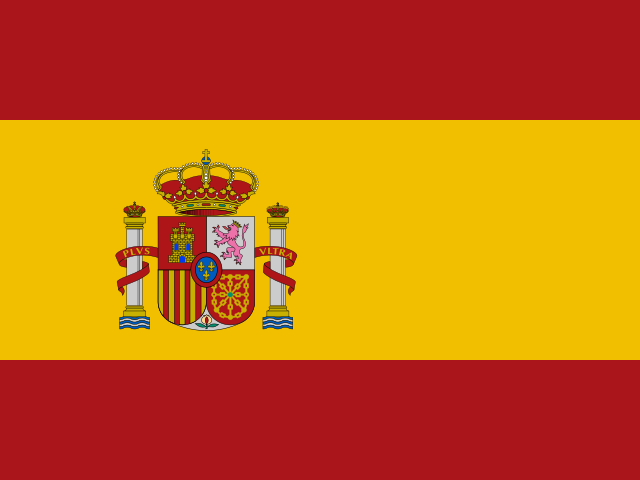
Symbolism of the flag of Spain: colours and coat of arms
Published Written by Flagpole Guides
This page is an English translation of the Spanish original. Where the two versions differ, the Spanish text is the original.
The red and yellow flag is one of the few national symbols whose meaning is written into a law. Law 39/1981 says what it symbolises, Law 33/1981 describes each element of the coat of arms and Royal Decree 441/1981 defines its colours with technical coordinates. This guide covers what those texts say and what official sources explain about the origin of the colours.
What the law says
Article 1 of Law 39/1981 states that the flag of Spain symbolises the nation; it is a sign of the sovereignty, independence, unity and integrity of the homeland and represents the higher values expressed in the Constitution. Under article 1 of the Constitution, those higher values are freedom, justice, equality and political pluralism.
Royal Decree 862/1997, which regulates the National Day within the Ministry of Defence, describes the tribute to the flag of Spain as a tribute to the ensign of the homeland and symbol of its unity and of national coexistence.
Why red and yellow
Unlike some other flags, the colours of the Spanish flag were not born with a declared symbolic meaning but with a practical purpose. According to the Royal Guard and the Historical Archive of the Nobility of the Ministry of Culture, in the eighteenth century the navies of France, Naples, Tuscany, Sicily and Spain used flags dominated by white, the colour shared by the branches of the Bourbon dynasty, and this caused confusion and attacks between friendly and allied ships. Charles III asked the Minister of the Navy, Antonio Valdés, for a flag visible at a great distance. From twelve sketches, the king chose two red and yellow ones, one for the navy and one for the merchant fleet, by Royal Decree of 28 May 1785. The central stripe was wider to make room for the coat of arms.
Red and yellow are often linked to the colours of the arms of Castile and Aragon. The official sources cited, however, explain the choice by visibility at sea.
The official colours
Royal Decree 441/1981 names them flag red and flag weld yellow (amarillo gualda bandera) and specifies them in the international CIELAB system, with a tolerance of five units. “Gualda” is the name of weld, a plant that gave a yellow dye, and that is where the word “rojigualda” for the flag comes from.
The coat of arms
Law 33/1981 describes the coat of arms of Spain in heraldic terms. Its elements, as the Flag Regulation identifies them when describing the King’s guidon, represent the old kingdoms:
- First quarter, Castile: a gold castle on a red field.
- Second quarter, León: a rampant purple lion, crowned in gold, on a silver field.
- Third quarter, Aragon: four red pales on a gold field.
- Fourth quarter, Navarre: a gold chain on a red field, set in cross, saltire and orle, with an emerald in the centre.
- In base, Granada: a pomegranate proper on a silver field.
- Inescutcheon, Bourbon: blue with three gold fleurs-de-lis and a red border, belonging to the reigning dynasty (article 2 of the law).
The shield is accompanied by two silver pillars on waves of the sea, with a red ribbon reading “Plus” on the dexter pillar and “Ultra” on the sinister one. The dexter pillar bears the imperial crown and the sinister one the royal crown. Above the shield is the closed royal crown. The pillars are traditionally associated with the Pillars of Hercules at the Strait of Gibraltar, and the motto “Plus Ultra”, “further beyond”, with expansion beyond that limit.
The proportion of the stripes
The yellow stripe, twice as wide as each red one under article 4 of the Constitution, follows the logic of 1785: it leaves room for the coat of arms. The guide to flag sizes explains the proportions, and the guide to the history of the Spanish flag follows its development to the present day.
Frequently asked questions
What does the flag of Spain symbolise?
Under article 1 of Law 39/1981, the flag of Spain symbolises the nation; it is a sign of the sovereignty, independence, unity and integrity of the homeland and represents the higher values expressed in the Constitution.
Why is the flag of Spain red and yellow?
According to the Ministry of Defence and the Ministry of Culture, Charles III commissioned a new naval flag in 1785 because the navies of the time used flags dominated by white, which caused confusion at sea. The king chose a red and yellow design, with a wider central stripe to make room for the coat of arms, easy to identify at a distance.
What do the quarters of the coat of arms of Spain represent?
The historic kingdoms: a gold castle on red for Castile, a purple lion on silver for León, four red pales on gold for Aragon, gold chains on red for Navarre and, at the base, a pomegranate for Granada. In the centre is the blue inescutcheon with three gold fleurs-de-lis and a red border of the reigning dynasty, the House of Bourbon.
What does Plus Ultra mean?
It is the motto on the ribbon around the two pillars of the coat of arms, “Plus” on the dexter pillar and “Ultra” on the sinister one, under Law 33/1981. The pillars are traditionally associated with the Pillars of Hercules at the Strait of Gibraltar, and the motto, “further beyond”, with expansion beyond that limit.
Sources
This guide is based on the following sources, most of them in Spanish:
- Ley 39/1981, de 28 de octubre, por la que se regula el uso de la bandera de España y el de otras banderas y enseñas – Boletín Oficial del Estado
- Ley 33/1981, de 5 de octubre, del Escudo de España – Boletín Oficial del Estado
- Real Decreto 1511/1977, de 21 de enero, por el que se aprueba el Reglamento de Banderas y Estandartes, Guiones, Insignias y Distintivos – Boletín Oficial del Estado
- Bandera de España – Guardia Real, Ministerio de Defensa
- Un proyecto de reforma de la bandera de España – Archivo Histórico de la Nobleza, Ministerio de Cultura
- Real Decreto 862/1997, de 6 de junio, por el que se regulan los actos conmemorativos del Día de la Fiesta Nacional de España, en el ámbito del Ministerio de Defensa – Boletín Oficial del Estado
- Real Decreto 441/1981, de 27 de febrero, por el que se especifican técnicamente los colores de la Bandera de España – Boletín Oficial del Estado
Related guides
- History of the flagThe history of the flag of Spain: the naval ensign of Charles III in 1785, the Army in 1843, the tricolour of 1931, 1936 and the laws of 1978 and 1981.
- Flag typesThe types of flags in Spain: with and without the coat of arms, regional, municipal, for pleasure boats, standards, guidons and advertising flags.
- Flag rulesThe flag rules in Spain: where the flag flies under Law 39/1981, regional and municipal flags, the place of honour, prohibited symbols and insults to the flag.
- Flag sizesThe dimensions of the flag of Spain: 2:3 proportion, stripes, coat of arms, the five official types of the Flag Regulation and the size for a flagpole.