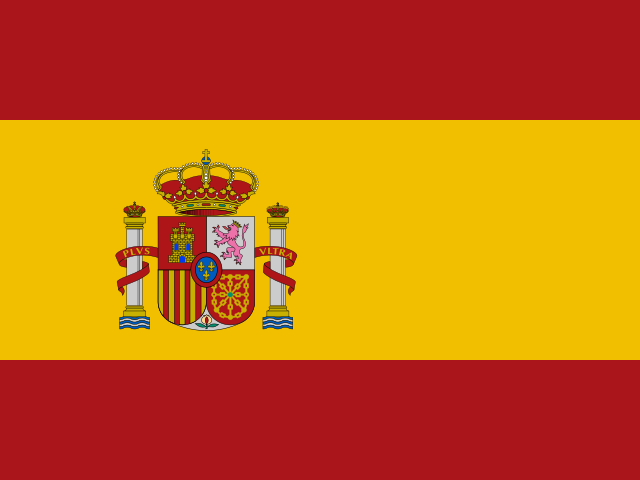
Foreign flags in Spain: what the law allows
Published Written by Flagpole Guides
This page is an English translation of the Spanish original. Where the two versions differ, the Spanish text is the original.
Spain receives millions of visitors and is home to many people from other countries, and flags from all over the world are seen in its streets: at hotels, campsites, consulates, clubs and on balconies. Spanish law regulates the flag of Spain in detail but says little about foreign flags. This guide summarises what Law 39/1981, the Vienna Convention and State protocol say.
Private individuals and businesses
Law 39/1981 regulates the flag of Spain and the regional and municipal flags on public buildings. It contains no rule restricting the use of foreign flags by private individuals or businesses. A hotel may raise the flags of its guests’ countries, a campsite those of neighbouring countries and a private individual that of their country of origin, on their balcony or on their own flagpole.
What does apply are the general rules: a new flagpole is building work subject to planning rules, and in a block of flats the owners’ association’s statutes and the Horizontal Property Act apply. The guide to flagpole installation covers these matters.
Together with the flag of Spain
When the flag of Spain flies together with those of other States, article 7 of Law 39/1981 refers to the international rules and customs governing this matter in relations between States, and to the internal rules and regulations of intergovernmental organisations and international conferences. In practice, the flags of States are usually the same size and fly at the same height, and it is common to arrange them alphabetically by the names of the countries.
On public buildings, article 6 also applies: the flag of Spain takes the place of honour and the others may not be larger. The guide to flag protocol explains that place of honour.
State buildings
At the seats of the constitutional bodies and of the central bodies of the State administration, the flag of Spain is the only one that flies and is displayed (article 3.2). The same applies to the flagpole of military buildings and barracks (article 3.3). On other public buildings, such as a town hall or a regional government building, the flag of a guest country may fly next to that of Spain during an official visit or an international event.
Embassies and consulates
Under article 20 of the Vienna Convention on Diplomatic Relations of 1961, published in the Official State Gazette in January 1968, the mission and its head have the right to use the flag and emblem of the sending State on the premises of the mission, including the residence of the head of the mission, and on their means of transport. That is why foreign embassies in Madrid fly their own flag.
In return, article 3.4 of Law 39/1981 provides that the flag and coat of arms of Spain are placed on the premises of Spanish diplomatic missions and consular offices abroad, in the residences of their heads and, where applicable, on their official means of transport.
Official visits
The Regulation on Military Honours (Royal Decree 684/2010) provides honours for foreign authorities. A foreign Head of State on a State or official visit receives the honours of presented arms, the national anthem of their country and the full national anthem of Spain and, where applicable, a 21-gun salute (article 21). Under article 3.3, at any event honours are rendered only to the flag of Spain and to the authority presiding over it or to the foreign authority to be honoured.
The European flag
Law 39/1981 does not mention the flag of the European Union. It commonly flies on public buildings next to the flags of Spain, the autonomous community and the municipality, and the same principle of article 6 applies to it: it may not be larger than the flag of Spain, which takes the place of honour.
Criminal protection
Article 543 of the Criminal Code punishes insults to Spain, its autonomous communities and their symbols or emblems. It does not mention the flags of other States.
Frequently asked questions
May a foreign flag be flown in Spain?
Yes. Law 39/1981 does not prohibit private individuals or businesses from flying the flags of other countries. It only regulates the case in which the flag of Spain flies together with those of other States, which under its article 7 follows international rules and customs.
May an embassy fly its flag in Spain?
Yes. Under article 20 of the Vienna Convention on Diplomatic Relations, published in the Official State Gazette in 1968, the mission and its head have the right to use the flag and emblem of the sending State on the premises of the mission, on the residence of the head of the mission and on their means of transport.
May a foreign flag fly on a Spanish public building?
At the buildings of the constitutional bodies and of the central State administration, the flag of Spain is the only one that flies, under article 3.2 of Law 39/1981. On other public buildings, a foreign flag may fly next to the flag of Spain on the occasion of a visit or an event, no larger than it.
Is a foreign flag protected by the Criminal Code?
Article 543 of the Criminal Code protects the symbols of Spain and of its autonomous communities. It does not mention the flags of other States.
Sources
This guide is based on the following sources, most of them in Spanish:
- Ley 39/1981, de 28 de octubre, por la que se regula el uso de la bandera de España y el de otras banderas y enseñas – Boletín Oficial del Estado
- Convenio sobre Relaciones Diplomáticas firmado en Viena el día 18 de abril de 1961 – Boletín Oficial del Estado
- Real Decreto 684/2010, de 20 de mayo, por el que se aprueba el Reglamento de Honores Militares – Boletín Oficial del Estado
- Ley Orgánica 10/1995, de 23 de noviembre, del Código Penal (artículo 543) – Boletín Oficial del Estado
- Bandera, himno, escudo, precedencia de autoridades – Ministerio de Asuntos Exteriores, Unión Europea y Cooperación
Related guides
- Flag protocolThe order of flags in Spain under Law 39/1981: the place of honour with odd and even numbers of flags, regional and municipal flags, indoors and at events.
- Flag rulesThe flag rules in Spain: where the flag flies under Law 39/1981, regional and municipal flags, the place of honour, prohibited symbols and insults to the flag.
- Flag typesThe types of flags in Spain: with and without the coat of arms, regional, municipal, for pleasure boats, standards, guidons and advertising flags.
- Flagpoles for businessesFlagpoles and flags for businesses in Spain: logos and the flag of Spain, outdoor advertising, roads, paperwork, rotating arms and wind.