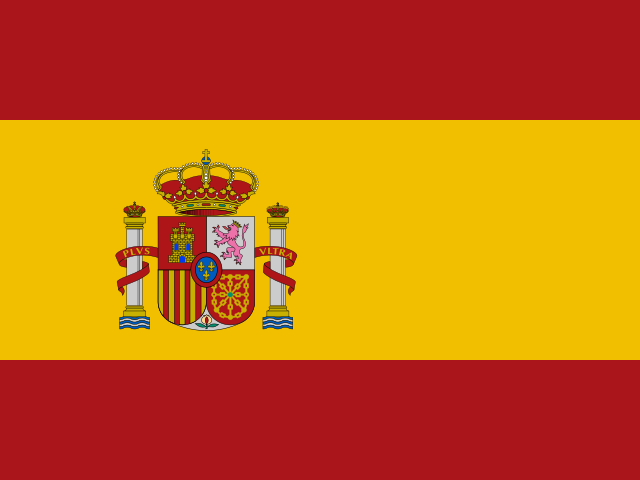
History of the flag of Spain: from 1785 to today
Published Written by Flagpole Guides
This page is an English translation of the Spanish original. Where the two versions differ, the Spanish text is the original.
The flag of Spain was born at sea. For almost sixty years it was only the flag of the Navy, and it took more than a century to fly on public buildings. It went through a republic with another flag, a civil war and several different coats of arms before being fixed in the Constitution of 1978. This guide summarises that history based on sources from the Ministry of Defence, the Ministry of Culture and the Official State Gazette.
Before 1785: Bourbon white
According to the Historical Archive of the Nobility, from the early eighteenth century the flags of the ships of the Royal Navy bore the royal arms on a white field, the colour shared by the branches of the Bourbon dynasty that then reigned over much of Europe. France, Naples, Parma and Sicily used similar flags, and confusion in battle led to attacks on friendly or allied ships.
1785: the naval flag of Charles III
Charles III asked the Minister of the Navy, Antonio Valdés, for a flag easy to identify at a great distance. Valdés presented twelve designs, dominated by red and yellow. The king chose two and varied the width of their stripes; by the Royal Decree of 28 May 1785, one became official for the navy and the other for the merchant fleet. The central stripe was wider to make room for the royal arms. A year later, another royal decree extended its use to the Navy’s barracks, shipyards, strongholds and coastal fortifications.
The Peninsular War
According to the Royal Guard, during the Peninsular War (1808–1814) some sailors served in land campaigns, and two-coloured ensigns were seen inland in Spain for the first time. According to the Ministry of Culture, it was during those years that the colours began in practice to be associated with the nation.
1843: the flag of the Army
Under Isabella II, a Royal Decree of 13 October 1843 provided that the flags and standards of all corps of the Army, the Navy and the National Militia were to have the same colours as the Spanish war flag. The red and yellow flag of 1785 thus became the national flag and a symbol of the Spanish monarchy.
1908: the flag on public buildings
On the proposal of Antonio Maura, a Royal Decree of 25 January 1908 provided that the Spanish flag was to fly on all public buildings, civil and military, on national holidays. It is the forerunner of today’s rule, which Law 39/1981 extends to every day.
1931: the republican tricolour
During the provisional Government of the Second Republic, a decree of 27 April 1931 adopted a new national flag formed by three horizontal bands of equal width: red at the top, yellow in the centre and dark purple at the bottom. It was the official flag of the Republic.
1936: the red and yellow flag restored
Shortly after the start of the Civil War, the rebel side took up the red and yellow flag again, but different designs proliferated. Decree 77 of the National Defence Council of 29 August 1936 provided in its single article that the red and weld-yellow two-colour flag was restored as the flag of Spain. In 1945 a Regulation on Flags, Insignia and Distinguishing Marks was approved.
1977 to 1981: the flag of democracy
After Franco’s death, Royal Decree 1511/1977 approved a new Regulation on Flags and Standards, Guidons, Insignia and Distinguishing Marks, which is still in force with amendments. The Constitution of 1978 set the current description in its article 4: three horizontal stripes, red, yellow and red, with the yellow stripe twice as wide as each red one.
In 1981 came the rules that complete that article:
- Royal Decree 441/1981: specifies the colours technically.
- Law 33/1981: describes the current coat of arms, with the quarters of Castile, León, Aragon and Navarre, the pomegranate, the pillars and the Bourbon inescutcheon.
- Law 39/1981: regulates the use of the flag of Spain and of other flags.
- Royal Decree 2964/1981: publishes the official model of the coat of arms and its position on the flag, and orders official flags that did not match it to be replaced immediately.
Since 2014
Royal Decree 527/2014 created the guidon and standard of King Felipe VI, with a crimson field, and amended the Flag Regulation to include them. The national flag has not changed since 1981. The guide to flag symbolism explains its colours and coat of arms.
Frequently asked questions
How old is the flag of Spain?
It dates from the Royal Decree of 28 May 1785, by which Charles III made two red and yellow flags official, one for the navy and one for the merchant fleet. In 1843 its use was extended to the Army, and the Constitution of 1978 set its current form.
What flag did the Second Republic have?
By decree of 27 April 1931, the provisional Government adopted a flag of three horizontal bands of equal width: red at the top, yellow in the centre and dark purple at the bottom. It remained in force until the end of the Civil War.
When was the red and yellow flag restored?
In the rebel zone, by decree 77 of the National Defence Council of 29 August 1936, which restored the red and weld-yellow two-colour flag as the flag of Spain. The Constitution of 1978 keeps it and Law 39/1981 regulates its use.
When was the current coat of arms adopted?
Law 33/1981 of 5 October describes the coat of arms of Spain, and Royal Decree 2964/1981 of 18 December published its official model. The flags of public bodies with the previous coat of arms were replaced from then on.
Sources
This guide is based on the following sources, most of them in Spanish:
- Bandera de España – Guardia Real, Ministerio de Defensa
- Un proyecto de reforma de la bandera de España – Archivo Histórico de la Nobleza, Ministerio de Cultura
- Símbolos del Estado – Punto de Acceso General de la Administración
- Real Decreto 1511/1977, de 21 de enero, por el que se aprueba el Reglamento de Banderas y Estandartes, Guiones, Insignias y Distintivos – Boletín Oficial del Estado
- Ley 33/1981, de 5 de octubre, del Escudo de España – Boletín Oficial del Estado
- Real Decreto 2964/1981, de 18 de diciembre, por el que se hace público el modelo oficial del Escudo de España – Boletín Oficial del Estado
- Real Decreto 527/2014, de 20 de junio, por el que se crea el Guión y el Estandarte de Su Majestad el Rey Felipe VI – Boletín Oficial del Estado
Related guides
- Flag symbolismWhat the flag of Spain symbolises under Law 39/1981, why it is red and yellow, and what the quarters, pillars and crowns of the coat of arms represent.
- Flag typesThe types of flags in Spain: with and without the coat of arms, regional, municipal, for pleasure boats, standards, guidons and advertising flags.
- Flag rulesThe flag rules in Spain: where the flag flies under Law 39/1981, regional and municipal flags, the place of honour, prohibited symbols and insults to the flag.
- Flag daysThe national holidays and flag dates in Spain in 2026 and 2027: 12 October, Constitution Day and Armed Forces Day, with the rule behind each day.